Dive Brief:
- Wendy’s same-store sales fell 7.8% in the U.S. in Q1, despite the brand’s deployment of early initiatives as part of its Project Fresh turnaround plan, according to the chain’s earnings release.
- The chain is working to prioritize aspects that directly impact the consumer experience, like restaurant cleanliness and order accuracy, Interim-CEO and Chief Financial Officer Ken Cook said on a Friday earnings call.
- The chain’s sales drop was less dramatic than in Q4 2025, when Wendy’s shed 11.3% of its comps. But it also marked the fifth-consecutive quarter of comps declines.
Dive Insight:
Concurrent sales growth at rivals McDonald’s and Burger King could escalate the chain’s turnaround efforts as it looks to remain competitive. Cook said the chain’s emphasis on cleanliness and order accuracy was driven by consumer feedback about areas the chain could improve its performance.
To improve order accuracy, Wendy’s is expanding the use of menu item label printers, which “helps ensure that customers receive their food exactly as they've ordered it, and helps customers quickly identify each item without unwrapping their sandwiches,” Cook said. Six months ago, less than half of Wendy’s restaurant system used the label printers, now upwards of 85% do.
In Q1, the chain launched a “White Glove” cleanliness program, Cook said, coordinating with franchisees to reinforce the importance of consistently meeting standards. So far, Cook said, customer satisfaction with restaurant cleanliness has increased 160 basis points as a result of the program, while the label printers drove a 170 basis point rise in order accuracy scores.
If those customer-facing changes result in frequency gains, it could help the brand offset some of the weakness it’s facing with many consumers, especially lower-income diners who are seeking value.
“We’re performing better with the higher-income consumer than with the lower-income consumer,” Chief Accounting Officer Suzie Thuerk said. “We do see continued pressure on the lower-income consumer.”
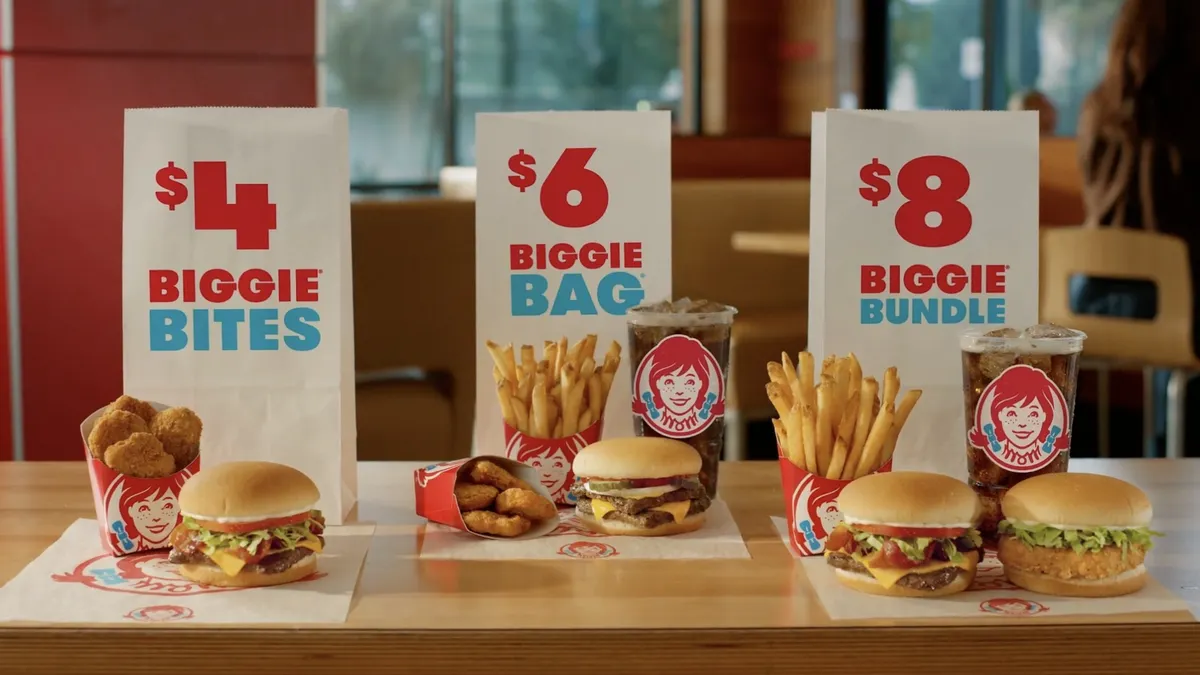
Wendy’s launched $4, $6 and $8 Biggie Deals in January, building on its longstanding Biggie Bag value platform with greater customization and variety. This expanded value menu, Cook said, constituted “an everyday value platform that customers can count on, as opposed to jumping from one price promoted offer to another.”
Cook added that the $4 bags appeal to snacking consumers, and Wendy’s will lean into snacking appeal in its messaging for that tranche of the value meal. The bulk of value traffic, however, is concentrated in the $6 range, which Cook described as a “full meal price point.” That deal offers consumers small fries, a drink, a four-piece nuggets and a choice from among several sandwiches.
The priciest Biggie deal, the $8 option, offers two full sandwiches with fries and a drink. Cook said the chain has an opportunity to grow occasions at the $8 price point, which meets consumer desire for “quality and abundance.”
The first quarter’s messaging around the Biggie platform was dedicated to increasing consumer awareness of its existence, while the second phase of its existence will be oriented around driving traffic from specific consumer bases, like snackers and families, Cook said.
Wendy’s is continuing with other aspects of its Project Fresh campaign, including the closure of hundreds of underperforming locations, re-establishing Wendy’s brand identity as a higher-quality, relatively premium QSR, and improving franchisee economics.