Major restaurant CEOs make hundreds, and sometimes thousands, of times more than their hourly workers, many of whom are making close to poverty wages, public filings show.
Last year Restaurant Dive analyzed the Dodd-Frank disclosures of seven major QSRs to determine what major restaurant brands paid their CEOs in relation to the median employee. This year, we’re adding several full-service and casual dining brands to better reflect the overall composition of the restaurant sector’s labor force.
As in years past, restaurant experts and trade groups cite rising wages as a cost pressure for operators. But nominal wage growth has been significantly undercut in real dollar terms by inflation — both the 2022-2023 wave coinciding with the post-COVID recovery, and the 2025-2026 wave coinciding with the AI boom and Iran War.
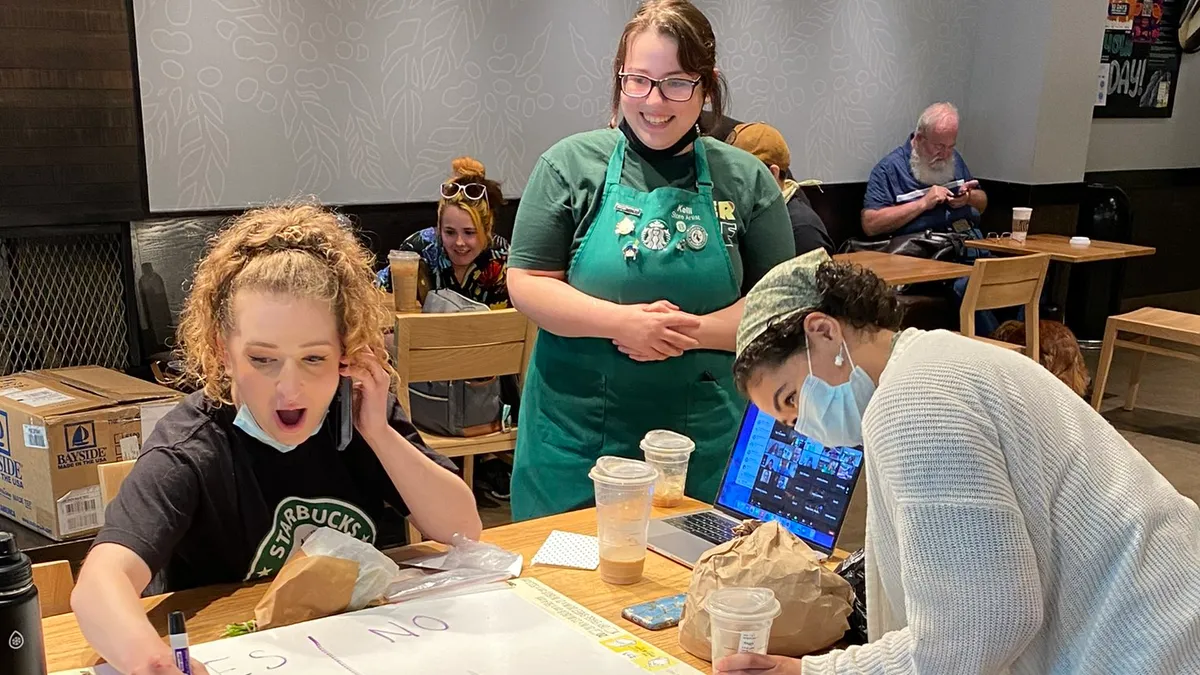
Affordability issues are starting to reshape politics in ways that could force restaurant operators to pay more to workers. For example, New York City has a socialist mayor, Washington, D.C., is poised to elect one, and several have won contested congressional races. The Democratic Socialists of America and its members have played prominent roles in recent social movements aiming to alter working conditions, from Starbucks Workers United to the effort to end the tipped subminimum wage in Washington, D.C. Given this shifting political context, major employers may face more scrutiny of their employment practices regardless of their reputations within industries.
Major hiring campaigns and new benefits have helped slow restaurant turnover and boost nominal wages. However, the median employees of major restaurant brands are, by and large, poorly compensated, with two brands paying below the federal poverty line for an individual, which is $15,960. Median pay at major restaurant chains ranged from 69% of the federal poverty line to about 230% of that metric.
Here’s what 10 major restaurant companies pay their CEOs and their median workers, ordered from the highest ratio — Starbucks — to the lowest.
Starbucks
CEO Pay: $30,992,773
Median Worker Pay: $17,279
Ratio: 1,794 to 1
In 2025 Starbucks’ had a 1,794 to 1 ratio in CEO pay to median worker pay, the highest out of 10 chains surveyed by Restaurant Dive. The chain also had the biggest pay disparity in fiscal 2024 with a 6,666 to 1 CEO pay ratio — though that was boosted by signing bonuses and stock grants for then-new CEO Brian Niccol. By comparison, its executive compensation moderated somewhat in 2025.
The company’s median worker is defined as a part-time barista in the U.S. making $17,279 a year. The chain’s calculation of its median worker pay includes 158,000 global workers, including many in markets where wages and hours may differ from the U.S. so the median figure may not necessarily be representative of U.S. workers’ typical pay.
Niccol has led the company through a major turnaround, with greater customization of beverages, warmer in-store atmospheres and an overhauled loyalty system helping to draw consumers back. Starbucks, under Niccol, has returned to same-store sales growth. But that turnaround has come with cuts as well — late in 2025 the brand closed some 400 stores almost overnight and laid off upwards of 900 corporate workers.
Restaurant Brands International
CEO pay: $15,159,780
Median worker pay: $11,075
Ratio: 1,369 to 1
Burger King and Popeyes owner Restaurant Brands International has the lowest median pay for workers out of all the brands on this list. The chain’s median worker, a part-time employee at a company-owned Burger King in the U.S. earned $11,075 in 2025. Low median compensation could make it more difficult for Burger King to attract and retain the tens of thousands of workers needed to sustain the momentum of its Reclaim the Flame turnaround campaign.
RBI’s CEO, Joshua Kobza, has overseen a significant revival in Burger King’s fortunes in the U.S. through investments in marketing, renovations and menu overhauls.
Sister brand Popeyes will likely undergo a similarly intensive turnaround that may require significant hiring as well. Firehouse Subs is also seeing significant growth — 109 net unit openings between Q1 2025 and Q1 2026 — that will raise the chain’s demand for labor.
Brinker
CEO pay: $30,465,768
Median worker pay: $23,905
Ratio: 1,274 to 1
Brinker’s flagship brand, Chili’s, has been the breakout success story of the casual dining segment since 2024, posting quarter after quarter of strong sales growth, even managing 4% comps growth in the most recent quarter despite lapping a 31% gain. That strong sales performance has been driven by a marketing strategy positioning Chili’s in price competition with fast food combo meals.
The brand is also looking to remodels to help sustain its momentum, and recently launched an updated version of its chicken sandwich platform to bring in more consumers. That strength may help explain why CEO Kevin Hochman had the second highest pay of any executive on this list, behind Brian Niccol.
Still the chain’s median employee, “a restaurant host averaging less than 40 hours of work per week,” is comparatively well-compensated, with $23,905 a year, the third highest median pay out of surveyed brands, behind only Domino’s and Wendy’s.
Yum Brands
CEO pay: $17,904,655
Median worker pay: $15,346
Ratio: 1,167 to 1
Yum Brands underwent a CEO change last year with Chris Turner succeeding David Gibbs on Oct. 1. Yum included both executives' compensation for the time they served as CEO in 2025 in its pay ratio calculation. Gibbs and Turner's pay was roughly 1,167 times the pay of a median worker — a U.S. Taco Bell employee.
Up until the ongoing Cyclospora outbreak caused traffic to decline, Taco Bell generally performed well, with consistent same-store sales growth supported by its competitive value offers, cultural tie-ins, digital engagement and menu innovation. Yum is looking to bring Taco Bell’s operating formula to KFC, which is undergoing a long brand turnaround in its home market.
Yum is in the process of selling Pizza Hut, its weakest brand in the U.S. in terms of same-store sales.
McDonald’s
CEO pay: $20,574,525
Median worker pay: $19,020
Ratio: 1,082 to 1
McDonald’s is fairly unique among restaurant chains in that its median employee is not in the U.S. Rather the chain’s basis of comparison with CEO pay was “a restaurant crew employee located in Poland” with a total compensation of $19,020 a year.
McDonald’s CEO Chris Kempczinski has led the chain since 2019, overseeing its response to the COVID-19 pandemic, multiple rounds of inflation, an E. coli outbreak and the onset of a new round of value wars.
McDonald’s brand power and menu innovation — with recent product launches ranging from chicken strips to dirty sodas — have helped the chain recover from a sales slump in 2024-2025.
Chipotle
CEO pay: $15,455,736
Median worker pay: $17,446
Ratio: 886 to 1
Scott Boatwright, who succeeded Brian Niccol as Chipotle’s CEO, earns about 886 times as much as the brand’s median worker, “an hourly part-time employee who works roughly 24 hours per week at one of our restaurants in Texas.”
Assuming that worker works 52 weeks out of the year, Chipotle’s hourly pay comes out to around $13.97. Prior to Chipotle’s recent sales troubles, the brand was adding hourly workers to expedite orders across many of its stores, due to its high throughput during peak hours.
Recently, however, Chipotle’s sales and traffic growth have stagnated, pushing the brand to try a variety of strategies to bring consumers back, from an overhaul of its catering program to a faster cadence for its limited-time protein offerings.
Darden
CEO pay: $13,995,870
Median worker pay: $23,074
Ratio: 606 to 1
Darden has seen significant sales growth, particularly at LongHorn Steakhouse, which reached the $1 billion quarterly sales mark last quarter, while Olive Garden has posted six consecutive quarters of same-store sales growth. The successes have been driven by relative value and investments in food quality, CEO Rick Cardenas said on the company’s most recent earnings call.
However, Darden also shut down one of its peripheral brands, Bahama Breeze, converting some of its units to other Darden chains and shutting the remainder.
Darden’s median worker, a part-time employee at a U.S. restaurant, makes about $23,074, relatively high for a restaurant company. On the company’s most recent earnings call, Cardenas said it possesses “a compelling employment proposition that is evidenced by our industry-leading retention.”
Domino’s
CEO pay: $10,696,081
Median worker pay: $36,776
Ratio: 291 to 1
For the second year running, Domino’s had the highest median pay out of major restaurant companies surveyed by Restaurant Dive.
The compensation for the chain’s median worker, a delivery driver working less than 30 hours a week, rose by $3,032 from 2024 to 2025, or about 9%.
Domino’s, under CEO Russell Weiner, has grown its market share considerably, pressuring competitors like Papa Johns and Pizza Hut. While Weiner will retire later this year, the chain’s momentum and strategic positioning could help it win out against other brands that have less ability to sustain a value war in the pizza sector.
Dine Brands
CEO pay: $4,638,215
Median worker pay: $18,429
Ratio: 252 to 1
Dine’s Brands has the second-lowest CEO compensation total of the survey, and its low median wage — 115% of the federal poverty line — means that its ratio is fairly low, 252 to 1. The median worker for Dine is a worker in Missouri.
In 2025, Dine struggled to drive consistent same-store sales growth at Applebee’s and IHOP, but those brands have both recovered somewhat from significant sales slumps in 2024. The company is emphasizing dual-branding development and high-traffic locations in its development strategy. The complementary strengths of Applebee’s and IHOP could help improve store-level performance and increase unit volumes.
Wendy’s
CEO pay: $4,503,440
Median worker pay: $24,880
Ratio: 181 to 1
At $24,880, Wendy’s had the second highest median compensation of any restaurant brand surveyed. But the topline figure obscures a low hourly wage. The brand’s median employee worked 1,841 hours at the burger chain in 2025. That computes an hourly wage of $13.51 — nearly $7 an hour less than the average hourly compensation for restaurant workers in May 2025.
The chain’s ratio is also kept somewhat lower because Kirk Tanner departed the chain in late 2025, succeeded on an interim basis by CFO Ken Cook, whose compensation served as the basis for the brand’s ratio. The chain hired Bob Wright, formerly of Potbelly, in the spring of 2026 to continue the chain and accelerate its turnaround strategy.
Wright’s base salary, according to an 8-K filed at the time of his hiring, is $1 million. He is also eligible for a performance bonus “with a target equal to 175% of his annual base salary.” His long-term performance incentives at signing included up to $5.5 million in stock options and performance incentives.
The burger brand has fallen behind competitors Burger King and McDonald’s in sales growth in recent quarters, despite menu innovation.