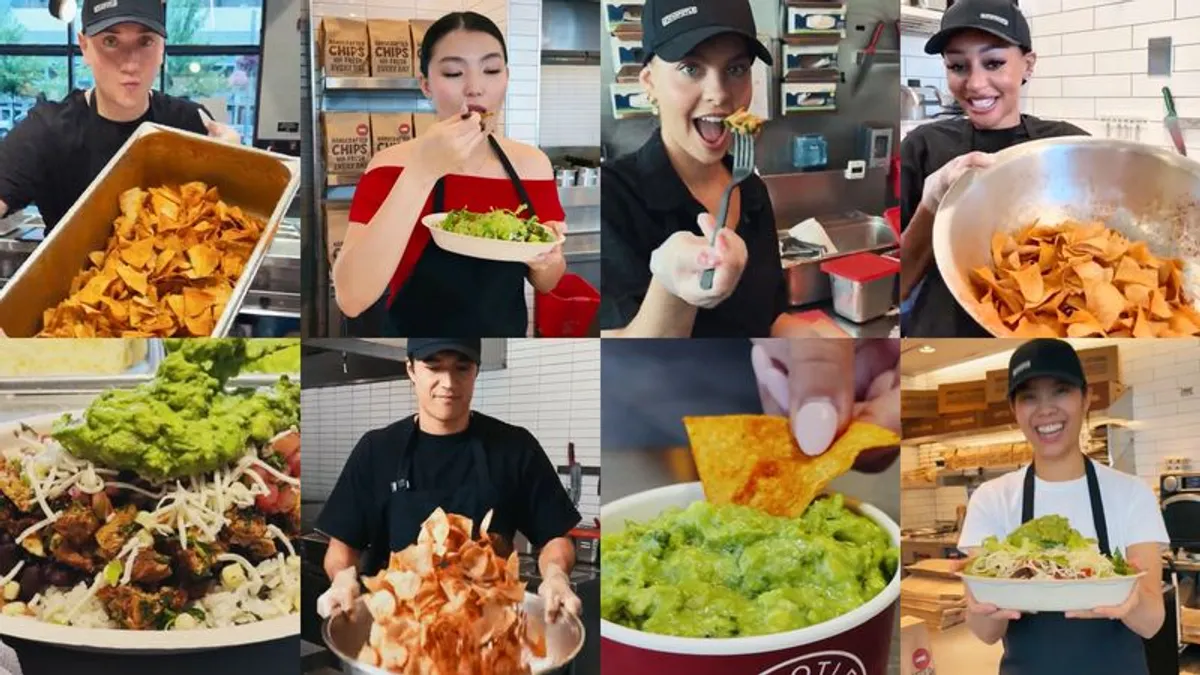
Earlier this year, Chipotle adopted a new growth plan after its same-store sales slipped in 2025. Its “Recipe for Growth” includes increasing the cadence of limited-time offers, increasing menu innovation, accelerating unit growth and relaunching its rewards program.
The chain has already delivered on some of these initiatives, such as its new rewards program. Chipotleis still working on several new elements from an operational and menu perspective that could help drive sales. So far this year, the chain has released two favorite LTOs, Chicken Al Pastor and Chipotle Honey Chicken.
But Chipotle has more in the works. Take a look at five business elements that Chipotle has tested or is in the process of testing this year.
Crunchy Chicken
In May, Chipotle tested crispy chicken in select restaurants for a limited time. It will use guest and operational feedback to determine whether to conduct a broader market test as part of its stage-gate testing process, the company told Restaurant Dive in early June.
During the initial test, the protein was available in burritos, tacos, salads and bowls, according to Nation’s Restaurant News. The chain marketed the chicken as “tender, light and crispy” and said it was free of gluten, antibiotics and artificial ingredients, USA Today reported.
The company is leaning on menu innovation in 2026 as it increases its limited-time offer cadence to four items annually. Its Chicken Al Pastor returned in the first quarter, for example, which helped drive incremental transactions. In April, it brought back its Chipotle Honey Chicken.
Happy Hour
During the chain’s first quarter 2026 earnings call, CEO Scott Boatwright teased the chain would test a “happier hour” in one of its markets, offering $2.50 tacos from 2 p.m. to 5 p.m.
According to Nation’s Restaurant News, Chipotle tested its “Power Up at Chipotle” promotion in Kansas City, and Orlando and Tampa, Florida. The offer was available for dine-in only with additional fees for guacamole, Queso Blanco, extra protein or other premium add-ons, Nation’s Restaurant News reported.
The chain told Restaurant Dive the test has now ended, but it did not provide any further details.
Remodels
The fast casual chain hasn’t had a remodel program in over 30 years, meaning a great deal of its assets are dated, Boatwright said during Bernstein’s 42nd Annual Strategic Decisions Conference in early June. The brand is considering different levels of remodel investments to determine where it could achieve the best returns.
Chipotle is testing several remodel packages at 20 restaurants across three different designated marketing areas. This will help inform the company on how to proceed with redesigns, Boatwright said.
“I think there’s probably 1,000 to 1,500 restaurants today that are just dated,” he added.
In 2017, when Boatwright joined the company, Chipotle’s assets were in distress. He initially focused on fixing things such as broken tiles, busted light fixtures, torn booths, bringing more light into dining rooms and addressing deferred maintenance, he said. Many of those fixes included painting walls light and installing new lamps with brighter bulbs.
“I think that worked well for about 10 years,” he said. “And I think we've gotten to a point now where some of our assets, no matter how much we reinvest in maintenance costs or maintenance capital, just need a facelift.”
The chain is testing investment packages priced at $200,000, $400,000 and $600,000 for interior design, exterior design and kitchen efficiency, he added.
“I'm hopeful that the test will work, because I'd like to pull together a remodel strategy to address those older assets,” Boatwright said.
Catering
Chipotle began testing a new catering platform in 2025 using a third-party platform in Chicago and expanded it into Boston earlier this year.
“We've seen extraordinary success in Chicago by using a platform to help promote the catering platform, but more importantly, load balance across restaurants, so we're not disruptive to the operator,” Boatwright said during the Bernstein conference.
Managers have been asking for catering for years because it gives a “a nice uplift in total sales for revenue for the business, but also is the most efficient labor utilization, and probably the most margin accretive platform that we have in the business,” Boatwright said.
The biggest concern has been if Chipotle could scale catering. Competitors have somewhere between 10% to 15% of their sales coming from catering, but Chipotle only has 1.5%, he said.
“I think our food travels better. I think people love the Chipotle experience when it's right from a catering perspective,” Boatwright said. “And we need to make sure we can deliver on the expectations for the consumer, deliver on our brand promise and not fracture lunch and dinner in a Chipotle restaurant.”
The chain’s expansion in Boston has gone well and Chipotle is bringing the new program to Phoenix this month. Ideally, Chipotle could do a full system launch next year, he said.
Family meal marketing
Roughly a year after it added Build-Your-Own-Chipotle for family meal occasions, sales have increased about 1%. Many people still aren’t aware of the offering for group occasions, Boatwright said, adding that part of the problem could be in the name.
“I've contested from day 1, it should be called family meals, but we had to get really clever about it,” Boatwright said. “So we call it Build-Your-Own Chipotle.”
The California-based restaurant chain tested calling this offering “family meals” in two markets, leading to a 10% jump in sales, Boatwright said.
The platform also was originally priced at $58. When it was first launched, Chipotle offered $10 off the first order, which led to additional sales compared to the higher price point.
“$50 really moves the needle. It's still margin accretive. It's proven to be highly incremental. And so we feel comfortable getting a sharper price point, naming it correctly and really promoting it effectively through social channels and digitally that it will have a meaningful uplift on the business,” Boatwright said.