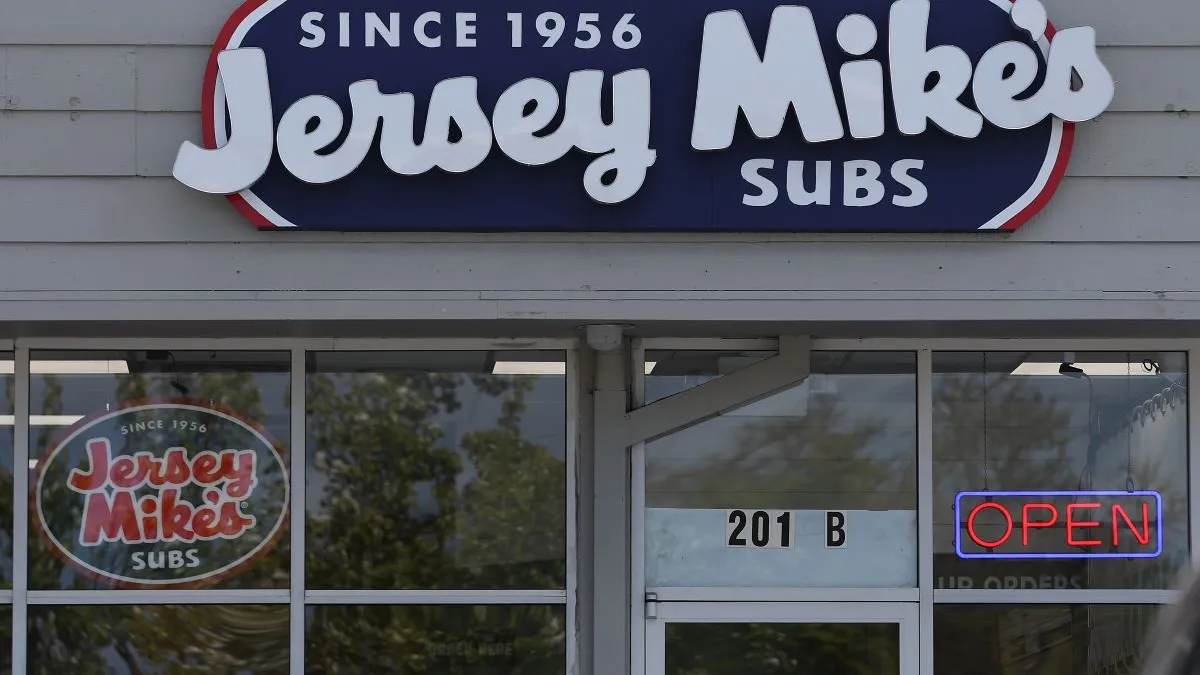
Jersey Mike’s has been the success story of the U.S. QSR sandwich sector in recent years as Subway’s long unit count decline has continued.
The sub shop’s strong sales — 50% cumulative same-store sales growth from 2020 to 2025 — and aggressive unit development set it up for an IPO earlier this summer.
Jersey Mike’s reported its earnings for the first time as a public company on Wednesday and its multi-year streak of success continued. The chain’s systemwide sales increased by 10% and its same-store sales growth continued. Executives discussed several key numbers that shed light on the chain’s momentum, brand awareness, operational performance and unit economics.
83
The number of new restaurants Jersey Mike's opened in the second quarter.
The sub chain opened 83 stores in the quarter, bringing it to 3,378 total stores and 8.1% year-over-year unit count growth. This growth was a substantial contributor to the systemwide sales increase, and will be a major component of its ongoing growth.
CEO Charlie Morrison said during a Wednesday earnings call that, in the long run, Jersey Mike’s envisions 7,500 locations in the U.S. and 15,000 stores worldwide.
It’s the very early innings for the chain's international expansion with only 30 units outside the U.S., or less than 1% of its store system. All of those units are located in Canada, a market with substantial cultural and media market overlap with the U.S.
William Blair Analyst Sharon Zackfia said in a research note that Jersey Mike's “limited international track record” is a key risk for the chain going forward, since it has less experience in international markets.
Morrison said the chain has already secured a flagship location in London, and has several other sites selected for its first round of stores on that side of the Atlantic. Morrison expects the first U.K. location to open by year’s end.
“Our supply chain is substantially in place. Store design and menu localization are nearly complete, and the first U.K. general manager just completed training here in New Jersey earlier this month,” Morrison said.
For now, U.S. store growth will account for the majority of its continued expansion. Morrison said the chain had 1,400 signed and committed stores in some stage of development, and another 200 locations in final negotiation in the U.S.
Notably, new openings did not seem to impact the chain’s same-store sales, with 2.3% comps growth. Morrison said the chain is looking to establish a robust, but predictable pace of growth.
Other rapidly expanding fast casuals, particularly Wingstop, have seen their same-store sales growth slip while new unit openings have continued to drive overall sales growth in recent quarters.
20%
The percentage of Jersey Mike's marketing spend allocated to digital marketing.
Jersey Mike’s has dramatically increased its digital marketing and call-to-action messaging in an effort to reach younger consumers. Morrison said the brand’s digital marketing spend shifted from less than 1% of its marketing expenditures to more than 20% over the course of this year.
A bigger presence in digital marketing is meant to translate the chain’s widespread brand awareness, which Morrison said was roughly 90%, into transactions.
Prior to 2026, the chain “really did not engage in any form of digital marketing, especially that which would be a call to action messaging strategy,” Morrison said.
The new digital shift is driving “promising early results. Loyalty registrations are up 22% year to date,” Morrison said, adding that the brand is able to convert more diverse Gen Z consumers, who may know of the chain but have not visited it, into new customers.
The brand’s loyalty system now has between 12 million and 13 million members, with 7 million active users.
“They use us about once a month on average, which is very high frequency,” Morrison said, adding that the chain isn’t satisfied with this scale. “It's very underdeveloped. We think that number should be, you know, 30, 40, 50 million users in that database.”
The growth of digital marketing and loyalty has been accompanied by an increase in digital ordering.
“Our digital channels expanded approximately 200 basis points to 43% of our sales mix, on our way to our targeted 60 to 70% sales mix over time,” Morrison said.
Because digital orders typically have a higher average check, an increase in digital sales mix can result in higher sales without pricing increases, he added.
2
Jersey Mike's has two makelines in most stores, alleviating operational pressure from digital orders.
Jersey Mike’s is preparing operationally for a future of significantly higher sales, including growing its digital sales mix, Morrison said.
“Virtually all the system has a second makeline dedicated to digital orders, which takes pressure off the front counter experience for our in-store customers,” Morrison said.
Other growing chains in the post-COVID period have faced operational pressure from the shift towards digital. Potbelly, for example, had to overhaul its kitchen design to add a digital-focused makeline starting in 2023.
Having this makeline already in place could help Jersey Mike’s exploit its growing digital engagement without having to invest in major store-level changes as a public company.
The chain’s menu strategy is also premised on balancing sales with restaurant-level operations.
“We expect to limit our promotional cadence to just two or three LTOs per year, allowing us to create excitement and attract new customers without compromising the authenticity of the brand or introducing operational complexity,” Morrison said.
$2 million
Jersey Mike's target average unit volume.
The brand’s current average unit volume is about $1.4 million, but Morrison said the company wants to push that figure up above $2 million in the foreseeable future.
Morrison said Jersey Mike’s knows what it takes to handle that level of sales because the chain already has “a meaningful number of stores operating at or above $2 million, so we know the store footprint can support these volumes.”
Digital engagement and brand awareness will play a role in that growth by driving traffic. Increasing store-level transactions is the main focus in expanding the brand’s unit economics, CFO Michelle Allen said.
Morrison said that the chain may see a greater emphasis on catering, which currently accounts for about 3% of its overall transactions. High performing stores typically see a much stronger catering mix, Morrison said.
“We can drive that to as much as 10% of sales, especially in stores that are in markets where there's high daytime populations and an opportunity to grow it,” Morrison said.
But Jersey Mike’s will face stiff competition in catering. Many chains, especially those facing same-store sales and traffic growth issues, have turned to catering as a key element in their efforts to revive momentum in recent quarters.