
Chipotle relaunched its loyalty program last week, aiming to offer more rewards, more often, while enhancing existing benefits. But whether its loyalty revamp lives up to its goals is a matter of debate.
Major restaurants have updated their loyalty offerings in recent months. Revamps at Dunkin’ and Starbucks brought many positive changes, but they ultimately reduced the value of their programs’ points, according to Brad Jashinsky, director analyst at Gartner.
In contrast, Chipotle’s changes were all additive to its existing program and may hint at a broader strategy at the Mexican restaurant chain focused on improving its value proposition, according to Jashinsky.
“Chipotle is not a value brand, but I think they're trying to toe that line between providing value and more reasonable options without doing huge discounts and value menus,” Jashinsky told CX Dive. “It's an interesting point to be at right now because, as you've probably seen, every quick-service restaurant is really going hard on value.”
Value is a top draw for customers to join a loyalty program. Chipotle’s value-focused relaunch could help the company drive in-restaurant traffic, win over less frequent customers and make the app more accessible to a wider customer base — though some experts predict the restaurant chain will run into challenges with its approach.
For Chipotle, the redesign had a clear value. "As Rewards has become more central to our business, guests want a more intuitive, engaging, and transparent way to track their progress and opportunities," Curt Garner, president and chief strategy and technology officer at Chipotle, said in an email.
Bringing the digital ecosystem in-store
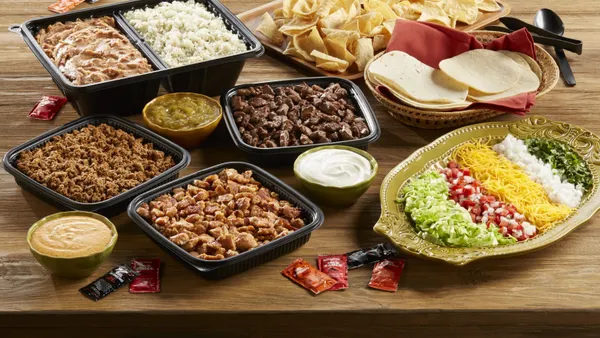
One of the highlighted benefits of the loyalty revamp is the introduction of a coupon for free chips and guacamole upon sign-up. The perk is particularly attractive for in-restaurant customers.
Chips and guacamole are a compelling proposition for customers currently looking at the prices on a restaurant menu board, according to Jashinsky. They can immediately put a dollar value to the benefit, which incentivizes customers to sign up.
Chipotle has been explicit that it wants to increase in-restaurant loyalty usage. Almost 90% of digital transactions are linked to Chipotle Rewards, but the share drops to 20% among in-restaurant transactions, the company said in a press release announcing the changes.
The pattern of high digital usage and low in-store usage is common in loyalty programs across industries, according to Jashinsky.
“Typically, your in-store customers are going to be ones that are not necessarily utilizing your app, are not necessarily utilizing digital ordering, and so that's a huge priority for a lot of restaurants,” Jashinsky said.
Instant rewards can incentivize in-store customers accustomed to using an app, but the approach has its own challenges, according to Jashinsky. When sign-up perks become too generous they can cut into margins and, in the worst cases, invite customer abuse or disloyalty.
One example is fuel retailers, which often incentivize sign-ups with a large one-time discount, according to Jashinsky. This can lead to some customers signing up for the same program multiple times, while others switch from retailer to retailer to keep getting that initial perk.
In Chipotle’s case, chips are likely inexpensive enough that they won’t threaten the bottom line, according to Jashinsky. However, a one-time coupon may not be enough to get in-restaurant diners to use the loyalty app in the long term.
“Personally, if I was advising Chipotle, I would have recommended that they provide enough points to provide free chips, because that way you can utilize incentives to train and explain the loyalty program instead of just giving the reward,” Jashinsky said.
Chipotle’s Garner say the restaurant wants to encourage customers to engage with the loyalty program during in-restaurant visits through a combination of factors. The relaunched program includes more frequent and visible opportunities to earn points, including special challenges, personalized offers and the return of the “Freepotle” recurring free food promotion. These perks reward customers no matter where they make a transaction.
“By making these challenges more prominent and easier to track in the app, guests have a stronger incentive to identify themselves and engage with Rewards during in-restaurant visits,” Garner said.
How long is too long for point expiration?
Chipotle Rewards points now remain active for one year, rather than six months. While the extension can make the program feel more rewarding for less frequent customers, it could also eliminate opportunities to drive frequency.
Generally, six months is a good expiration window for a quick-service restaurant’s business model, according to Jashinsky. Active loyalty members already tend to dine out with relatively high frequency, and communication around expiration dates can drive even more trips.
“When it's six months, and especially with their larger rewards catalog, they would be able to say, ‘Hey, your points are expiring. Come in, utilize them for free chips and guac before they expire,’” Jashinsky said. “It provides an urgency driver.”
Urgency can help businesses overcome a perennial loyalty challenge — getting customers to actually participate in the program, according to Jashinsky. Gartner research has found that 8 in 10 consumers don’t actively use every loyalty program they have joined.
A year-long point expiration window is usually the domain of companies in the hotel, airline or specialty retail industries, according to Jashinsky. These businesses expect one or two purchases from each customer per year, which aligns well with longer expiration times. But he acknowledges there are other reasons to extend the window.
Chipotle sees the extended window as an opportunity to provide flexibility and confidence for customers, according to Garner. Members know their points won’t disappear, which encourages them to stay in the program and build up rewards — translating into stronger lifetime engagement.
“It also aligns with our broader strategy of making the program feel more generous and accessible,” Garner said. “As noted in the relaunch, we are focused on adding value without trade-offs. Removing friction points like shorter expiration windows helps reinforce that philosophy while encouraging sustained frequency over time.”
App design looks beyond the big fans
The redesigned Chipotle Rewards experience, which centralizes all loyalty content within the Chipotle app, could serve as a course correction for a formerly flawed app and build inroads with less connected members.
Historically, Chipotle has had a strong digital ordering experience, but its loyalty content has been buried off to the side, according to Jashinsky. It forced customers to explore the app just to see their loyalty status, rather than integrate this information in an easy to find fashion.
Prior versions of the app spread key elements of the loyalty program, including points, challenges, and offers, across different parts of the app, according to Gartner. The updated version puts the relevant information in a single place, making it easier to understand where they stand and where they can go next.
“For example, instead of displaying a static points balance, the app now features a dynamic progress bar that shows how close a guest is to their next reward,” Garner said. “Challenges, called ‘Extras,’ are surfaced more prominently at the top of the experience, and completed achievements are visually organized. This makes the journey feel more interactive and motivating.”
The goal is to support Chipotle Rewards’ shift toward a more personalized and gamified experience, according to Garner. The update is designed to not only improve clarity, but encourage engagement by showing a clear path to earning rewards.
The new app makes it much easier for the “vast majority” of members to keep up with what they’ve earned, Jashinsky said.
“It's just reminding members, especially those members that are less active or are not thinking about maximizing loyalty, about their rewards,” Jashinsky said. “Doing that on the CX side can help encourage more redemption of those rewards.”
Making loyalty point acquisition, totals and redemption options readily visible is important no matter the industry.
Customers always want easy access to their points total, according to Dan Woods, SVP and global market leader for retail and e-commerce at Alorica. They recognize that loyalty points are part of a transaction, and they want to see the benefits.
“People look at rewards as a return on their investment, their spend,” Woods told CX Dive. “So if they're unorganized, obviously that's subtractive to customer loyalty. I see that across all the verticals that we support.”
For Chipotle, integrating rewards into the wider app experience can help drive greater customer frequency by simply making points more visible, according to Jashinsky. Ideally, companies should remind customers about rewards at every touchpoint.
“I see so many brands spend millions of dollars on technology and strategy and everything else, and then loyalty is sort of hidden away within the organization, the digital experience, or the in-restaurant experience,” Jashinsky said. “It feels like Chipotle has probably recognized some of those errors that have been made in the past, and sounds like they're really focusing on integrating loyalty within every single aspect of their customer experience.”