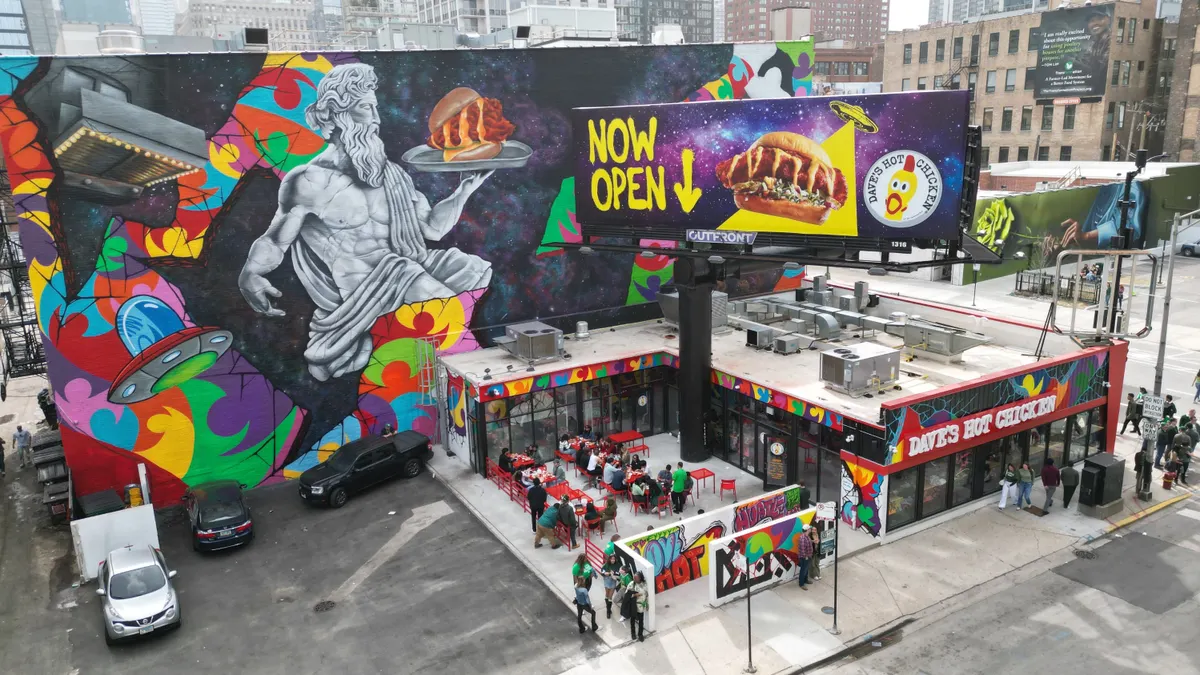
Dave’s Hot Chicken is evolving its technology as part of a multi-year initiative called Dave’s of the Future, designed to keep the chain on the cutting edge of restaurant technology. These tech evolutions have helped power Dave’s meteoric rise, and its partial acquisition by Roark Capital last year, said Leon Davoyan, chief technology officer at Dave’s Hot Chicken.
But not every innovation is a slam dunk. Even if a piece of tech has reached the point where it’s scalable, economical and reliable in restaurants, it still may not be the right choice. Dave’s, like many chains, tested and then pulled back from drive-thru voice AI.
“It was extremely successful from our order completion standpoint,” Davoyan said. “[But] our guests didn't enjoy talking to a robot at the drive-thru, and so we pulled it.”
Dave’s Hot Chicken is focused on ensuring its deployment of new technology meets consumer desires, and that it only deploys new technology “when it makes sense for the guests, Davoyan said. “We just don't do it for the PR value, we don't do it just to get accolades.”
Despite the prevalence of tech solutions and artificial intelligence, many restaurant brands — and many restaurant tech firms — seem wary of embracing new tech too quickly. A hasty rollout can risk operational problems, guest alienation and brand damage.
Dave’s approach, Davoyan said, balances the need to keep pace with new technology with a focus on what works and what the chain’s core consumers are comfortable with.
The chain has looked into point-of-sales systems kiosks, artificial intelligence, drone delivery and computer vision, but not all of these deployments made sense, he said.
How Dave’s tech evolution started
The Dave’s of the Future transformation began because the chain’s previous point-of-sale system, Revel, wasn’t built for the volumes Dave’s was processing.
Dave’s now uses Qu for its point-of-sale system and QSR Automations for its kitchen display system technology. That basic change set the groundwork for other technology tests at Dave’s, as the rapidly growing hot chicken chain searched for ways to stay ahead of the competition.
Davoyan said the brand is testing new order-tracking technology that integrates with its POS and KDS so customers can see what stage of preparation their order is in.
Additionally, the brand is exploring the possibility of dynamic quote times, so consumers can get more accurate estimates for how long an order will take to be ready.
Generic all-in-one KDS and POS systems would not have been able to support tests like these, Davoyan said.
Dave’s kiosk strategy reaches maturity
Davoyan was initially skeptical of the utility of ordering kiosks. He felt that consumers’ phones could function as a sort of pocket kiosk, and that the tech might result in franchisees shifting labor out of the front of house.
Nevertheless, the chain began testing GRUBBR’s kiosks in 2024 as a way to adapt to the cost pressures resulting from California’s fast food minimum wage.
The tech proved to be a natural fit for Dave’s operations, and is live in almost 300 of the chain’s roughly 440 global stores. The brand’s identity is well-suited for digital ordering channels like kiosks, Davoyan said.
“Our core customer would much rather order from a kiosk than a cashier,” Davoyan said. “Younger generations [are] more comfortable with a digital screen than they are interacting with a human.”
This hasn’t resulted in a shift away from front-of-house labor. Cashiers still greet consumers when they come in the door and still take many of the chain’s orders, but it has resulted in higher average tickets — without programmatic upselling.
“Our franchisees continued to staff the cash register station, but we've also been able to take that cashier and utilize them elsewhere when they're not bringing up orders,” he said.
About 25% of Dave’s overall sales come through kiosks, Davoyan estimated, despite about 30% of the chain’s system lacking the tech. In terms of on-premise transactions, Davoyan said, kiosks likely account for a majority of sales at stores where they are installed.
“We’re interested in allowing machines to do things that machines do well, so that the humans can focus on the guests and food quality and things that machines can't quite do."

Leon Davoyan
Chief technology officer, Dave’s Hot Chicken
Other tech isn’t quite ready for prime time
Looking forward, Davoyan said, there are a suite of new technologies that result in efficiencies, but cost, robustness or scale don’t yet meet Dave’s needs.
Chief among these are robotic fry cooks. Davoyan said Dave’s has Atosa’s robotic fry cooks in testing in four stores.
The robots come with considerable upsides. They make more baskets of fries, with fewer fries per basket, resulting in reductions in food waste and improvements in food freshness.
Davoyan said the chain doesn’t look at these robots as replacements for workers.
“We’re interested in allowing machines to do things that machines do well, so that the humans can focus on the guests and food quality and things that machines can't quite do,” he said.
But the chain doesn’t have plans for mass deployment of fry cooks.
“We're on standby to see what's going to happen with robotic technology from a cost perspective, because it's cost prohibitive now,” Davoyan said. “Over time they're going to get more and more affordable, and at that time when the ROI makes sense, we'll pursue rolling them out.”
As of 2023, one of Atosa’s fry stations cost an estimated $80,000 dollars. Other restaurant brands have found robotic arms cost tens of thousands per year when leased as a service, rather than purchased outright, with additional installation costs. By contrast, a full-time worker hired at $15 per hour for 2,080 hours a year costs $31,200 in wages, with additional benefits costs.
Computer vision tech that monitors order accuracy is another solution that hasn’t reached full maturity yet, Davoyan said. Performance and reliability, rather than cost, is computer vision’s obstacle.
The tech can help identify mistakes before off-premise orders leave the store, and it works, under ideal conditions. But fast food kitchens are not ideal conditions.
“When things get really busy and the kitchen gets overwhelmed … we found that that system couldn't keep up with the number of orders and the shuffling that happens in the kitchen,” Davoyan said.
But Dave’s would be happy to test improved versions of the tech, he added.
Drone delivery, at least in some markets, might be closer to in-restaurant deployment. Dave’s has been testing first-party drone delivery with Matternet near its location adjacent to California State University, Northridge. As a result, delivery times have decreased.
“It took me about 15 minutes to drive from the restaurant's parking lot over to the street where the drop off would occur, and it took the drone about a minute and a half from the time that the propeller spun up till the time that the package was dropped off,” Davoyan said.
That means consumers receive fresher food faster. Davoyan hopes to have that technology available permanently at the Northridge location by the end of the summer.
The chain is also talking with Zipline about third-party delivery in the Dallas area, where brands including Chipotle have piloted Zipline’s tech. On the ground, Dave’s is working to set up delivery in Arizona through DoorDash’s Dot program, the third-party delivery aggregator’s proprietary robot.