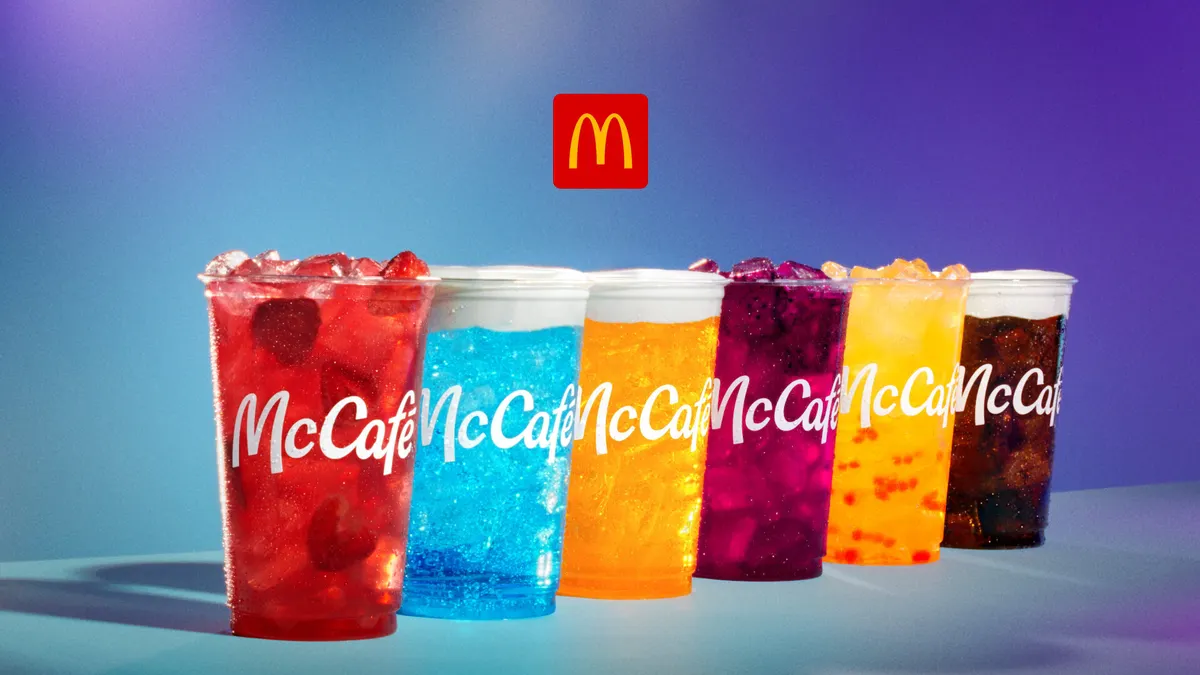
LAS VEGAS — In the last few years, restaurants have adopted new beverage platforms en masse, from dirty sodas and energy drinks at McDonald’s to refrescas and horchata at Taco Bell. Simultaneously, a new generation of beverage brands have capitalized on the boom.
This boom has made it possible for restaurants to take share of the afternoon and snack daypart from c-stores and consumer goods. This has resulted in the dramatic expansion of drinks-focused restaurants, experts and brand leaders said during a panel on beverage trends at the RFDC conference in Las Vegas this week.
Two decades ago the snacking or beverage occasion consisted of something like a Coke or a Pepsi and a Hershey Bar, and many consumers of afternoon coffee brewed it at home, said Nicole Miller Regan, an industry advisor who previously served as 7 Brew’s chief strategy officer.
Now, those occasions have shifted substantially to restaurants. The trend shows no signs of slowing down, either, as beverage chains are some of the fastest-growing concepts in the restaurant industry.
Several interlocking trends help explain the expansion of beverage chains themselves and the adoption of new, premium beverages by major brands.
Serving everyone
The beverage boom has extended beyond coffee to encompass dirty sodas, premium iced teas, energy drinks and a wide range of other beverages, Miller Regan said. Despite the segment’s association with social-media forward younger consumers, new chains have a broad customer base in part because of the diversity of drink bases.
“You'll see every kind of car come through with every kind of person come through,” Miller Regan said. “That is the thing that really has me convinced that this category is here to stay.”
Justin Howe, co-founder of HTeaO, said the brand’s customer base is built around the family unit, but Gen Z consumers represent an opportunity.
Brandon Knudsen, co-founder and CEO of Ziggi’s Coffee, said the chain has worked to cultivate a multi-generational, family consumer.
“We’re locked in on that active family, that crazy car that pulls up with two dogs in and out of the window, the mom that's late for drop off, the kid that needs a little pick-me-up before school,” Knudsen.
Customizability is another driver of broad interest in the segment, Howe said.
“The guest is able to customize inside the store,” Howe said.
HTeaO sometimes draws inspiration from these customer creations, especially ones that trend on social media, when designing LTOs. That degree of engagement keeps consumers invested in the brand.
Minnie Bird, a brand specializing in dirty sodas and chicken tenders, has a similar approach, particularly when adopting colorful drinks that can appeal to kids, according to David Sloan, the chain’s CEO.
“They can customize their own drinks, and they love it. What’s funny is sometimes you'll take a look at a drink a kid made, and you're like, ‘man, that could not be good.’ And then we actually make it and we're like, ‘Wow, that's phenomenal. This kid came up with something,’” Sloan said.
Afternoon and morning strength
If the breadth of the beverage category can draw any kind of consumer, it is also flexible enough to work in any daypart. This is helping create a new type of restaurant occasion focused primarily on drinks — similar to a morning coffee, but broader in appeal and in menu content.
“There's both morning and afternoon concentration,” Miller Regan said of beverage traffic. “It’s become a real occasion.”
For HTeaO, the beverage boom is tied to the afternoon.
“[Our] sales curve peaks around 4 p.m.,” Howe said. This aligns with afternoon snacking, afterschool occasions and late-in-the-workday pick-me-ups.
Caffeinated beverages are particularly good at creating habits and rituals, said Chris Mumm, a lawyer specializing in restaurant M&A for Monroe Moxness Berg.
“Habits create frequency, and frequency is the business model,” Mumm noted. If strong consumption of caffeinated drinks continues in dayparts outside of the traditional morning coffee occasion, beverage-only brands and beverage-focused brands may be able to cultivate habitual consumers at new times of the day.
Attach is everything
But beverages alone may make for a rather limited menu, and consumers often want food to accompany a drink, even if the drink is the centerpiece of the occasion. Major players in the spectra, like Dutch Bros and 7 Brew, have added or expanded food menus recently, and food has long played an important role for Starbucks.
The same is true at emerging brands, like Ziggi’s, Knudsen said.
“One in three of our orders have food attached to it,” Knudsen said. “Typically, what you'll see is a pup cup put out the window, a cake pop, a burrito, probably a sugar-free something for mom, and then potentially a scoop of protein in there somewhere.”
For Minnie Bird, a more traditional QSR but one with a strong drink focus, the premium beverages drive margin and check.
“Most of our meals are served with combos. We're getting roughly about a 60 to 70 percent attachment to dirty sodas with that. So that's a huge positive, it helps our costs, it helps our profitability,” Sloan said.