Portillo’s will close a handful of restaurants outside of its core Chicagoland market and focus on existing restaurants, CEO Brett Patterson said on the chain’s Q3 2026 earnings call last week.
The changes came after the brand took “an honest look at our business over the past several months and confronted a hard reality. Portillo's has not delivered the returns our investors expected,” Patterson said.
The brand has struggled to grow same-store sales and realize strong returns at new units in recent years, but reported 1.4% comps growth in Q3, according to its earnings release.
“I am encouraged by the early progress, but let me be clear, one quarter is not a trend,” Patterson said. “We have significant work ahead.”
The hot dog chain’s sales growth was driven mostly by pricing, and traffic actually fell 0.7%. Several other fast food and fast casual brands that saw comps growth in Q3 also reported that mix and price drove their sales growth more than traffic.
Patterson said the chain will continue to shift its business and strategy in coming quarters in hopes of establishing sustainable growth.
A managed retreat
Part of that refocusing process entails culling a number of restaurants, though Portillo’s was mum on the precise number of closures investors ought to expect.
The closures will occur at “a mid-to-high single-digit number of underperforming restaurants outside of Chicagoland, with the majority occurring in the fiscal fourth quarter of 2026,” according to the earnings release.
Patterson offered slightly more clarity, noting that the brand’s rapid efforts to infill new markets — like Texas — were not accompanied by sufficient investments in brand awareness to build a fanatical customer base.
Under-performance in new markets, particularly in Texas, contributed to the departure of CEO Michael Osanloo in 2025.
“We ramped up so quickly in those markets and plugged in a lot of infills, … [which] redistributed sales from those geographic areas. That put a lot of pressure on the business models,” Patterson said. “We did a little bit of damage to ourselves with how we branded the restaurants. In some of them, we just have the name Portillo's. We took off what we do, what we serve.”
The closures may, therefore, be concentrated in areas where the chain has little brand awareness or too much density. According to the brand’s FAQ, Portillo’s operates restaurants in several states outside of Chicagoland , including California, Texas, Florida, Georgia and Arizona.
Development and corporate expenditures
Accompanying the geographical retrenchment, Portillo’s is working to shrink the physical footprint of its next class of new stores.
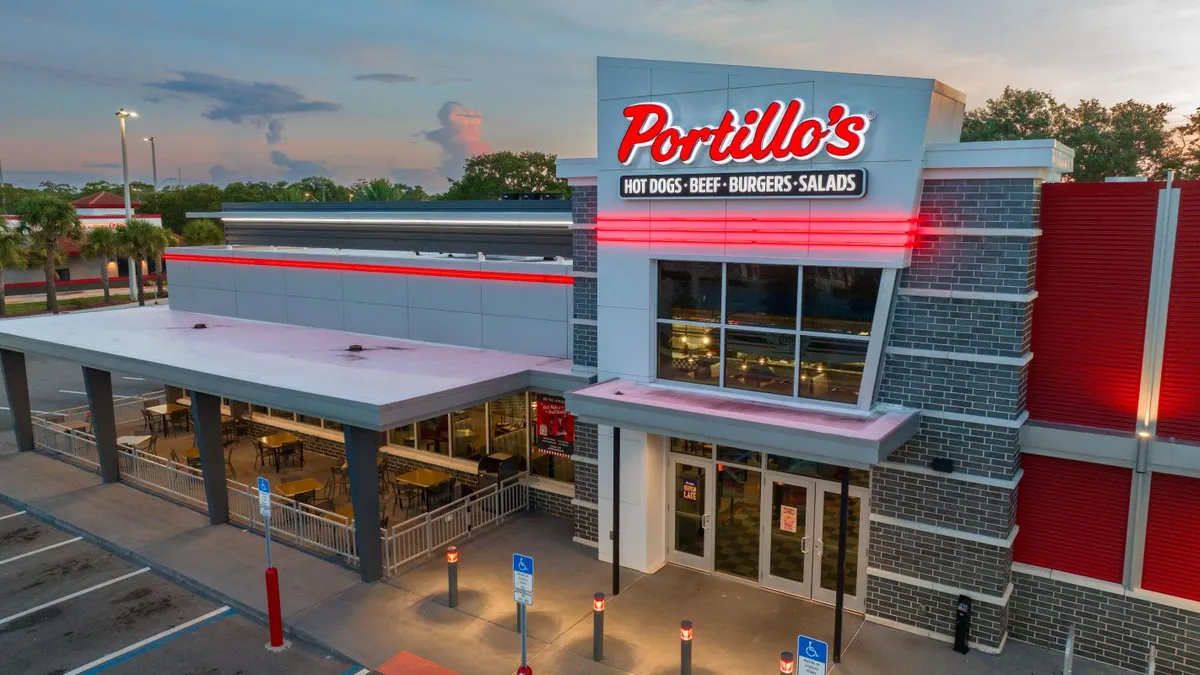
The brand has spent years developing new prototypes with smaller kitchens. In 2023, the chain announced its Restaurant of the Future concept, a 5,500- to 6,000-square-foot restaurant, much smaller than prior models, which ranged from 7,700 square feet to 11,000 square feet. Those locations also require up to three acres of land as well, per the earnings release.
Now, the chain wants to build even smaller. Portillo’s 2028 restaurant prototype is 4,600 square feet and requires only an acre and a half, according to the earnings release.
That reduction in size will lower development costs, while “standardized design and greater site flexibility are expected to improve throughput and productivity,” the brand said.
And, rather than targeting aggressive unit growth, the brand is shifting its capital expenditure to “prioritize investment in existing restaurants, including technology and maintenance to keep them clean, safe and well-maintained,” according to the earnings release.
Portillo’s recently undertook a series of moves meant to economize on expenses, Patterson said, and the company “right-sized our corporate structure, deepened our understanding of our guests through formalized research, identified meaningful operational and supply chain savings, and implemented a more rigorous site selection process.”
As part of its new site selection process, the chain canceled real estate agreements for future units that had low potential for returns.
Changes in operations
These changes are being accompanied by alterations to the brand’s store-level operations.
First, Portillo’s reduced the number of restaurants its regional leaders oversee and made its regions more geographically compact.
“This allows field leaders to spend more time in each restaurant and provide focused, hands-on support to restaurant teams,” the brand said in its earnings release.
Patterson said Portillo’s has overhauled its training programs, which were previously underdeveloped. To support these teams, the brand is evaluating new equipment and technologies that could improve efficiency.
“Candidly, we didn't have a very strong training culture at all. We are going to over-index on having well-trained team members and managers leading our restaurants,” Patterson said.