Artificial intelligence is supposed to be the wave of the future. SpaceX’s blockbuster IPO claimed its AI segment had a total addressable market of $26.5 trillion, according to the Financial Times. Other AI-forward companies are pursuing IPOs at trillion-dollar valuations, and OpenAi claims ChatGPT has 1 billion active monthly users.
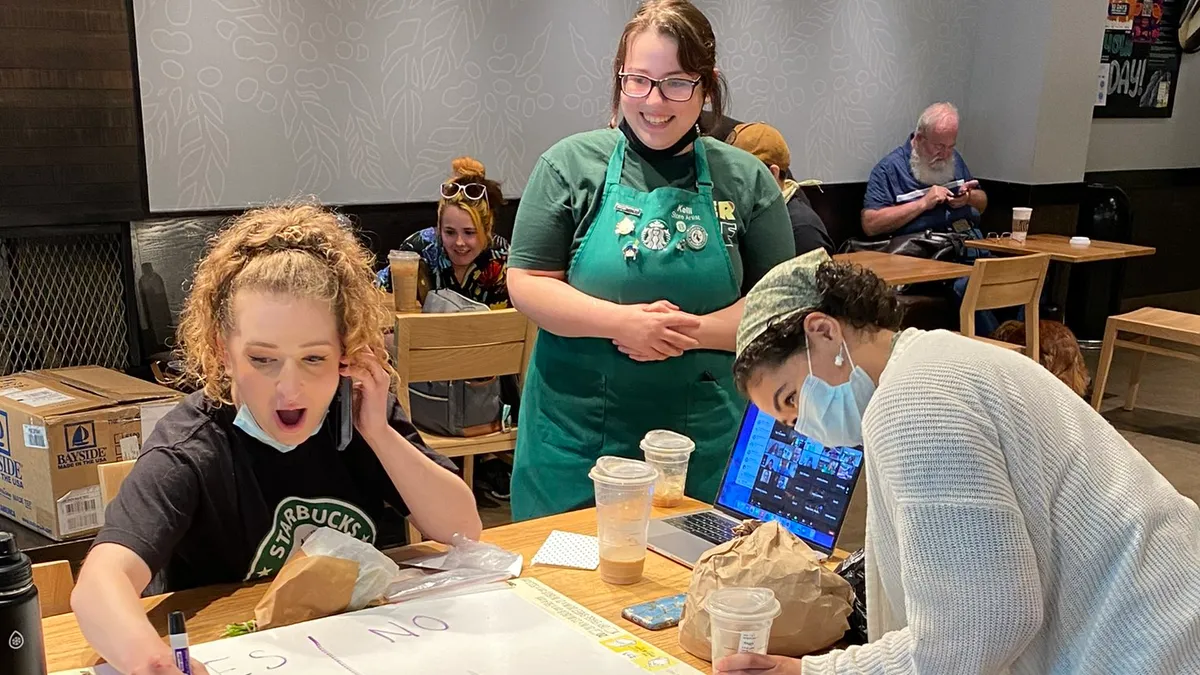
But there seems to be something of a breakwater between restaurants and the wave of the future: Starbucks abandoned its AI inventory counting system after less than nine months in May. McDonald’s eased up on voice AI testing in 2024, but may test similar tech under its new strategic plan. Pizza Hut’s AI order management system allegedly cost one franchisee $100 million in sales. And at the National Restaurant Association show, earlier this year, restaurant tech executives cautioned against expecting AI to solve too many problems.
So what does it take for artificial intelligence to be successful in a restaurant?
Oliver Ostertag, president of growth and AI at Par Technology, a restaurant tech company, said that the technology’s continued maturation and its ability to integrate a wide range of restaurant data matter more than finding individual tasks for which the tech is especially suited.
“Use case is important, but it's really a question of whether or not the technology is enterprise-grade, whether it's proven and how deep the data is,” Ostertag said.
Restaurant Dive spoke with Ostertag about how continual improvements in restaurant AI could drive same-store sales growth and margin expansion by making management, marketing and other data-heavy tasks more efficient.
Editor’s Note: The following interview has been edited for clarity and brevity.
RESTAURANT DIVE: What's going on in restaurant AI right now? What do the recent retreats or setbacks in restaurant AI have in common?
OLIVER OSTERTAG: Obviously there have been some high-profile flops. I wouldn't look at this as AI being too early for restaurants. I don't think that's the case. With Starbucks specifically, it was a very early use case of a technology. Because of how early that specific technology was there were some gaps. New technology being used at enterprise scale is really hard.
If AI tooling is sitting on really deep data and it understands — for instance — inventory and labor, and then has context on how that ties back to restaurants’ in-store sales and operations, it is actually very performant.
What specific kinds of technology do you mean when you say AI?
Technologies that are more platform-based that cover point of sale, payments, back-office functionality, including labor, including inventory, as well as engagement products, loyalty products and online ordering.
[Such platforms] understand as a consequence the full operations of a restaurant, in-store and above-store. You can have a platform provider that doesn't have the full 360 degrees view of a restaurant — maybe it's just the back-office piece — but as long as a platform covers multiple dimensions over an extended period you can actually have great results with AI.
What problems are these platform AI tools capable of solving?
The use cases are really expansive. You have AI agents that are working on top of your existing platform.
You can have an analytics tool where you can query your data set and ask for specific insights, like “Which stores are performing best and why?” or “Where am I seeing the largest amount of wastage and why?” It will spit out that information for you. The next step is to actually go a bit beyond that to where insights are automatic.
It can move beyond the analytics to have, for instance, an offers agent that sets up promotions for you to optimize based on what inventory you carry. You can have a fraud agent that is proactively identifying where you are hemorrhaging cash. Those are the most common cases that we're seeing right now. The easiest application of AI will always be on the back-office side.
What sorts of restaurant problems can’t AI solve? What is beyond its capability at this point?
When you think about something like “how am I driving incremental revenue?” and specifically attribute that revenue growth to AI, that's early. It still needs to be proven out that you are seeing those results — it's about the ROI.
If you don't have full context equity, AI cannot solve the challenges that operators are facing. You're only as good as the underlying tech stack, and if integrations are not great, it's really hard to have that 360 approach.
What does deep context equity mean?
You need to understand where orders are being processed, where they're coming in from, where those orders are being pushed to and what the consequences of those orders are. But also the depth of that order itself. Are you understanding that this cheeseburger contains these various components, how these components are currently priced, this is the amount of inventory that you carry, etc.
Have the economics of AI changed over the last like six months? Some of the AI providers have shifted toward token-based billing in hopes of eventually having an IPO. Has that changed how expensive it is to use AI?
It's definitely a very dynamic space right now. Specifically for Anthropic’s AI model, Claude, for instance, Par tracks this very closely: What is our token spend? That token spend has unsurprisingly continued to climb up month over month over month.
But I would expect two things to happen: One, as we develop certain products, we also realize how to run most efficiently with tokens when we are releasing or re-releasing something new. So your relevant token spend, I would assume, ends up going down, especially once you have the hang of AI-based development.
The other thing is that as some of these IPOs happen and there is more pressure, in terms of market competitiveness, I would assume that some of these [token] prices go down. I think it's a natural consequence of where that is headed.
Everybody is focused on token spend — yes — but as long as the relative efficiency gains are climbing in excess of the rising token cost, you don't have much of a problem.
Is there evidence that things are actually getting dramatically more efficient?
With coding, yes, for sure. For Par, we're seeing more efficiency by engineer, by team, by time to merge — all of those things are trending in the right direction.
We're into software development. We're definitely moving faster using AI. We're able to release more with AI, there's still a responsibility on the team to make sure that the code is high quality.
Where you are seeing gaps in a lot of AI usage is how are organizations converting their efficiencies into real dollar gains, that's the big question mark right now.
When it comes to operations, where exactly does AI fit? Some major voice AI tests, for example, have wound down. Where can AI be of use?
I don't think AI will be a replacement for people operating within restaurants. Hospitality still depends on having a great brand experience. AI can make an operator more performant and able to engage better with customers because you know the customer more and you are then prompted in real time to engage with the customer in the way that they want to be engaged with, based on the data collected. But it should not replace people themselves.
With respect to voice AI, the technology was just early. I think it is inevitable that it will end up working really well. But when a technology is early, in order to be enterprise-grade, it's a slog to get there.
Initially, you can expect there to be breakage. When there's breakage, the customer experience is bad, you're slower, orders are dropped, etc. And then also, your unit economics for the product don't make any sense. So, a lot of those startups that are early on the voice-AI space, I know that they have really struggled to scale. Yet it is inevitable that it will be ready. It's just a timing question, if you are too early to the party, you also lose, despite best intentions.
What technology is your restaurant-facing AI product built on?
Primarily, Amazon Web Services. They've really done a great job there with the launch of AWS Bedrock. They're definitely innovating in that space. Then whether through AWS or whether this is Par going direct — we are partnering or using technologies from the likes of OpenAI.
How can restaurants ensure the AI tools that they're using have proper context equity? Is there a minimum size to the data set that's usable?
The most important thing is that those mom-and-pop shops need to still have a unified tech stack, because that ultimately is what will dictate your success.
The most important thing is to have partners that run more of an integrated platform-based strategy, and then how many sites you have is not as important.
What does AI in general, and then in the restaurants, look like in another two or three years?
If you premise this on the idea that people will continue spending heavily with a core focus on AI, those providers that do have context equity will see the underlying platform itself performing better. If you're able to automate certain actions, you are making the operator themselves smarter. They have more insights, they can move quicker.
I would expect to see an improvement, then, in terms of same-store sales for those kinds of brands, and I would expect to see a competitive advantage as it pertains to margins, as well.
One of our big partners is Burger King. They're using our point-of-sale product and our back-office product. You see it in the market that they are winning. You're seeing margins improve, you're seeing same-store sales go up. They've also made a major capital investment into their technology.
I don't think AI will be this major displacement of human talent. I think AI has the power to launch a bunch of new innovations. I believe in its ability to actually create jobs.
When you see people talking about restaurant technology, what's something people get wrong?
You do read sometimes that restaurant brands are slow to adopt and slow to experiment. I certainly don't believe that's true. That’s a common misperception. The restaurant space is truly dynamic in terms of what the best in class organizations are willing to experiment with. They have a strong finger on the pulse. They have sophisticated tech teams.