After going private and bringing on CEO Christopher Bode, Denny’s has been looking for ways to strengthen its business. In April, the brand announced a multi-pronged initiative — Project Grand Slam — that will modernize the chain’s menu, digital channels and operations.
Project Grand Slam is meant to “flip the script” on a sluggish few years at the chain, including tepid sales and closures of underperforming units, Bode said. The chain is looking to move beyond that period, he added.
“All legacy brands go through these transformations,” Bode said. “It's easy just to shut down restaurants, but what's the plan to rebuild the brand?”
Denny’s is loading the bases with changes meant to return it to a leading position in the casual dining breakfast sphere.
Catering — done right
Catering is the leadoff baserunner in Denny’s Grand Slam plans.
“There's several [initiatives] actually that we're working on. [Catering] is the one that actually was able to get to market first,” Bode said.
In 2024, Denny’s had tried to launch catering through a partnership with ezCater, Bode said. But the chain didn’t do much to make that first wave of catering a success.
“[Management] just said to the franchisees: ‘Here's an avenue you can go and get catering sales. We didn't create a menu. We didn't do training. We didn't do any education around profitability. So where did it go? It went nowhere,” Bode said.
Last year, Denny’s only reported $1.5 million in catering sales, Bode said. Comparatively, Cracker Barrel and IHOP, Bode said, had combined catering sales close to $150 million. Working more closely with ezCater this time around, Bode said, the chain was able to determine that trade areas near Denny’s stores saw upwards of $600 million in breakfast daypart catering sales.
“When you dig into the other dayparts, the opportunity becomes so tremendous. We had no choice but to say this is the channel that I need to stand up for our franchisees,” Bode said.
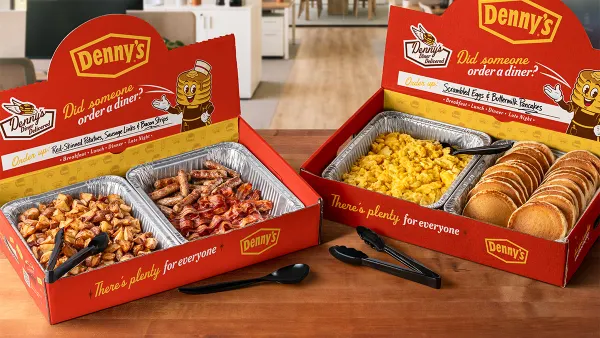
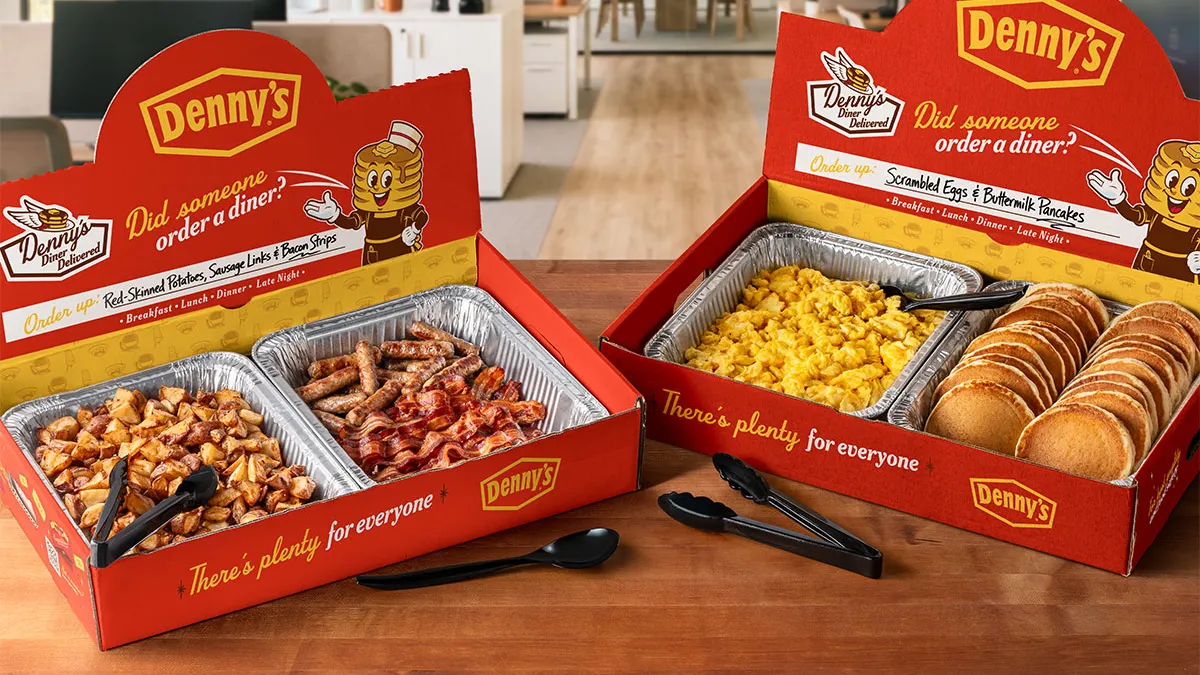
To avoid the issues it faced last time it made a catering push, Denny’s worked more closely with franchisees, and put together new packaging. The brand also started training workers in the first 400 stores to be included in the catering launch months in advance, Bode said. Much of this training took place through webinars and e-learning platforms, and the brand focused on getting its store-level leaders prepared to handle the channel.
“Managers and above-store leaders had to pass tests. They had to make sure they understood everything associated with catering to make sure that we execute right: How do we package? What does the menu look like right? What are the washouts of catering? What about labor deployment? All that stuff was built in that training,” Bode said.
Ultimately, Bode expects the program will start fairly slow, but sales will build. He anticipates that catering will add $50,000 to the sales volume of each participating restaurant in the first year, rising to $100,000 by the end of the second year.
Private ownership makes a substantial turnaround possible
Denny’s turnaround strategy was sparked by the brand’s transition from public markets to private ownership. Several other chains have made similar shifts in recent years — notably Del Taco and Pizza Hut — as private ownership can insulate chains from some short-term investor pressures.
In November 2025, Denny’s was purchased by TriArtisan Capital, Treville Capital Group and Yadav Enterprises — a franchisee of the chain, and owner of Del Taco. That move followed slumping same-store sales and significant closures of underperforming units. The new ownership structure has allowed the chain more room to maneuver, Bode said, and is facilitating its turnaround.
“Going from public space to a private space has been a breath of fresh air. You get to move faster, nimbler and quicker, and make better decisions. You don't have to worry about shareholder returns in the short term, so you can leverage capital in different ways to create some growth,” Bode said.
The new ownership structure also gives Denny’s the ability to restructure its corporate operations, Bode said, eliminating layers of bureaucracy and some corporate staff. Bode said the brand cut around 20% of corporate roles during this restructuring.
Culinary improvements, new tech and store renovations load the bases
The chain ultimately wants to improve its unit economics substantially, but this will require considerable changes at the store level.
“We have a $2 million AUV, and over the next couple of years, we're targeting $2.5 [million],” Bode said. “What we want to have are realistic programs in place that allow us to get there. I don't want to throw stuff up against the wall and hope it sticks.”
To get to that goal, one of the next major steps is reworking food and beverage to appeal to a wider range of consumers, Bode said. Denny’s, historically, has done a good job of appealing to Baby Boomers, but now it wants to bring more generations in the door.
“We want to be America's diner,” Bode said.
Once more, the chain is learning from past failures. Some previous attempts to broaden the menu confused the brand identity. At various times, Denny’s has tried adding lasagna, pot roast and other non-core items, Bode said.
Instead, Denny’s wants to do its classic dishes — only better.
“We’ve got to have the best burgers, the best chicken sandwiches, best club sandwiches,” Bode said. “And the brand will focus on getting the basics right at breakfast — with more fruit-forward pancakes.”
While the culinary team has worked hard to find new versions of classics and to come up with fresh, appealing dishes, restaurants can only rework their kitchens and reeducate consumers so quickly, and Bode said it might take two years to overhaul the menu.
To support that innovation, Denny’s will soon test a redesigned menu — one page instead of many folded pages — to help drive ticket and focus consumer attention.
In addition to culinary innovation, the brand is investing in technology, like new point-of-sales tech, including pay-at-the-table options, Bode said.
“It's archaic to ask our guests to get up from the table at the end of their meal and go to register to pay,” Bode said. The new POS will support both servers cashing tables out and tables checking out at their leisure, Bode said.
The chain is also increasing the cadence of its remodels, which slowed down during the COVID-19 pandemic. Now Denny’s is offering its franchisees three potential timescales. Bode said the brand will target a 10-year full renovation option for well-capitalized operators.
Operators at lower-volume restaurants with weaker balance sheets can opt for a two-year exterior refresh meant to “get the consumer to see there's something new and different going on at Denny's,” Bode said.
The final option is a five-year modernization timescale, which splits the difference between a triaged refresh and thoroughgoing overhaul, Bode said.