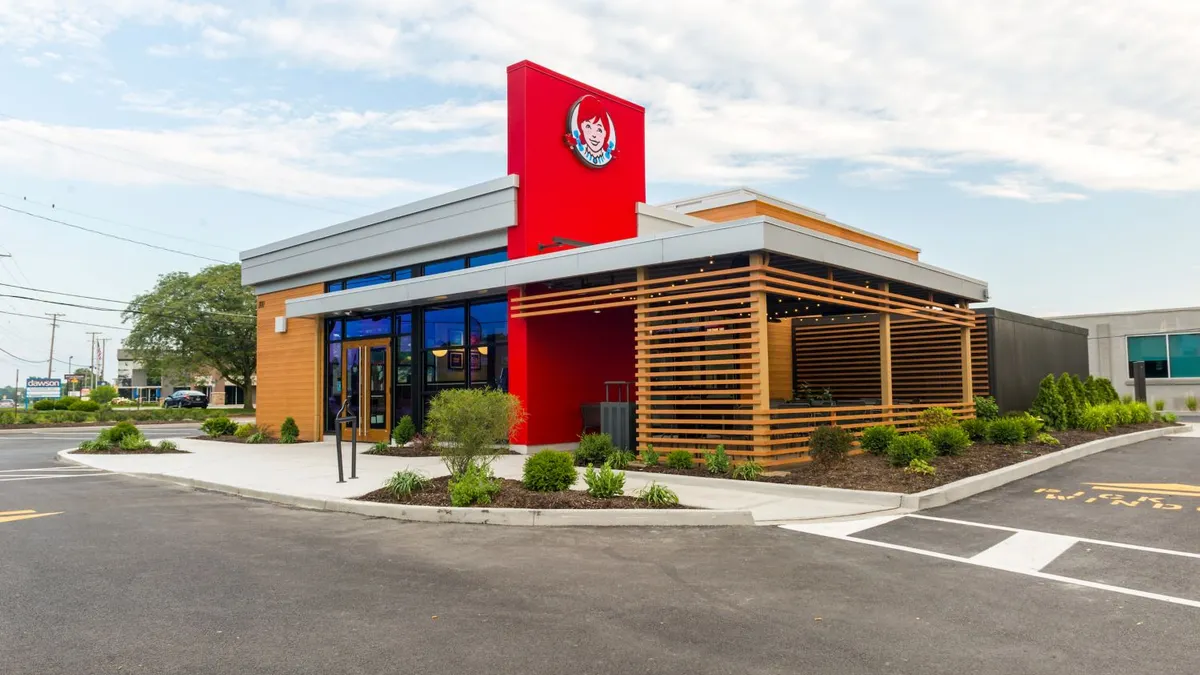
In 2022, Wendy’s International awarded Meritage Hospitality Group, one of the chain’s largest franchisees, a Momentum Award for “Visionary Growth and Expansion.”
Over several years, the operator spent $400 million of capital growing its Wendy’s portfolio to more than 370 units, including developing about 100 new restaurants and redesigning older, underperforming units. At the time, all indicators pointed to ongoing growth for the franchisee.
But four years later, Meritage is facing significant financial strain and filed for Chapter 11 bankruptcy protections last week, showing how quickly even the largest franchisee’s fortunes can change.
After several quarters of declining same-store sales across Wendy’s system, Meritage has been unable to maintain profitability, Kevin Cleary, chief restructuring officer, said in a first-day motion.
Revenue declined 7.6% to $618 million in 2025 compared to about $669 million in 2024. Revenue continued to drop during the first half of 2026, falling 14% to $274 million compared to $318 million in the year-ago period, Cleary said.
Meritage’s same-store sales also declined 7.2% during 2025 and 8.3% during the first half of this year.
An $8 million net income in 2024 flipped to a nearly $32 million net loss in 2025, and a net loss of $23 million in H1 2026.
“After more than a year of working constructively with its lenders and its franchisor toward a solution, the Company’s Board of Directors and management team determined that a voluntary, court-supervised restructuring is the most effective and proactive path to strengthen Meritage’s finances, address these headwinds directly, and protect the long-term interests of its stakeholders, team members, guests, and communities,” the company said in a press release about its bankruptcy.
A long history of growth
Meritage wasn’t always in this position. It was originally incorporated in Michigan in August 1986 as a hotel operating platform, but entered the quick-service restaurant industry in 1998 with the purchase of 28 Wendy’s restaurants after selling its hotel platform, per the court filing.
Meritage began trading on the OTCQX in 2007 and completed the first of 28 acquisitions in 2009 when it purchased 20 Wendy's restaurants in Florida. At the time, Meritage aimed to reach 150 restaurants by 2015. It ended up operating 166 restaurants in 2015. From 2011 to 2018, Meritage acquired 234 restaurants that brought its portfolio to 317 units.
In addition to the 314 Wendy’s restaurants it owns today, the company also operates one Bojangles and five independent concepts. At one point Meritage operated seven Taco John’s restaurants, but they closed in September 2024. The franchisee entered Bojangle’s system in 2025 with a plan to build 15 new restaurants by April 2031, Cleary wrote.
Meritage Hospitality Group financials
A diminishing financial position
Meritage’s good fortunes soured starting in 2024. Wendy’s same-store sales stagnated in late 2024 and turned negative in 2025, ultimately dropping by 11.3% during Q4 2025. Cleary said this sales decline and several external conditions compressed Meritage’s margins.
Wendy’s customers visited the chain with less frequency, tied to less effective brand marketing under prior management, he said. Winter weather associated with La Niña disrupted sales in the South. Deep discounting and national promotion strategies from Wendy’s further squeezed margins.
Record U.S. beef prices driven by lower herd levels, tariffs on imported beef from South America and a cutoff of Mexican beef imports due to disease led to a nearly 19% increase in Meritage’s average cost of beef for the second quarter.
In an April shareholder letter, the company said that Wendy’s protein mix is about 80% beef and 20% chicken. By contrast, McDonald’s protein sales are about 50% beef and 50% chicken, allowing that chain to promote chicken when beef costs rise. The introduction of new chicken sandwiches at Wendy’s during the spring was expected to allow for more options to promote lower-price chicken, Meritage said.
In 2025, food, paper and labor costs rose to an “all-time high of 66.1%,” while traffic patterns remained uneven. This drove restaurant-level margins to a 30-year low and resulted in negative EBITDA, which Meritage had “not experienced in the past two decades,” according to the shareholder letter.
“Because we cannot control external conditions, our strategy is built around controlling what we can: running a lean operation, protecting cash flow, and avoiding decisions that depend on optimistic assumptions,” the company wrote in the shareholder letter. “This discipline is central to our expectation of margin stabilization and EBITDA recovery as conditions normalize within Wendy’s franchise system.”
Creating a stronger financial position
Leading up to its bankruptcy, Meritage conducted various cost-saving measures with the blessing of Wendy’s, including a pullback in breakfast hours and closures of underperforming restaurants.
Meritage closed about 60 underperforming restaurants, exited or altered the breakfast daypart and cut $7.3 million from its general and administrative expenses and operational expenses through restructuring. It also completed 18 sale-leaseback transactions that led to net proceeds of $41 million, of which about $34 million was used to pay down debt. It later completed five additional sale-leaseback deals during the first half of this year, netting over $11 million.
The operator fell into default on a number of its obligations to lenders and to its franchisor. After forbearance agreements expired on Aug. 18, the franchisor and Meritage’s lenders were no longer prevented from taking action against the company. On Sept. 16, Wendy’s franchisor organization, Quality Is Our Recipe, sent a termination of franchisee rights and termination of lease occupancy rights to Meritage, Cleary wrote.
The franchisor said that Meritage owes over $27 million in past due royalties and more than $119 million in continuous operations fees.
Meritage, however, “dispute[s] the effectiveness of the Termination Notice as a matter of law and under the terms of the respective Franchise Agreements,” Cleary wrote. “The Debtors contend that the Franchise Agreements remain in effect and are property of the bankruptcy estates.”
Meritage will use the bankruptcy process to review various options to maximise stakeholder value, Cleary said. Its restructuring will include portfolio optimization through closures or sales of underperforming restaurants, resolving this franchise termination dispute with QIOR, looking into a strategic market sale to generate liquidity and reduce its portfolio to a “sustainable size,” and recapitalization of the balance sheet.
Wendy’s is also in the process of developing a turnaround strategy under new CEO Robert Wright that will improve franchisee profitability and could support Meritage’s restructuring efforts.
“The Debtors believe they can achieve a successful restructuring that maximizes value for all stakeholders while preserving jobs and restaurant operations across the 15-state footprint,” Cleary wrote.