Dive Brief:
- Yum Brands closed out Q2 with fundamental strategic shifts at KFC and Pizza Hut, according to the company’s earnings release.
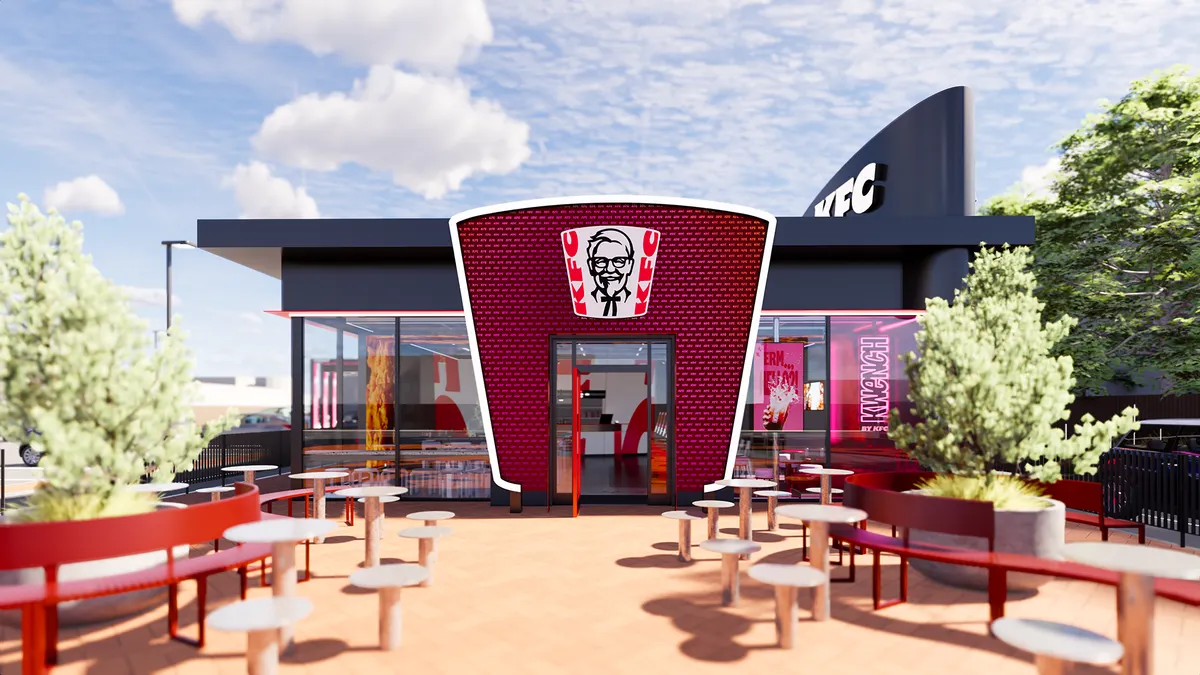
- In addition to Yum’s decision to sell Pizza Hut for $2.7 billion in two separate transactions, the company debuted a new global brand identity for KFC, which it plans to roll out across its top 20 markets in a “coordinated global effort,” CEO Chris Turner said on a Thursday earnings call.
- KFC’s international units have long outperformed its U.S. system, and Pizza Hut, before the sale, was the sick man of Yum’s portfolio.
Dive Insight:
Pizza Hut’s systemwide sales in the U.S. fell by 5%, while its same-store sales dropped 2%, as the chain closed large numbers of underperforming U.S. locations. LongRange Capital, the buyer of Pizza Hut’s non-China assets, filed an early termination notice with the Federal Trade Commission this week, indicating the transaction is proceeding swiftly. Yum expects the transactions to close in Q3.
The turnaround at KFC includes a shift toward boneless chicken, an emphasis on sauces and the modernization of the chain’s stores and brand identity, Turner said.
“Our consumers will experience new [chicken] tenders in select markets that are built for dunking, dipping and solo snacking, an expanded sauce pantry of nine bold sauces, unlocking customization and flavor discovery,” Turner said.
When that brand transformation will come to the U.S. was not made clear on the earnings call — in the announcement of the global transformation, KFC said the U.S. rollout would happen in 2026, following deployments in the United Kingdom, Ireland and Australia. It does plan to open a KFC in McKinney, Texas, in the late summer that will illustrate much of its global transformation and new design elements.
The U.S. accounts for 12% of KFC’s global sales, compared to China at 26% and Europe at 13%. The U.S. market has been the target of turnaround efforts by Yum for some time, so U.S. deployment may be a priority.
Yum no longer reports U.S. same-store sales for KFC in its earnings release, making it difficult to assess the brand’s performance on a quarterly basis — systemwide sales, however, were down 2% year over year and year-to-date in the U.S.per the earnings release.
These changes could potentially help KFC slow or stop the shrinkage of its U.S. storebase. The brand closed 147 net stores in the U.S. in 2025, after closing 124 and 127 in 2024 and 2023, respectively, per its franchise disclosure document.
Tenders-focused and boneless-focused chicken chains have been on an expansion tear of late, with both Zaxbys and Raising Cane’s passing the 1,000-store mark this year.
The U.S. is home to Saucy, KFC’s tenders-focused spin-off concept, which operates as a laboratory for sauce and tenders innovation. Globally, KFC’s development has continued to expand, said Ranjith Roy, Yum’s chief financial officer.
“We expect KFC to deliver its best development year ever, as franchise partners' confidence in KFC's long-term potential translates into faster store expansion,” Roy said.
Roy said the brand sees whitespace for 20,000 further units across India, Southeast Asia, West Africa and Brazil.