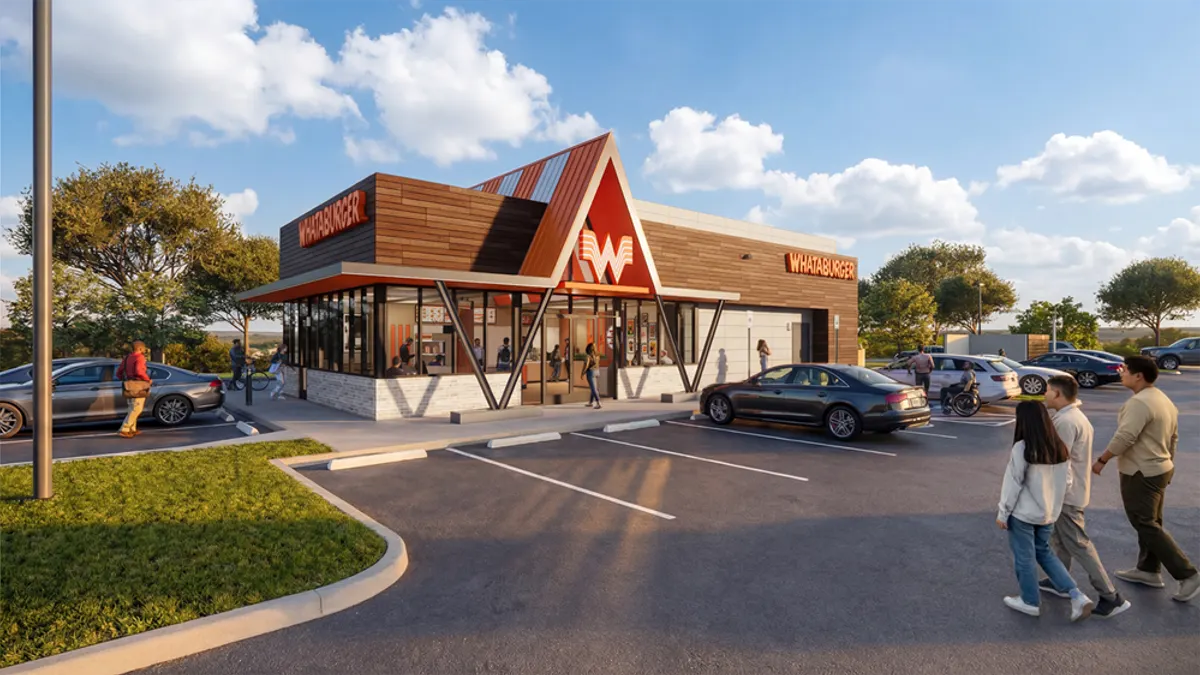
Take a road trip in Texas and you’re bound to see the Whataburger A-frame with orange and white stripes. The easily recognizable design elements are part of the experience many Texans have grown to love.
But as Whataburger — which has over 700 locations in the Lone Star State — expanded into new markets, the chain lost its A-frame.
“We have not necessarily built the A-frame beyond Texas in large numbers, and so we thought it was important that we bring that iconic element back for new customers,” Whataburger Chief Development Officer Todd Ewen said. “The opportunity to… have that be kind of a universal design going forward was really important to us.”
Ewen joined the chain last year and has been working with Billy Bias, director of design, to bring back some key elements into new prototypes as Whataburger expands outside its home state.
The team is ready to debut its new prototypes, dubbed Legacy and Essentials. Both use wood tones and orange and white stripes, and feature glass and modern materials. The Legacy design contains the classic A-frame with a larger dining room, while the other version leans more into the orange and white stripes.
“In Texas,... you notice Whataburgers, and that’s really what we wanted to invoke in these new markets,” Bias said. “Creating these memories for new customers is really important to us.
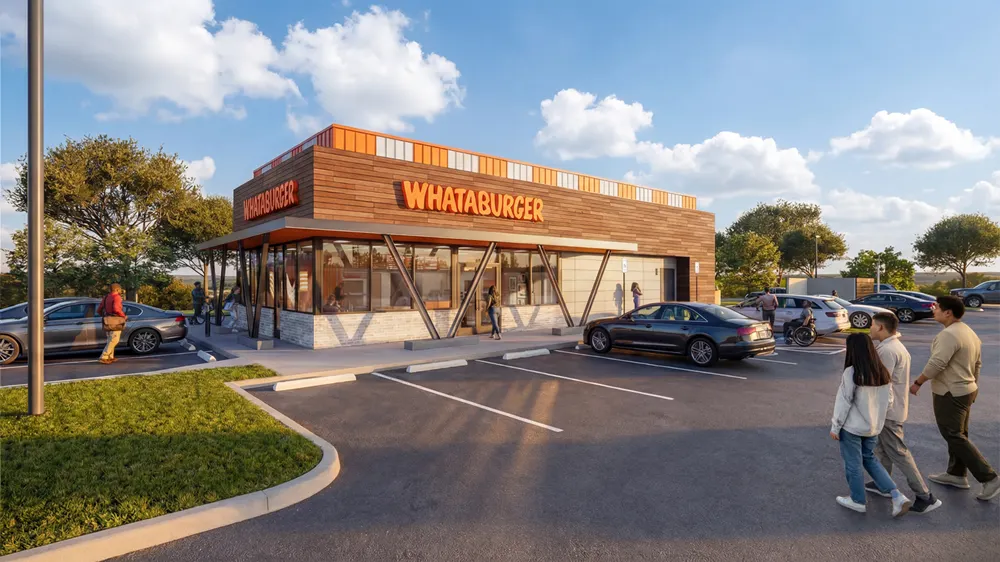
Whataburger will update the kitchen to have a better flow for operations, Bias said, adding that it was too soon to describe the different elements of the revamp as the chain is still finalizing the kitchen design.
Several of the design elements will be incorporated into rebuilds and remodels with existing stores in Texas and core markets, particularly interiors, Ewen said. Redesigns will unlikely include an A-frame, as that would be cost prohibitive.
Whataburger is working on two company-owned prototypes in Texas expected to open in late 2026 or early 2027. Restaurants in new markets, including North Carolina, Florida, Arizona, South Carolina and Georgia, will roll out in the second quarter of 2027, Ewen said. The new builds will be a mix of Legacy and Essentials prototypes and will be constructed by corporate and then made available later to franchisees, Ewen said.
Franchisees are excited about the new prototype, and the chain already has a list of operators ready to add new units as soon as the prototype becomes available, Ewen said.
“We’ve done some test runs with a few municipalities across the U.S. in various states, and have received very favorable feedback,” Ewen said. “They liked the fact that it was not just a generic box. So we’re really excited to get it on the ground and have people see it.”
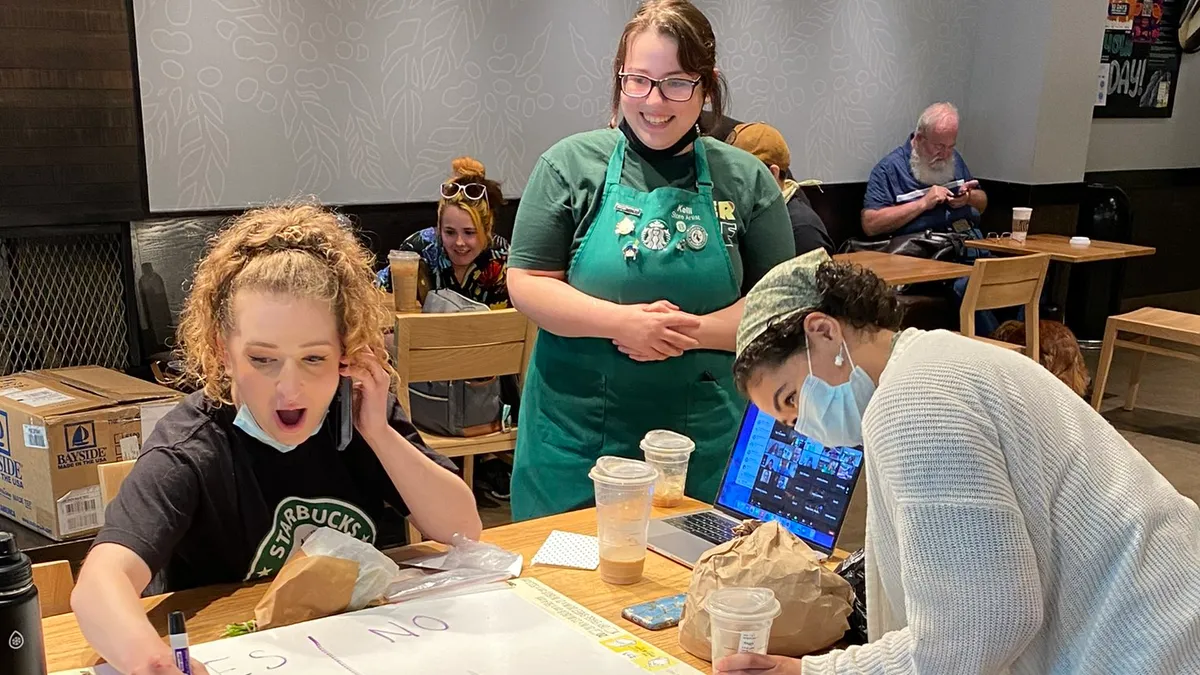
Other QSRs, like Huey Magoo’s, Burger King, Starbucks and Schlotzsky’s have rolled out new prototypes in recent years as a way to boost traffic and sales and create more inviting spaces. New designs are also helping lower construction costs. Huey Magoo’s latest drive-thru model is expected to reduce buildout costs by 40%, for example.
For Whataburger, the new design wasn’t driven with cost reduction in mind — it was an effort to revive elements that are widely recognizable in Texas. But the chain does expect that the new prototypes will cost less than the current restaurant model.
“We think creating a sense of place and an environment which invokes impressions for all generations, that’s the leading factor, more so than cost,” Bias said