Krispy Kreme has made significant progress on its turnaround strategy with improved margins and EBITDA up by 38%, or 260 basis points, year over year, CEO Joshua Charlesworth told Restaurant Dive.
The company announced a turnaround strategy August 2025, highlighting a refranchising strategy that would shift it towards a more asset-light business model, alongside improving its return on invested capital, expanding margins and driving sustainable and profitable growth, particularly in the U.S.
Given its progress on the turnaround, the company updated its financial guidance, projecting net revenue of $1.25 billion to $1.35 billion, adjusted EBITDA of $140 million to $150 million and updated free cash flow of more than $15 million, according to a May earnings release.
The chain still has a ways to go, however, as it is still operating with a $22.7 million net loss, though that is a $10.7 million improvement. Net revenue declined $367 million, largely reflective of strategic closures of underperforming locations completed in Q3 2025.
How Krispy Kreme is growing
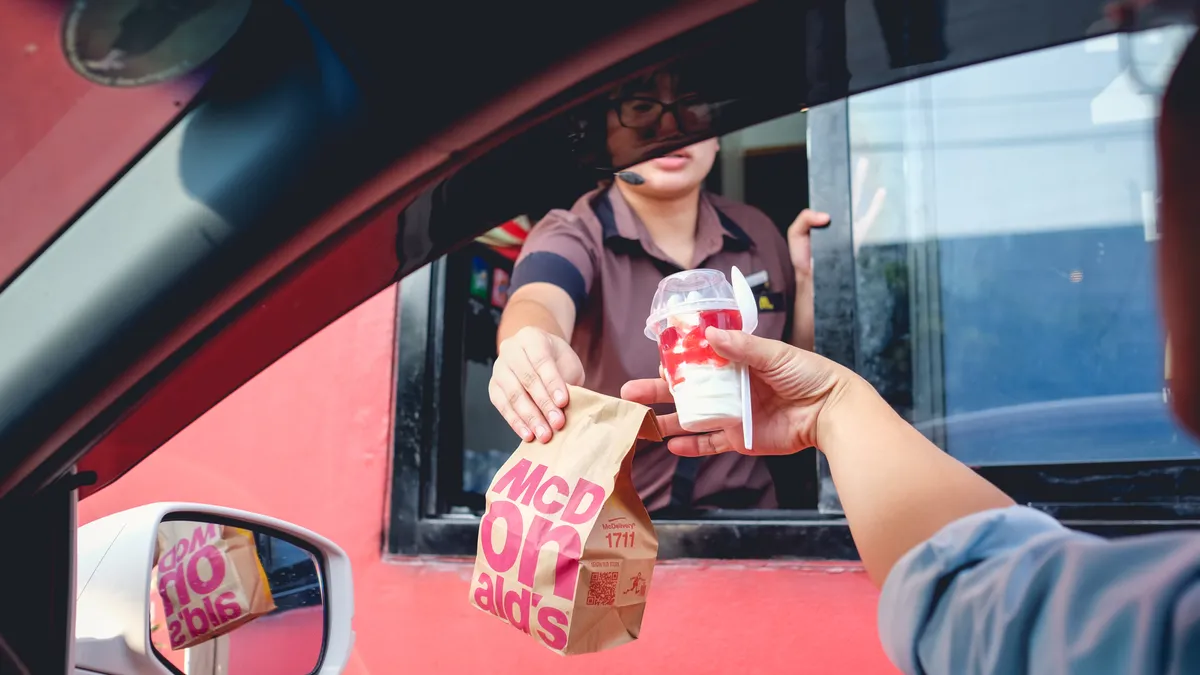
For the second quarter in a row, the company added doors in the U.S., Charlesworth said. Its 275 new doors were concentrated in Publix, Sam’s Club and Target locations, all of which were strategic partnerships where conditions were right for profitable growth, Charlesworth said. This is particularly meaningful as the chain exited underperforming locations in 2025. The end of its McDonald’s partnership in July removed the chain’s doughnuts from as many as 2,400 locations.
Average weekly sales are up 17% year over year, reflecting improvement at new and existing doors, he said.
Krispy Kreme has also been completing refranchising deals, mainly in international markets. However, in Q1, it completed a $90 million deal with an existing joint venture, WKS Restaurants, where the brand transitioned from majority stakeholder to minority owner, Charlesworth said.
This deal moved Krispy Kreme toward a more traditional franchised model, with the sale of 23 company-owned units in the West. WKS plans to add more restaurants across the region, particularly in California, he said. He reiterated, however, that the main target of refranchising isn’t the U.S. Instead, Krispy Kreme is focusing on refranchising as a component of its international strategy at this time.
Creating more profitable operations
Alongside profitable growth, the chain has also been focusing on improving operations. That included partnering with logistics providers to deliver its doughnuts instead of Krispy Kreme delivering the doughnuts itself. This switch has freed up Krispy Kreme teams to focus on finding efficiencies elsewhere instead of managing logistics.
“We are delivering to thousands and thousands of locations every day and when you start thinking about making sure you got the right doughnuts in the right place at the right time, that becomes quite challenging,” he said. “You want to minimize waste, for example.”
The chain and its third-party logistics providers are using artificial intelligence and other tools to optimize how it gets doughnuts to people. AI can take into account various elements that can impact doughnut making and delivery like weather patterns, seasonality, days of the week, and help Krispy Kreme improve its efficiency , he said.
The company is also testing drive-thru voice AI to evaluate its effectiveness. But the bulk of its operational improvements are more traditional. The chain is adapting production and delivery schedules, working with customers to optimize where it delivers, and making sure that it leverages opportunities to produce doughnuts in more efficient ways than it has before.
“One of the benefits of the turnaround has really been to focus on our core business, [and] making sure those Original Glazed Donuts, often sold by the dozen, get out there in the most efficient way possible,” he said.
Krispy Kreme continues to focus on the differentiation of its doughnuts. Charlesworth highlighted the specialty collections it sold around Valentine’s Day and St. Patrick’s Day, as well as the creation of the Artemis II Doughnut launch earlier this year.
“People can grab those online, and we can get them to them quickly, and that's a real source of growth for us, momentum for us that I think is important to add to the story,” he said.
The chain is also seeing significant growth in its fresh delivery and digital channels, and 23% of retail sales came from online or through third-party aggregators, Charlesworth said. It also has 17 million loyalty members that are “feverishly engaged with the brand,” he added.