Dive Brief:
- Huey Magoo’s, a roughly 90-unit fast casual chicken tender chain, developed a drive-thru prototype that cuts its development cost by 40%, according to a Friday press release.
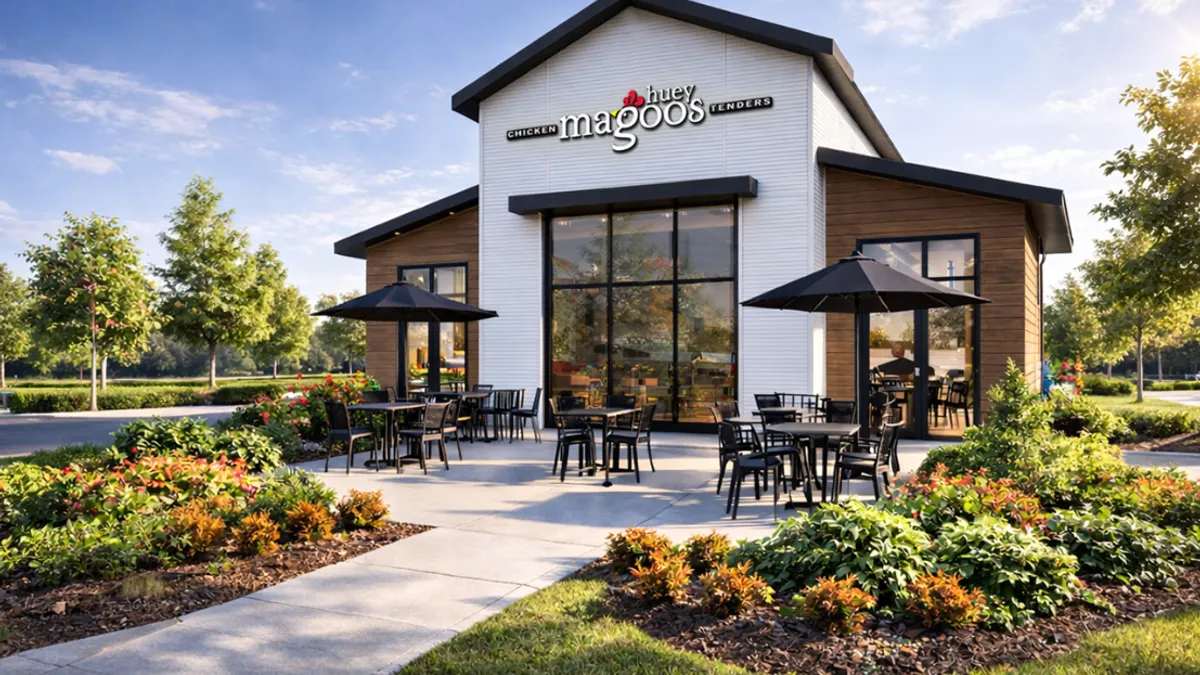
- The freestanding prototype is about 1,850 square feet, plus an external cooler, which makes it roughly 750 square feet smaller than Huey Magoo’s previous drive-thru design.
- This new design, which only needs parcels of 0.5 acres, is meant to open up “development on sites that were previously not viable, supporting growth in more markets while reducing upfront investment,” the company said.
Dive Insight:
Increased real estate flexibility could help Huey Magoo’s keep pace with other growing chicken tender chains.
The success of Raising Cane’s, which hit its 1,000-store mark earlier this year, has spurred a wave of franchising in the chicken tender space. Cane’s operates on a company-owned model, but Huey Magoo’s and Layne’s Chicken Fingers are opting for franchised growth. Huey Magoo’s expects to surpass 100 units this year, while Layne’s expects to double its footprint again this year as it nears 100 locations.
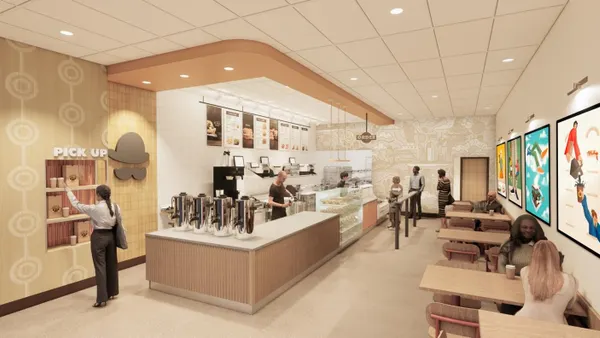
Huey Magoo’s sought to preserve on-premise experience, despite trimming hundreds of square feet from the design. The new prototype has 37 indoor seats and 18 outdoor patio seats that expand its dining room, per the press release, while the previous version had 42 indoor seats.
Melissa McCammack, the chain’s director of architecture and design, said the new footprint was meant to prioritize efficient use of space.
“By refining the layout and focusing on how guests and team members move through the space, we reduced the overall footprint while maintaining an open and comfortable environment,” McCammack said.
The new drive-thru model was designed in-house by McCammack. Bringing design in-house made it easier for the chain to “evaluate sites in real time, create test fits and develop solutions for a wider range of locations,” the release stated.
The prototype minimizes "unnecessary circulation and excess volume” resulting in improved flow at the kitchen, dining and ordering areas, the company said. The space features a centralized ordering area with a dining area along its perimeter.
“This approach reduces the overall building mass while also allowing mechanical systems to be more discreetly integrated,” the company said.
The kitchen is more compact, and cooking zones are organized to support speed and consistency as well as employee movement to minimize steps and boost workflow during peak periods.
The brand roughly doubled its unit count from early 2023, when it had 43 stores, to 85 at the end of 2025, according to its 2026 franchise disclosure document. Its drive-thru locations tend to have significantly stronger unit volumes — $2.2 million — compared to inline restaurants, which average $1.8 million. Reducing the development cost of drive-thru stores thus improves the payback time for those locations and may lead franchisees to prioritize drive-thru development.
The chain is heavily concentrated in Florida and Georgia, which together house a majority of its stores, according to its FDD. Increasing the variety of real estate available to operators could help it expand from a regional concept to a more national brand.
All the growth in the chicken sector has put pressure on legacy QSRs to adjust their menus, with Wendy’s, McDonald’s and even Taco Bell adding chicken tenders as permanent menu items or long-running LTOs in the last year.