Yum Brands’ $2.7 billion deal to sell Pizza Hut to two buyers marks a “step forward” for the company — and for the pizza brand — but the likely outcome for both remains unclear.
“The sale removes a lagging brand, improves the financial profile and optimizes their resource allocation, but is also dilutive to operating profit and removes them from a large, global category,” Peter Saleh, an analyst with BTIG, wrote in a research note emailed to Restaurant Dive.
The sale may position LongRange Capital, which is buying Pizza Hut’s non-China operations for $1.5 billion, to help the chain address its major issues, but the future is uncertain.
Pizza Hut’s ongoing troubles
Pizza Hut has long trailed both Taco Bell, Yum’s leading U.S. brand, and major competitor Domino’s in same-store sales and other financial health metrics. The concentration of a plurality of its store system in the U.S. meant it could not — as KFC could — look abroad for dramatic revenue growth while undertaking a multi-year brand turnaround.
Neil Saunders, managing director of GlobalData, said the inability of recent changes to return the brand to sales growth showed the difficulty, and likely duration, such a turnaround would require.
“It has become increasingly clear that pushing the division back into growth will require a level of investment and patience that Yum is just not prepared to commit to,” Saunders said in an email.
In the U.S., the chain fell behind Domino’s, as the latter “trumped Pizza Hut across many aspects, including menu innovation, marketing, ordering technology, and its delivery infrastructure,” Saunders said.
While Pizza Hut is closing about 250 stores in an effort to strengthen the performance of its remaining U.S. restaurants, Domino’s sees the closures as a strategic opportunity to ratchet up the competitive pressure on Pizza Hut through aggressive discounting.
What can actually change?
The deal was somewhat larger than anticipated, Saleh said, with a valuation roughly 7.5 to 9 times the size of Pizza Hut’s EBITDA, depending on whether one adjusts for Pizza Hut’s portion of Yum’s general and administrative expenses. That multiple, Saleh said, is “higher than deals for other depressed brands,” which he attributed to “the brand's sizable international presence ($5.2B in sales excluding China) and established China business ($2.4B in sales) with its existing franchisee.”
LongRange is inheriting the problems of Pizza Hut, and private ownership could result in “a more drastic turnaround effort, but the track record of similar deals isn't great,” Saleh said.
Other major brand turnarounds and recent statements by Yum might provide a clue as to the brand’s strategic direction.
Starbucks’ turnaround under CEO Brian Niccol has included significant investment in on-premise experience and in hourly labor, for example, while Burger King has poured hundreds of millions of dollars into renewed marketing, menu innovation and store renovations. Both brands took considerable time to return to sales growth, but are now seeing results.
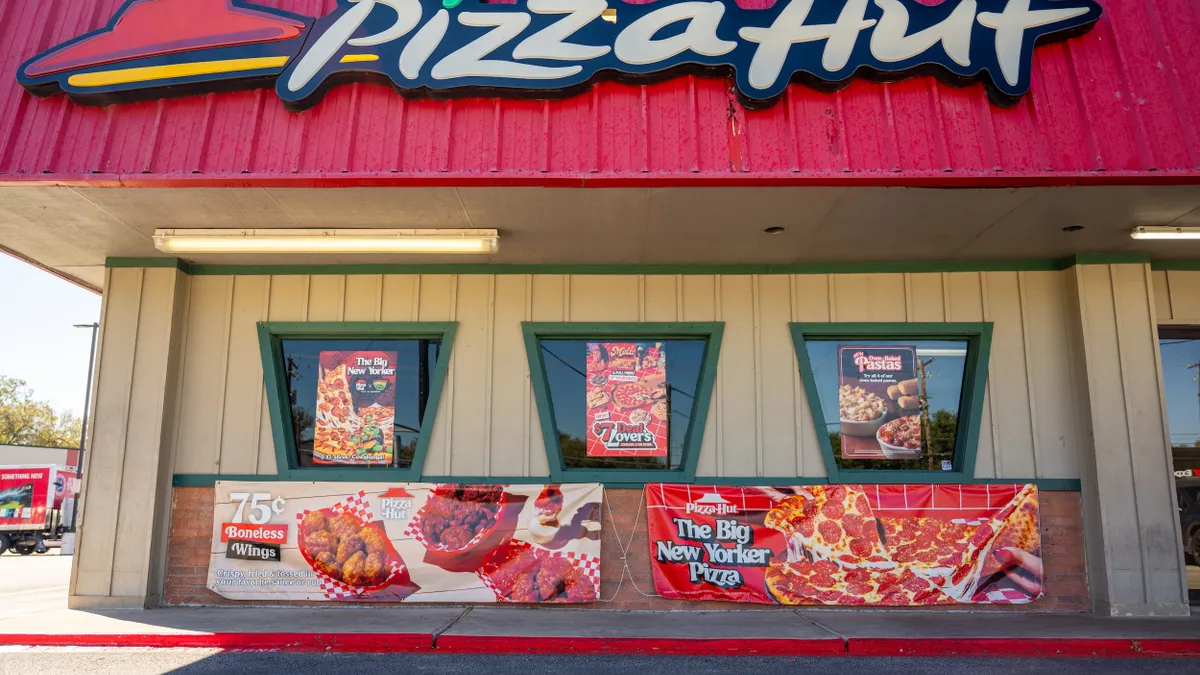
Yum recently highlighted that retro versions of Pizza Hut’s stores — the red roof design — with more intensive on-premise service, are seeing considerable consumer interest and nostalgia.
Saunders, however, said an emphasis on retro, on-premise experiences might not be a silver bullet, considering that many consumers “prefer the more balanced menus and a more contemporary environment offered by a large number of modern casual dining chains.”
Earlier this year, Yum announced the Hut Forward program, a partial brand turnaround for Pizza Hut.
Hut Forward “represents a bridge to a longer-term acceleration of the brand,” Ranjith Roy, Yum’s CFO, said on the company’s earnings call in February. Hut Forward includes “a vibrant marketing program, modernization of certain technology and franchise agreements, and Yum! providing a onetime contribution to marketing support,” Roy said.
Saleh was not optimistic about the prospects for the chain’s turnaround efforts, however.
“We've seen a succession of different leaders, turnaround efforts, closure activity and franchisee transfers at Pizza Hut over the last twenty years, and the brand is in roughly the same position and modestly smaller in the U.S. ($5.1B in system sales) than it was back then, so we struggle to identify something that hasn't been tried already,” Saleh wrote.