Church’s Texas Chicken has secured a significant minority investment from Golub Capital to help the brand shift from a turnaround period into a growth phase, according to an emailed press release. Precise details of the investment were not disclosed, but Church’s CEO Roland Gonzalez said the investment was enough to significantly increase the pace of remodels at company-operated stores.
Since 2021, when the chain was acquired by High Bluff Capital Partners and Future Standard, Church’s Texas Chicken has worked to remake its operations, overhaul its menu and return to net unit growth in the U.S. Golub has backed the turnaround push with funding since 2024, but Tuesday’s announcement marks Golub’s first equity investment in the chain.
The turnaround effort, according to the press release, has paid off. Gonzalez said that growth has continued with 6% same-store sales growth and a 7% traffic increase in 2026.
Gonzalez said Church’s plans to use the investment to speed up remodels at the brand’s roughly 160 company-operated U.S. stores.
Remodels, growth and refranchising
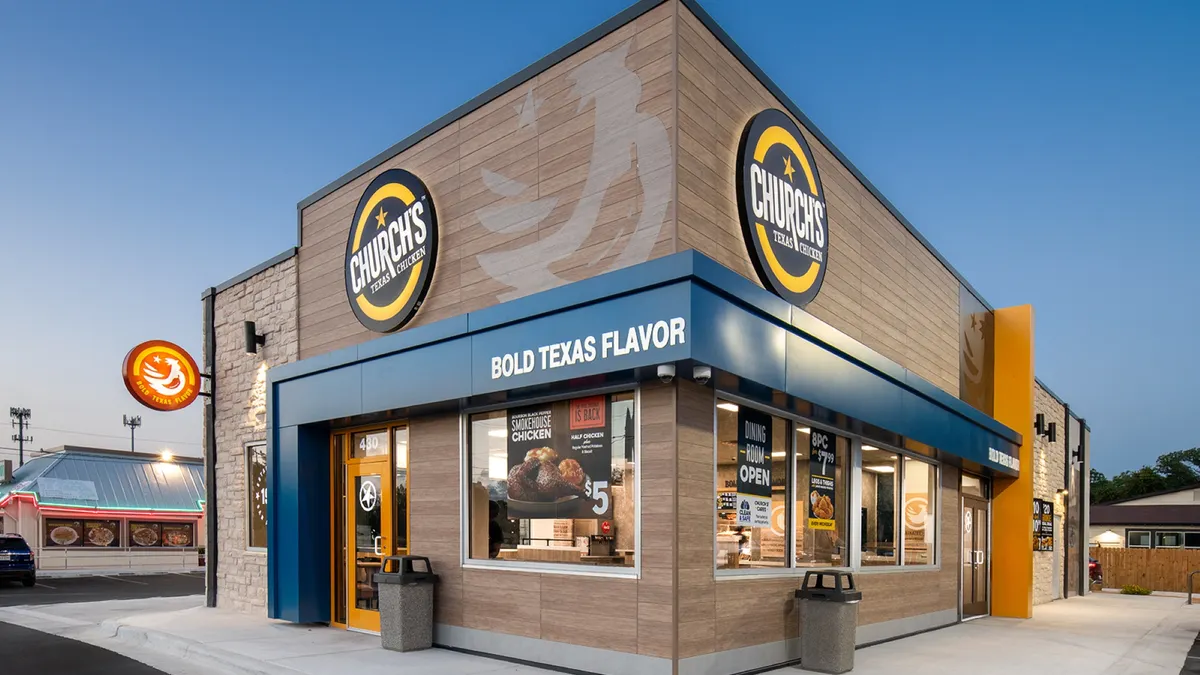
Church’s franchisees have spent the last few years remodeling their stores to fit the chain’s new Blaze Platform. Now, that remodeling push will come to Church’s company-owned stores, Gonzalez said.
“It's not uncommon to see 15 to 20 percent or plus [sales] lifts when we do our remodels,” Gonzalez said.
The brand is significantly moving up the timeline for its company-operated store reimages. The remodel program tends to cost about $400,000 per store, but the total cost varies depending on store age, needed maintenance and other factors, according to Gonzalez.
By year’s end, the chain expects about 500 of its roughly 760 U.S. stores to be up to date. In addition to the sales lift from reimaging, Church’s turnaround has included significant investments in store-level operations, Gonzalez said.
As part of the turnaround, Church’s introduced a restaurant-level scorecard that closely correlates with sales, Gonzalez said. The scorecard grades performance on food quality, cleanliness, friendliness and other areas and has helped drive significant improvements in operations. The brand has also worked to improve efficiencies.
“We simplified procedures also in the back of house,” Gonzalez said, noting that Church’s has cut down on the types of batters it uses, without changing the flavor profile of its chicken.
As a result of these changes, undertaken since 2021, “average franchisee restaurant sales have increased by over $200K, translating to more than $55K of additional profit per restaurant, reflecting a healthier, more resilient franchise system,” according to the press release.
The strength has made it possible for Church’s to grow its domestic store count for the first time in more than a decade, Gonzalez said. 2025 marked the chain’s first year of net unit growth in its home market since 2010, and the brand, which has focused on international expansion in recent years, is looking to increase the pace of its U.S. store openings.
The chain’s market re-entry in Philadelphia broke Church’s record for new opening sales volumes.
Church’s will “seed” markets like Philadelphia, Cleveland and Baltimore, with company development, Gonzalez said. Once company-operated units have proven the brand’s strength in those markets and given it a foothold, Church’s intends to sell the units to a franchisee to continue growing the market.
Dark meat costs and value preserve Church’s advantages
On top of Church’s unit growth, the recent investment and the long-running brand turnaround, Church’s has other strengths unique to its position within the chicken category, Gonzalez said.
Bone-in dark meat chicken accounts for the majority of the chain’s sales mix, Gonzalez said, and the chain has seen deflation in dark meat costs even as costs for white meat chicken products — like tenders — have increased. This has helped Church’s restrain price increases and even take share.
At the same time, QSR chains like Taco Bell, Wendy’s and McDonald’s have added chicken strips to their menus in the last year. But Gonzalez doesn’t see these menu innovations as a significant competitive threat.
“They're not going to be able to hand batter and bread like we do,” Gonzalez said. “I expect them to launch those categories, but I don't expect them to be at the quality that we have.” In the long run, such brands will likely move away from chicken innovations to focus on their core brand competencies, Gonzalez predicted.
Church’s has built its menu strategy around individual and group dining, rather than a more standard daypart structure. This strategy extends to the brand’s value offerings, with its $3.79 two-piece feast and a $5 chicken box the brand launched during Lent. Church’s changed its Lent strategy to emphasize value, rather than seafood, though consumers could still opt for a shrimp box with an upcharge. On the group dining side of the value menu, Gonzalez said, the chain offers two 10-piece deals, one priced at $11.99 with the chicken only, and one at $19.99 with two large sides and five biscuits.
Attachments to those meal deals have helped strengthen the brand’s average ticket, while the price points get consumers in the door and the operational improvements ensure the chain can handle increased traffic.
“It's a really really great time for Church’s. All of those are the inputs for the growth that we're having now,” Gonzalez said.