The QSR pizza sector has had a rough decade in the U.S. The advent of delivery aggregators eroded major chains’ delivery advantage; the COVID-19 pandemic killed the group occasion for a substantial period of time; persistent inflation has weakened consumer appetites for restaurants across the board; and pressure from pizza programs outside the traditional fast food sector has only grown. The result: declining same-store sales, underperforming units and fierce competition over value.
“Just think about gas stations and c-stores. A lot of nontraditional locations have really popped up, so the consumer can get great pizza at an affordable price in many different locales,” Papa Johns CEO Todd Penegor said.
Papa Johns is familiar with the ill-effects of this competition. The brand saw an 8.3% same-store sales drop in North America in Q3, according to its earnings release. In response, the chain announced a new business strategy Thursday morning. That strategy, dubbed “Unbox Better,” is meant to help the chain regain its footing, carve out a bigger slice of the QSR pizza pie and establish itself once more as the segment’s quality leader, Penegor said.
Higher quality through greater consistency
Penegor said the brand’s main advantage was in its quality.
“We've got a lot of quality ingredients that go into pizza that delivers better; people give us credit for better, but they can't tell us why. So we start from a good spot. We're going to amplify the ‘why’ on why we're truly better,” Penegor said.
One part of amplifying better is making better an operational reality. Despite Papa Johns’ ingredient quality, performance is uneven across the chain’s system, Penegor said.
“We get a lot of customers that say, ‘Hey, Todd, I love going to that Papa Johns.’ Well, I know what the next piece is: ‘Well, I'm never going to that one on the other side of town.’ We can't have that inconsistency gap,” Penegor said.
Some of the chain’s competitors have more consistent execution, though they have a lower quality ceiling, Penegor said. To address this lack of consistency, Papa Johns is retraining workers and increasing its intervention in underperforming restaurants. The chain has shifted toward a more regional training system that allows its support teams to get into more restaurants more frequently.
“Pizza is a game played nationally, but won locally, and we've been missing that win locally.”

Todd Penegor
CEO, Papa Johns
The chain is also evaluating the quality and physical properties of its core pizza, in hopes of improving its consistency.
“We're looking at heat retention for the pizzas as they're being delivered. We're looking at the melt points of our cheese and the taste profile of the cheese. We're looking at the handling of our dough,” Penegor said.
More marketing, but higher franchisee margins
Communicating the brand’s quality to consumers will require more marketing dollars, Penegor said, but Papa Johns is balancing the need for marketing investments with franchisee margins.
The brand is re-establishing its local marketing co-operatives, which it had moved away from in 2023 and 2024, under previous leadership. To support the new cooperatives, Penegor said, the brand is bringing back a 2% local marketing contribution, but cutting its national marketing fee from 6% to 5%. This would yield a significant increase in marketing spend overall, and greater flexibility in messaging.
“Pizza is a game played nationally, but won locally, and we've been missing that win locally,” Penegor said.
The co-ops will make it possible for Papa Johns to have a coordinated national message, while remaining cognizant of the quirks of different markets.
“We can fight hard where the local [designated marketing areas] can either amplify and complement a national message, or work to localize and offset some of the national message to connect to the communities that they serve,” Penegor said.
The brand is making other changes to its unit economics to offset the higher marketing spend, Penegor said. For instance, the chain’s margin on its commissary operations was set to rise to 8% next year, but the brand is now restricting it to 4%, resulting in a 100-basis-point margin increase for its franchisees. It will also cut its tech fee from 1.75% to 1.5%, yielding another 25 basis points in margin support.
This increase will help franchisees implement changes under the new system, whether that’s new equipment or operational changes.
“Our franchise community is really going to need the fuel to fight to really help us bring unbox better to life,” Penegor said.
Domino’s has made it an explicit goal in recent quarters to pressure Papa Johns’ and Pizza Hut’s unit margins, with the hope of exacerbating store closures and gaining market share. A marketing offensive combined with defensive improvements in operator margins could insulate Papa Johns from that strategy — and help it sustain new value plays.
Discounts and consumers have a part to play
While some chains have put an end to their participation in the value wars, Papa Johns still sees a barbell strategy as key to its performance.
“There's a lot of discounting across all QSRs, but it did feel like a bit of a race to the bottom,” Penegor said. “The consumer wants quality, and they want to be not disappointed when they spend their hard-earned dollars.”
The top of the brand’s menu price range will be anchored by specialty pizzas, Penegor said, while, at the bottom, the pizzamaker will use discounts and LTOs to drive traffic. There is a secondary purpose to some of the upcoming discounts, however.
Next week, Penegor said, the chain will add a “Bounce Back Offer.”
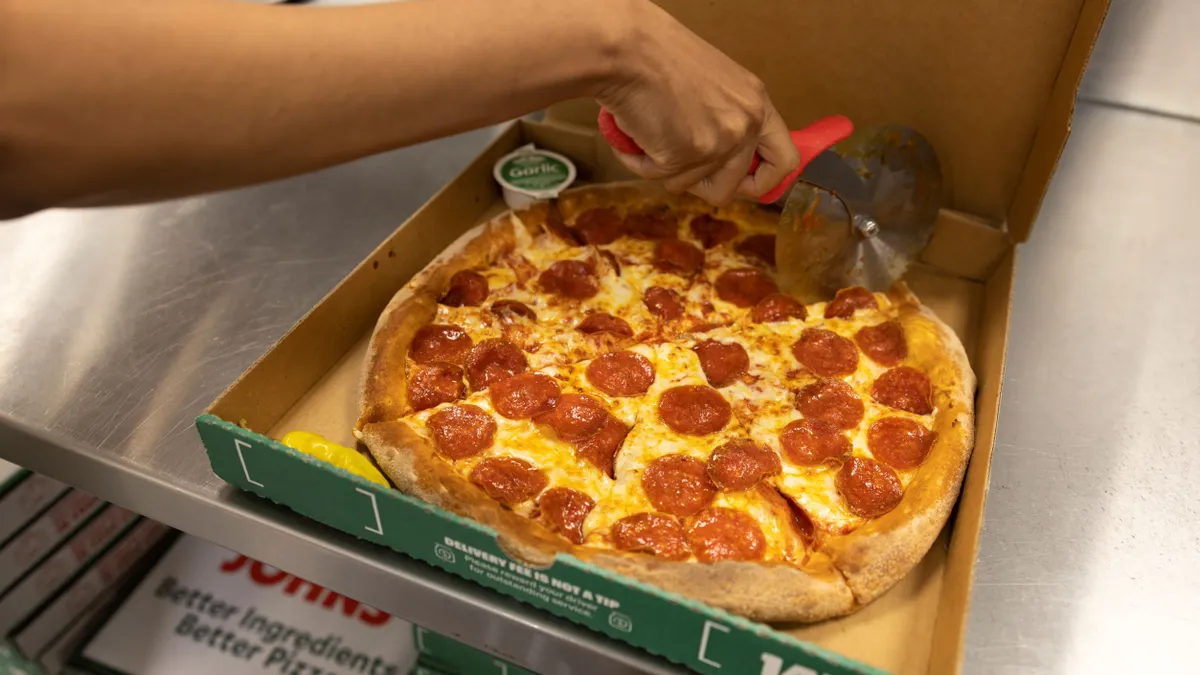
“With a $15 purchase, if you take a picture of your pizza and submit it to us, we will give you a free pizza on your next purchase with a $5 minimum order,” Penegor said. This should help the chain solicit customer feedback and gather data on its pizza quality. The pizza pictures will be shared with restaurants, while the brand will use an artificial intelligence agent to analyze the images and customer feedback to assess matters like heat retention, cheese quality, sauce investments and tweaks to the pizza dough.
“We'll probably come back to this Bounce Back Offer during the course of 2027 a few times to continually get this feedback from the consumer to make sure they feel like they're part of the solution,” Penegor said.
Overall, these changes might take the better part of a year to result in improvements in sequential sales, but Papa Johns will assess early success by measuring — and sharing — customer service metrics.