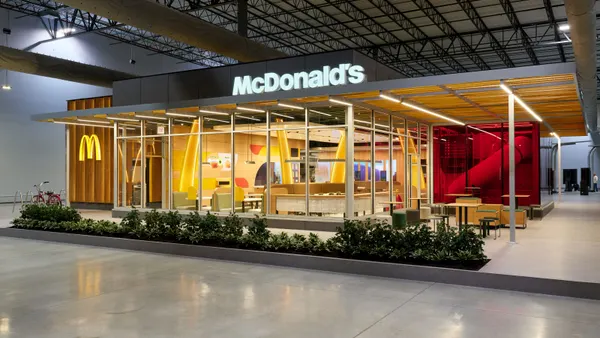
At McDonald’s investor day last week, the brand’s executives laid out a high-level vision for drawing in consumers, improving operations and strengthening its menu.
The chain is working on everything from tiered loyalty systems and drive-thru artificial intelligence to chicken bowls and bigger burgers. But sustaining an ambitious growth plan at the store level requires significant investment, particularly in operations, equipment and store design.
McDonald’s Chief Financial Officer Ian Borden detailed the scale of McDonald’s investments in its Next strategy, outlined the per-store costs and shared estimates for its efficiency gains.
Here are three big numbers that show how McDonald’s plans to finance its next phase of growth.
$8.5 billion
The amount of support McDonald's will provide for the Next program through 2036.
The headline figure from McDonald’s investor day was its massive partner investment with franchisees over the next decade. This money consists primarily of rent relief and capital support.
The Golden Arches typically rents real estate to its franchisees, and charges pass-thru rent to operators for sites where the brand itself is the lessee, per its franchise disclosure document. In 2025, McDonald’s revenue from the sale or lease of real estate and services to franchises was roughly $7.4 billion.
The chain has a greater ability to offer immediate relief and incentives to operators than competitors that do not own their real estate.
Borden said the bulk of the money — about $5 billion — would be invested by 2030 to “accelerate deployment of ArchIQ technology bundles, as well as kitchen and operations enablers.”
The investments will have a roughly four-year payback period for franchisees, and a five- or six-year payback period for the chain, Borden said. The extent of this partner support “will vary by market and be flexible and targeted to the realities that franchisees face locally,” Borden said.
$800,000
The expected per-store cost for traditional drive-thru locations for tech deployments and remodels.
Borden estimated the overall Next changes, from tech deployments to remodels, would cost about $800,000 per store for traditional drive-thru locations in the U.S.
“It's the additional operational, kitchen and technology capabilities and design elements as well, that we believe unlock incremental growth and greater productivity,” Borden said.
The Next investments, which McDonald’s funds through the aforementioned partner rent relief and capital support, are incremental to required renovation expenses outlined in the brand’s FDD. Borden said that standard lobby remodels at representative U.S. restaurants cost between $400,000 and $450,000, which will be funded by the franchisee.
The incremental Next investments will be phased in over time, as technologies mature, Borden said, while design elements of the program will be timed to coincide with the regular remodel cycle.
250
The amount of basis points of efficiency McDonald’s expects at the restaurant level.
The goal of these investments, Borden said, is to realize about 250 basis points — or 2.5% — in restaurant-level P&L efficiency. This is expected to equate to $100,000 in gross annual cash flow, he added.
The chain’s AUV is “north of $4 million with operating cash flow of about $500,000” for its U.S. units, Borden said. The additional cash flow could go a long way for many franchisees.
McDonald’s hopes some of this increased cashflow will be put back into restaurants.
“We expect a portion of that will be reinvested to support Next growth initiatives, but that the majority will benefit the restaurant's bottom line over time,” Borden said. “That's real value creation at the restaurant level.”