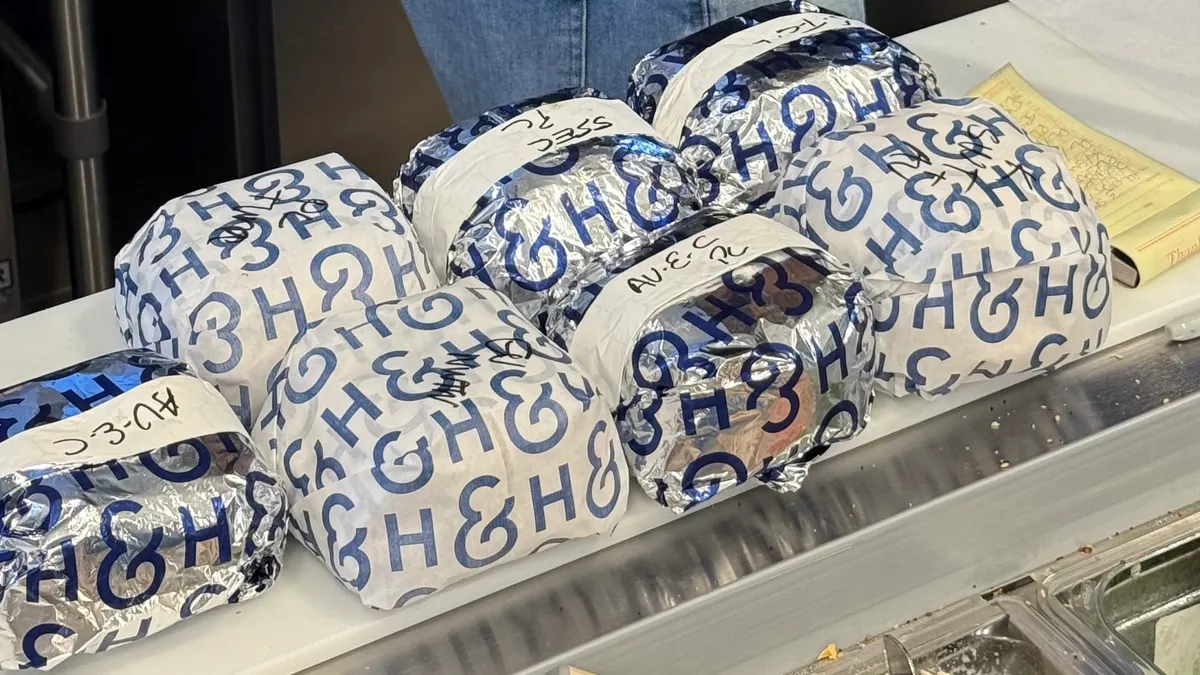

On a Thursday morning in Pinecrest, Florida, the line was already forming before the doors opened. Over the next ten hours, H&H Bagels’ new Miami location processed more than 900 orders, moved hundreds of bacon, egg, and cheese sandwiches, and hit approximately 30-minute wait times at peak. They reported zero sell-outs across their entire menu during the launch.*
H&H had already opened locations in West Palm Beach and Boca Raton, which taught the team something useful about South Florida: When you bring a New York institution into a market full of transplants, demand shows up fast. Miami, with its density and culinary press attention, was the same dynamic at higher volume.
Ryan Klepper, who oversees operations for H&H Bagels, walked Toast through how it happened.
Staff for positions, not just headcount
Thirteen people worked the Miami opening: nine crew, three shift leaders, and one GM. For a grand opening in a major market, that’s not a large team. What made it work was how each person was deployed.
“A major part of training is trying to have some individual time with every person — to get a gauge of where in our service model they will thrive,” he said. “Trusting store leadership’s judgment to put people in positions where they’re going to succeed. It all comes together to create a really healthy environment with a lot of great output.”
The team that showed up that day also happened to be a fast one, which mattered. “You can educate on process,” Klepper said. “You can’t educate on speed.”
Design your station for the volume, not the average day
H&H operates out of small-footprint locations, which means there’s no slack for inefficiency when volume spikes. Every item a crew member needs during a rush has to be within arm’s reach.
“Everything that you need to maximize the potential of where you are needs to be right where you are,” Ryan said. “Anytime someone has to turn and look for something, or go to the back to get something, you’re hurting yourself. Think about that happening 25, 30 times in a three-hour window at max capacity. That’s the difference between you going into the weeds.”
Standard operating procedures (SOPs) do the work of making high-volume execution teachable and repeatable. When everything is done a certain way, processes are easier to teach, mistakes are easier to correct, and work is easier to sustain across a ten-hour day.
Communicate wait times before guests ask
At peak, egg sandwiches were running approximately 30-minute waits. H&H’s approach was to get ahead of it rather than let expectations go unmanaged.
“The worst thing somebody can do is blindly take an order and not let somebody know how long it’s going to take,” Ryan said. “You have to give them the out.”
Every guest-facing team member was trained to communicate wait times at the moment of order, which also became an opportunity to introduce something else on the menu. “Maybe it gives you an opportunity to try one of our spreads or our salads. You’re introducing people to new things and managing their expectations at the same time.”
The operating principle is straightforward: under-promise, over-deliver. “You say 15 minutes, and you get it out in 12. Now the person’s leaving thinking, wow, that was faster than they projected.”
Know your inventory math before the day arrives
Maintaining full menu availability across 900 orders is a logistics story as much as an operations one. For H&H, that planning comes down to deep familiarity with walk-in capacity, reliable distributor relationships, and disciplined “First In, First Out” (FIFO) practices: knowing that a Wednesday delivery needs to land before a Thursday grand opening, and that a Friday delivery has to account for the weekend ahead.
“The more stores you open, the clearer your gauge of what to prepare for,” Klepper said. “We try to make a new mistake every time. We’re not looking to go over the same pothole twice.”
Measure success beyond order count
Klepper’s post-opening review goes wider than the numbers.
“What do your Google reviews look like after your first day? Did you get any emails into your info box? What was the interaction like on site? You want to judge it as a whole.”
And if a negative review surfaces after 900 orders: “You cannot let that take away from the 899 you crushed. And you also cannot put that on a team that did an incredible job.”
The most transferable lesson from Miami may be the simplest one Klepper offered: “Never stop looking for ways to get better. Never stop building out new processes. Never stop making the program more teachable.”
The result speaks for itself. What makes it better is that the program behind it keeps improving, because for H&H, there’s always another market to open.
*As reported by H&H Bagels