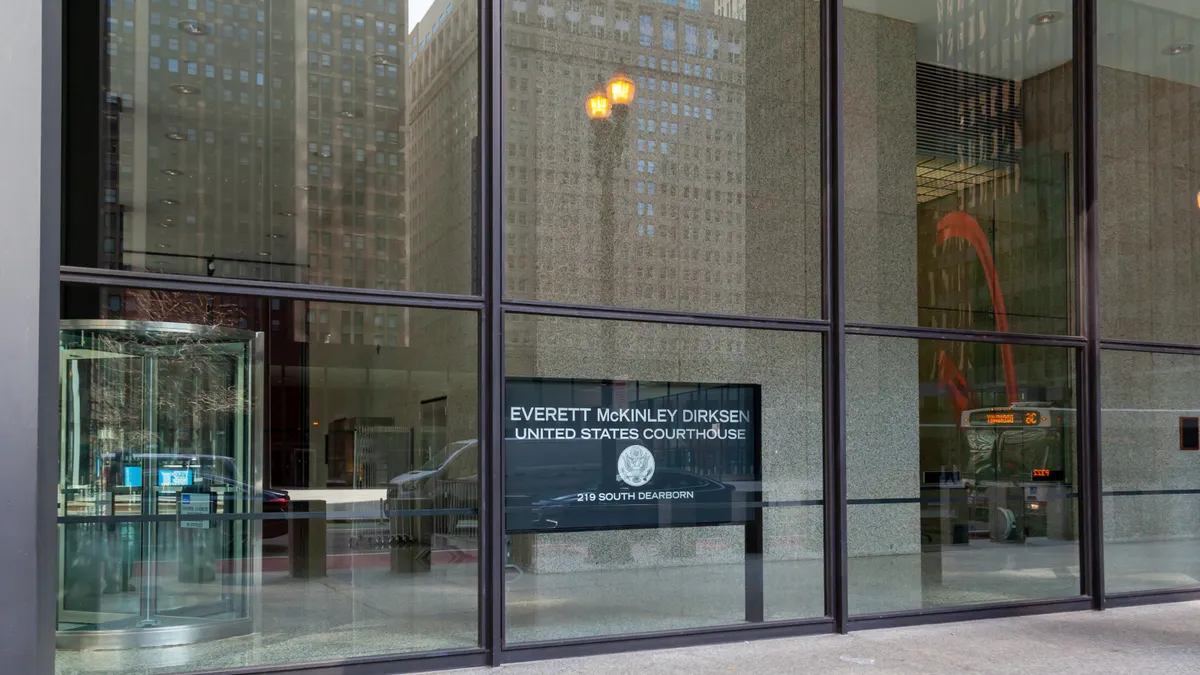
A federal judge on Monday granted an injunction against Illinois’ Interchange Fee Prohibition Act, which barred payment processors and financial institutions from charging interchange fees on tips and state and local taxes. The judge found that the state law conflicted with federal law and harmed financial institutions, court records show.
At the same time, Illinois’ state legislature passed an amendment delaying the implementation of the IFPA for a year to July 1, 2027.
These two blows against the bill significantly reduce the odds that the law, championed by the National Restaurant Association as part of the Merchant Payments Coalition, will take effect.
A defeat in Illinois would likely narrow the scope for state-level regulation of interchange fees and other payment problems, like swipe fees, that are political priorities for many restaurants.
Mike Whatley, vice president of state affairs and grassroots advocacy at the National Restaurant Association, called the changes “a blow to restaurants across Illinois,” in an emailed statement.
“When a business runs on a 3-5% profit margin, changes like the one in the IFPA can have a major impact,” Whatley wrote.“We will continue to support the efforts of the state restaurant associations in their efforts to pass these laws.”
The Merchant Payments Coalition issued a statement estimating that a year’s delay in implementing IFPA would cost Illinois businesses $500 million.
In a separate statement, Doug Kantor, an MPC executive committee member and general counsel for the National Association of Convenience Stores, said that a rule issued by the Office of the Comptroller of the Currency, which strengthened the case for the injunction, will face a legal challenge.
Kantor said that court had to defer to the OCC’s preemption order, which was issued in April, because the OCC was not a party to the Illinois case and its order had not yet been challenged in a lawsuit.
Kantor said that the OCC’s rule would soon face a court challenge seeking to invalidate the preemption and that the MPC was “confident [the court] will do so. The OCC has the law wrong on preemption, doesn’t have the power to do what it is trying to do, and violated the Administrative Procedure Act.”
If Kantor’s prediction proves correct, Illinois’ law will be able to take effect. Illinois’ law is one of the first efforts in the country to block payment processors from charging fees on the portions of transactions where merchants are immediately remitting payments — either as tips or taxes — to other parties.
Interchange fees on credit card transactions, according to the Association for Financial Professionals, tend be about 2% of a transaction’s value. Debit card interchange fees, by contrast, are limited by federal regulations to 0.05% of transaction value plus $0.21.
Such charges, while small on individual transactions, can accumulate to significant sums for businesses with a high volume of transactions.