A viral video of a woman struggling to place her order at a Wendy’s AI-operated drive-thru was posted on TikTok last year. After ordering a Dave’s Double burger with just meat and cheese, she was told to pull up to the next window by the automated machine, without giving her a chance to add to her order.
An employee eventually intervened in the drive-thru speaker to help the frustrated customer complete the order. A sign posted on the drive-thru speaker by the restaurant stated, “Avoid using the words ‘Um’ and ‘Uh’, as our AI is still learning and will interrupt.”
“What a joke. I CANNOT, AI in the drive-through. See you never, Wendy’s,” a caption in the video read.
The post is one of many across social media, demonstrating customer and employee frustration with AI technology that’s recently been integrated into restaurant operations.
Restaurant chains have deployed the technology for a range of functions from staff forecasting to front-facing service such as drive-thru ordering, said Lu Lu, a professor at Temple University’s Fox School of Business and Management. Lu has expertise in food service consumer behavior.
But the implementation of AI in hospitality for both front- and back-of-house functions has received consistent scrutiny, said Nik Allen, global insight manager for consumer foodservice at Euromonitor International.
That’s because AI technology has underperformed across the operational chain, including inventory management, order fulfillment and generative menu imagery — creating issues amplified by an overall negative public sentiment toward the technology, Allen said.
When products are out of stock or logistical miscalculations occur, it can cause headaches for both operators and customers, said Allen. However, the largest risks restaurants face when implementing AI tools come from technology that is visible in the customer experience, he said.
Viral posts on social media, for example, have shown AI-generated images of food offerings on menus that look unappetizing, garnering consumer pushback.
“Public-facing agentic failures are the biggest threat to brand loyalty, where these can be perceived less as a futurist experience and more as a cost-cutting measure,” Allen said.
Risks and blowback
Over the past two years, a number of restaurant chains have pulled back on AI technology that they explored to help improve customer satisfaction for both front-of-house and back-of-house operations.
In May, Starbucks, for example, ditched its AI inventory management system after just nine months after it reportedly, on occasion, miscounted or mislabeled items.
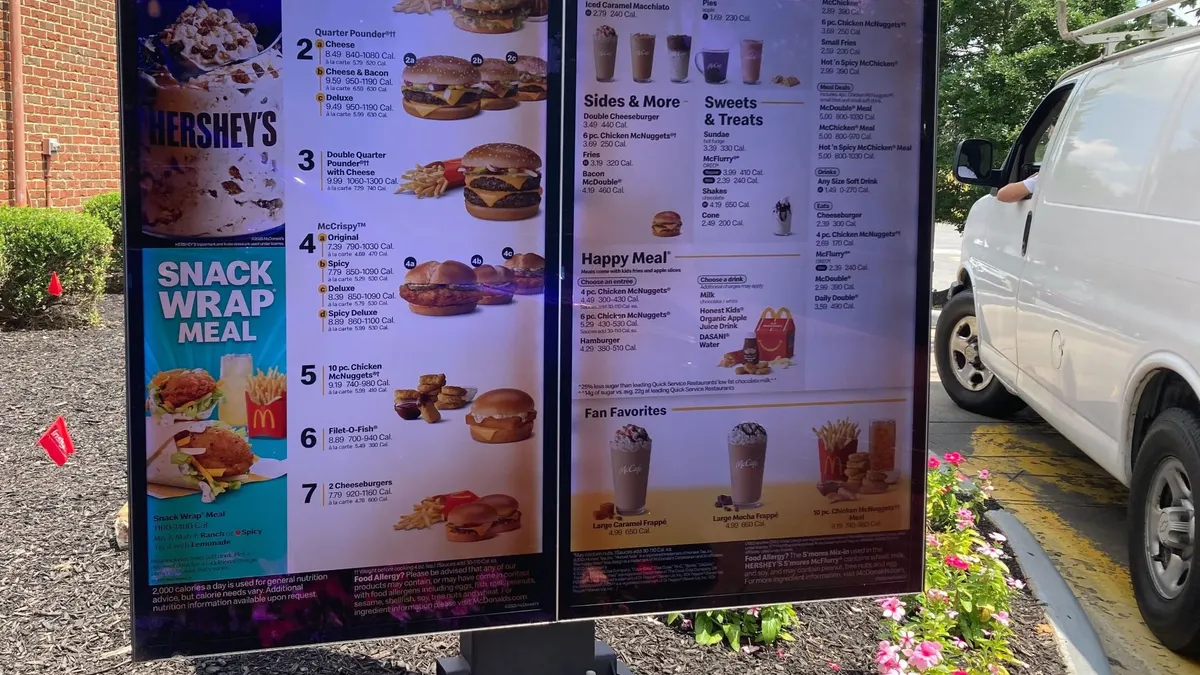
McDonald’s sunsetted its automated order-taking partnership with IBM in 2024 after analysts reported the technology wasn’t meeting expectations. The company later announced in June that it would once again test Google-powered drive-thru technology at five of its U.S. locations. It has since shared plans to deploy ArchIQ, an AI-powered restaurant operating system, that will support drive-thru voice AI, automated inventory tracking and connected equipment with computer vision.
The aspirations and promises of AI tools still outpace the actual execution, said Allen.
“We are still in the frontier phase of agentic applicability,” he said.
Restaurant executives cited other risks surrounding the implementation of AI.
Nearly half (48%) of restaurant executives are concerned about managing risk around AI technology, according to Deloitte’s survey of restaurant leaders that was conducted in Q4 2024. When asked further about AI implementation risks they faced, 20% of restaurant leaders cited intellectual property issues, and 16% cited misuse of client and customer data, the survey stated.
Restaurants face other risks, as well. The new and still improving early AI-powered tools have come with learning curves and bugs, oftentimes requiring humans to intervene, said Lu. As a result, many employees have become both frustrated about the extra labor and anxious that the tools will one day replace them, she said.
More than half (52%) of Americans reported being more concerned than excited about the increased use of AI in their daily life, according to a Pew Research Center poll conducted in June. A lot of those concerns were largely attributed to growing fears of future job losses, the report stated.
Anxieties over potential job displacement have translated to a loss of trust employees have for their employer and declining morale, as companies failed to communicate why they were implementing AI, said Lu.
And the loss of human touch and hospitality could also face pushback, as many consumers go to restaurants for a particular experience that includes interactions with employees, said Lu.
Investments in AI forging ahead
Despite the risks, restaurants aren’t running from AI technology. The challenge of selecting the right technologies and data limitations haven’t held restaurants back from integrating such tools, the Deloitte’s survey stated.
“That suggests the challenge may be less about willingness to invest and more about identifying the right use cases and scaling them responsibly,” said Evert Gruyaert, principal and the U.S. restaurants and food service leader at Deloitte.
Sixty-three percent of executives, according to the Deloitte survey, reported their restaurants use AI daily to support customer experience, while over one-quarter (26%) reported piloting or utilizing the limited implementation of such technologies. That includes digital ordering technology that provides personalization and recommendation capabilities, the report added.
Overall, roughly 80% of restaurant executives said they planned to increase their investments in AI during the next fiscal year as they anticipate the technology will improve the customer experience, yield smoother restaurant operations, and make loyalty programs more impactful, the Deloitte report stated.
The sentiment shows AI has been effective in handling narrow repetitive tasks, such as forecasting demand with food ordering or scheduling, which has improved speed and consistency, said Lu.
Those results have translated to optimism among restaurant leaders, as 60% cited enhanced customer experience as one of the top three benefits they hope to achieve through AI efforts, the report added. Many others said they hoped it would yield improved restaurant operations (36%) and better loyalty programs (31%) as one of the chief benefits.
“Some [restaurants] may see higher impact from creating personalized experiences and deeper connections with their diners,” said Gruyaert. “Others may get more impact from AI optimizing operations and streamlining inventories.”
Deploying the right AI tools
So far, the restaurant AI tools that have been effective and generated the least blowback have been demand forecasting and inventory management tools — areas that require large data processing and are challenged by human error, said Lu.
AI has also been effective when used to set worker schedules, she said. McDonald’s, for example, significantly reduced the amount of time it takes to build schedules using such a tool at a number of its international locations.
Restaurants should start small when adopting AI technology, said Allen, utilizing tools that will help improve operational functions, but are removed from the customer experience.
Pilot tests of new AI technology can be helpful and allow restaurant leaders to work with the challenges that they may encounter, Lu said. This is important since the tools should be used to help empower employees to do their work, not create more friction, she said.
“In theory, at the early stages of adoption, AI should be used to really reduce those frictions where humans struggle and smooth out the process,” said Lu.
That means taking note of how other leading brands fared when they started deploying different tools at their restaurants, so restaurant leaders know what to expect, Lu said. That can be achieved by reviewing available research and information about the different tools, she said.
Importantly, restaurant leaders need to be careful not to transition to AI tools faster than what the consumers and employees can accept, said Lu.
They should involve employees early on so they understand the restaurant’s needs and issues, and how exactly AI tools will help address them, Lu said.
Lastly, they should listen to their customers and employees about where AI can add value and where it may lead to a sense that there are too many cooks in the kitchen, said Gruyaert. Doing so could “help lay a positive foundation for continued, successful implementation,” he said.