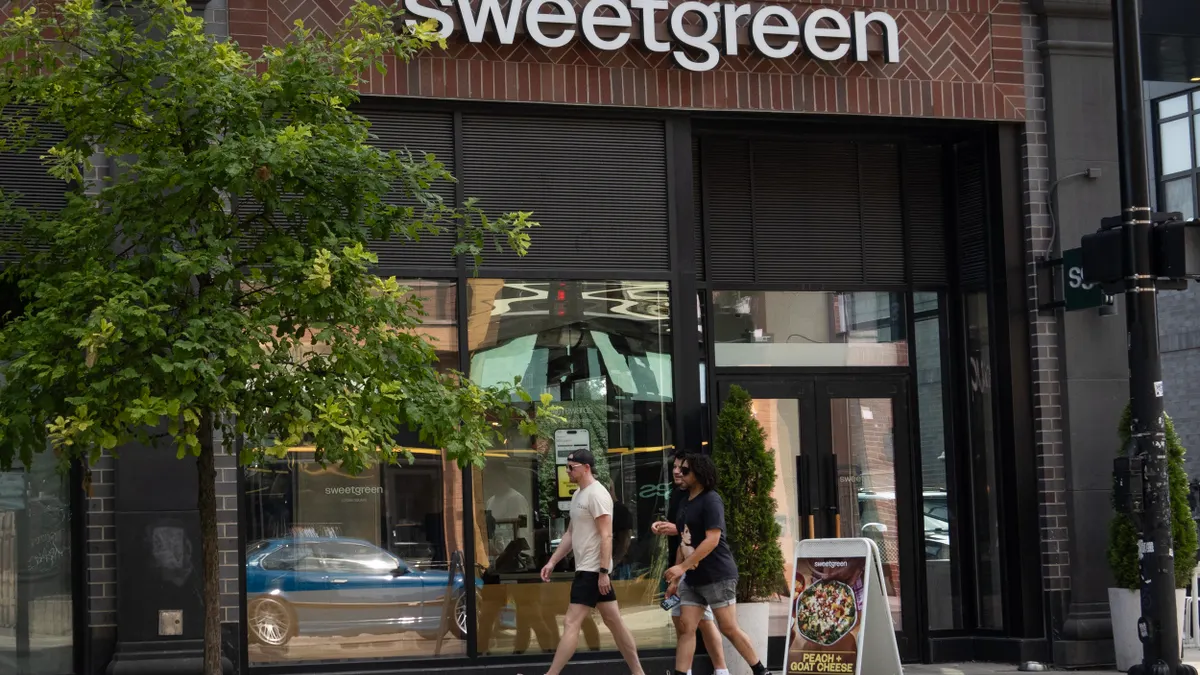

Sweetgreen aims to put human connections at the forefront of its brand, from how it trains employees in hospitality to emphasizing its food’s connection to farmers.
Technology can work in tandem with the human side of the business, according to co-founder and Chief Concept Officer Nicolas Jammet. The company started building its digital ordering app in 2011, and it introduced the Infinite Kitchen concept, restaurants which include an automated kitchen and digital ordering kiosks, in 2023.
“We build and invest in technology to support and elevate the food and support and elevate the people,” Jammet told CX Dive.
Sweetgreen’s Infinite Kitchen locations are designed to balance speed with the human touch. The company wants to offer customers a great experience whether they want to quickly order from a machine or prefer ordering with an employee at the counter — a balancing effort that is vital to the company’s turnaround strategy.
Sweetgreen is working to reverse its declining sales and traffic by focusing on experience and hospitality. The restaurant’s same-store sales dropped 12.8% year over year in the first quarter of 2026, according to an earnings report last month. Traffic fell 11.2% during the same period.
“The most important thing we are focused on right now is the fundamentals of delivering an excellent customer experience,” co-founder and CEO Jonathan Neman said on an earnings call last month.
The Infinite Kitchen concept and its kiosks could help Sweetgreen achieve its goals. The technology has evolved over time as the company learned from early implementations and worked to design a flexible experience that balances digital speed with the human touch.
The store model’s technology helps workers focus on customer service, according to a Sweetgreen spokesperson. “The Infinite Kitchen technology delivers faster throughput, improved order accuracy, and elevated food quality, all while creating a better experience for both guests and team members,” they said in an email.
Traffic flow matters in kiosk experiences
As Sweetgreen started opening its Infinite restaurants, the company found that a lot of customers loved the kiosks, but some didn’t.
Kiosks present the biggest challenge for first-time customers, according to Jammet. Regulars know the restaurant and its options, but on any given day a high percentage of customers will be visiting the chain for their first time.
“There's this kind of constructive pressure to make sure the retail design and the flow and the wayfinding are very clear,” Jammet said. “When a customer walks in, they see a kiosk, and obviously they know what that means. They can go up there. But how do we make the visual cue really obvious that, at all of our restaurants, you can order with a team member on a handheld tablet and up at the counter?”
Sweetgreen didn’t get it right immediately, according to Jammet. The first few Infinite Kitchen locations didn’t make it obvious enough that customers could choose between the kiosk and the counter, or that employees weren’t just there to work the frontline assembly.
“In our first couple of Infinite Kitchen restaurants, the kiosk was more front and center,” Jammet said. “Now we put them off a little bit more to the side. It's still very obvious and clear that you can go there, but we want to make the counter more of a focal point for ordering and for pickup.”
Keeping a human in the loop is critical even when customers prefer digital ordering options, according to Greg Carlucci, senior director analyst at Gartner. Even when an experience proves intuitive for most customers, the extra layer of support keeps operations smooth.
“Having the ability to speak to an actual person at that point in time when you're at the restaurant I think is a critical customer experience point, because consumers are still used to a lot of just the embedded cultural norms of just how experiences work,” Carlucci told CX Dive.
The restaurant has added more workers to welcome customers and improved signage as well, according to Jammet.
Even the training for Infinite Kitchen locations is slightly different, according to Jammet. In these locations, Sweetgreen puts an emphasis on having workers engage with customers, especially in stores where the share of new customers is high.
Flexible options serve different customers
Many people don’t want the same experience day after day.
Someone might be super busy on a Monday and want to make pickup or delivery as fast as possible, while on Thursday they have a bit more time, go out to lunch with a friend and want to take their time ordering, according to Jammet.
“There's so many different versions of the Sweetgreen experience,” Jammet said. “We wanted to make sure that we built that range of experiences that customers could select into based on their mood or preference, or just how they were feeling.”
Sometimes speed is key. At least 60% of Sweetgreen’s transactions are made off premise for pickup, according to Jammet.
Other times a bit of friction can be positive for the experience, according to Jammet. For some people, waiting a few minutes in line lets them take a break from their work and just breathe. The key is ensuring customers who want to get in and out immediately also have an option.
“For us, hospitality is creating the best experience in making people feel like they've been seen, heard and served, whether that means you want to just grab it off a shelf and walk out, or that means you want to have a whole conversation with one of our team members,” Jammet said.
There is space for restaurant experiences with limited or no human interaction, according to Carlucci. Customers who want that can use tools like digital kiosks without interrupting the experience for others who want to stay and chat with the person behind the counter.
“That allows consumers that are just seeking the experience for speed and convenience and nothing else to go in and out,” Carlucci said.
Sweetgreen aims to greet every customer within five seconds of entering a restaurant, according to Jammet. This is a simple acknowledgement that won’t slow down anyone who is just coming in to pick up an order, though the connections can run deeper when appropriate.
“We like to explain to our team members that hospitality is not always these big, grand experiences,” Jammet said. “We have moments where customers come in and you can tell they're having a bad day, and they engage in a much deeper way and have these really special one-on-one interactions. It could just be smiling at you when you're picking up your bowl off the shelf and saying, ‘Hey, welcome back.’”