Editor’s Note: This Q&A is part of a series of interviews with political figures in the restaurant industry about the issues facing brands, workers and operators in 2026. This is the second part of a two-part Q&A with the National Restaurant Association about its specific priorities.
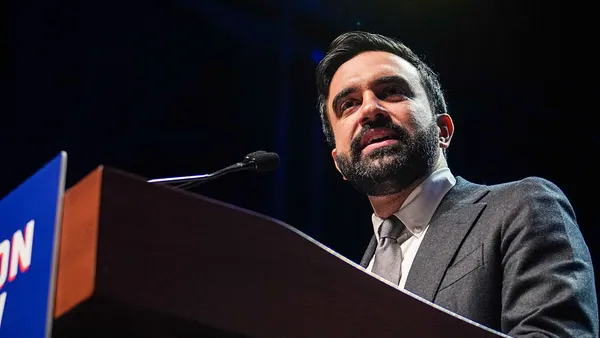
Labor regulation — immigration reform, the preservation of the tip credit, fights against sectoral wage setting — tends to dominate the headlines in restaurant politics, but there are other pressing political issues for eateries, according to Sean Kennedy, chief advocacy officer for the National Restaurant Association.
As consumer price sensitivity and energy input costs both climb, the NRA is looking for ways to constrain costs and prevent restaurants from succumbing to low margins.
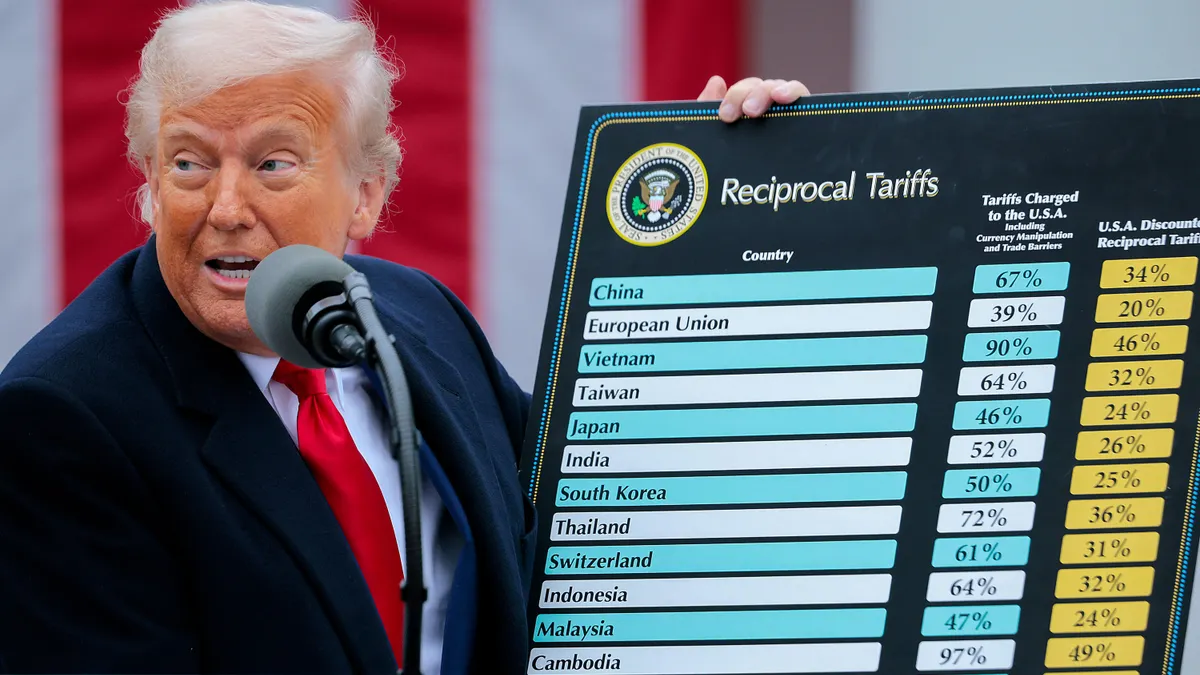
Tariffs, which drive up food costs, are one target, but so is the highly concentrated credit card processing industry. Other factors, like the Sysco-Restaurant Depot merger and third-party delivery, pose challenges for consumers, but may not require regulatory relief, Kennedy said.
Kennedy sat down with Restaurant Dive to discuss the NRA’s major political priorities in 2026. This piece, which focuses on regulatory matters that do not impact the workforce, is the second part of that two-part conversation.
Editor’s note: This Q&A has been edited for clarity and brevity.
RESTAURANT DIVE: Outside of labor issues, what are the biggest political issues facing restaurants right now, and what are the National Restaurant Association’s major priorities relating to those issues?
SEAN KENNEDY: The short-term priority is the U.S.-Mexico-Canada Agreement, which is up for reconsideration this July — USMCA is vital for the restaurant industry. We import an awful lot of produce and proteins from Canada and Mexico. These are items that we cannot produce at all in the United States, or we cannot produce at the right quantities, like tomatoes, avocados and coffee.
USMCA was negotiated by President Trump in his first term. We think it works very well. It allows for the free trade of goods between those three countries. It helps address the continued inflation that we see in food prices.
What we would like to see out of the administration is to “do no harm” and keep the free trade agreement in place, keep tariffs off the table, as it were, for trade between those countries, and keep our input costs down.
In the medium term: swipe fee reform.
I don't know that swipe fee reform is going to receive a floor vote in the Senate. But operators are still reporting that swipe fees are the third-highest cost that they're seeing, behind food and labor. Swipe fees have doubled over the past decade. They show no signs of going down.
U.S. consumers and U.S. small businesses pay the highest swipe fees of any country in the industrialized world. Why? Because in the U.S. there is a duopoly — Visa and Mastercard.
We are calling for common sense legislation that does not regulate credit card companies — we support open markets. The bill we support simply says banks with $10 billion in assets or more, have to offer a third payment network. It can't just be Visa or Mastercard.
Our goal — and we share this with a number of other businesses — is that if you add that third network you're going to start seeing Visa and Mastercard reduce their fees to stay competitive, and that provides benefits for consumers and restaurants alike.
Is the National Restaurant Association interested in more regulation of third-party delivery and other technological solutions that interpose between consumers and restaurants?
Third-party delivery wasn't really a thing until the pandemic, where it became a necessity. What we saw then was a nascent industry that went through growing pains, you had restaurants that didn't want to sell items online for third-party delivery, and you had some unscrupulous third-party delivery companies that would just scan a copy of the menu, post it on their website and say, “we will order it and we will deliver this dish to you.”
We engaged third-party platforms on basic principles like if a restaurant wants to not be in the third-party space, that should be their right, and if they say, “we do not want a company to buy our product and mark it up and ship it to someone's house,” restaurants should be allowed to do that.
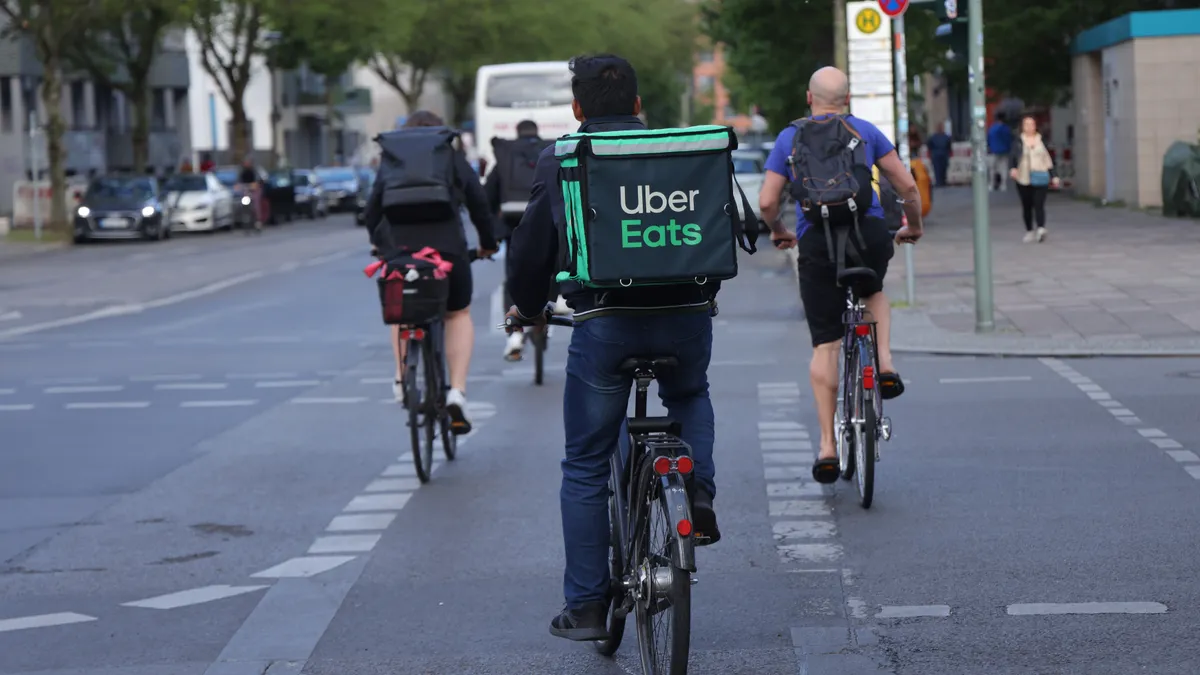
Fast forward to 2026, there are definitely pressure points for what the relationship is like between third-party platform providers and restaurants. You have drivers coming in before a dish is ready and clogging up the area. So how do we improve communication? And how do those delivery drivers know to stay in their car or moped. That's low-hanging fruit.
Mid-hanging fruit would be as customer data comes in, how is it organized? Is there anything that prevents someone from every week ordering from the same restaurant and then saying “I ordered salsa, the salsa didn't come in, I want a refund.”
Some of the larger pressure points are how refunds are given. What should the trigger be for a refund? Should a restaurant be allowed to try to fix a problem if a customer has a concern, or is it automatic that they have to give a full refund?
Third-party delivery is not going anywhere. The younger generations were raised with it, they're going to continue using it, and they're going to be the prime customers five years and 10 years from now. So we know it's not going anywhere.
We are seeing a maturation of the major providers like DoorDash and Uber Eats and Grubhub under Wonder.
The issues that we were dealing with five years ago we were able to address without regulation. Let's see which ones we can do before we start looking at regulation.
So it's not yet the time to pursue regulation?
Correct. But that's not to say that there aren't genuine concerns among operators about what the future is for third-party delivery.
The Credit Card Competition Act would require major banks to offer a third payment processing option. Is that the ideal outcome? How has the political landscape regarding the possible passage of that bill changed in the last year?
Progress is measured in feet, not yards, on that issue. We are always going to be heavily outspent by the banks. The banks have no shortage of outrage and fear mongering and money that they can throw at the problem.
We have seen continued interest from the left wing of the Democratic Party and the right wing of the Republican Party agreeing that the status quo is unsustainable. Probably the biggest part of that would be Donald Trump himself endorsing the CCCA earlier this year.
What we are equally excited about is how much progress has been made at the state level on legislation that would ban swipe fees for small businesses that collect sales tax. If you buy a meal in Washington, D.C., or in Maryland or Virginia, you pay a sales tax. That's money that I, as the restaurant owner, collect as sales tax and immediately remit to the local government. The fact that I have to pay the banks for the privilege of being a tax collector for the state is rich.
A very common sense solution should be that restaurants and small businesses do not have to pay swipe fees on money that's going to the state that doesn't go into their bank account.
Similarly, if you want to give a server a gratuity for a great service, restaurants are serving as a pass through. You saw legislation that passed in Illinois. It was immediately challenged by the banks; a district court ruled in favor of the Illinois legislature, and said they did have the statutory authority to pass legislation on this. It was not preempted by the federal government. It was appealed to a circuit court within minutes by the large banks. The Restaurant Law Center, which is part of the National Restaurant Association, filed an amicus brief in support of the lower court decision. But what we're excited about on this is it shows that the bank's grip on legislatures isn't infinite.
You're seeing legislation move in Delaware, Colorado, Pennsylvania and Rhode Island. This shows that it's not a complete lock. The National Restaurant Association is sending our policy leads to testify in those states. What I'm hoping is that the passage of that brings people to take a closer look at why the U.S. has the highest swipe fees in the industrialized world.
And what are some of the smaller ideas from policymakers that you're excited about or dreading?
Let's ensure that privacy legislation is still written in a way that allows us to have apps that remember what your favorite dishes are, that remember how frequently you've come to our restaurant, and that we can offer you a discount as a loyal diner in the future.
We still have tariffs right now on European spirits and wine. That 3.8% profit margin for restaurants that serve alcohol, that is an absolute lifeline. They are not making money on the salads.They're not making money on the dessert. They are making money on wine and spirits. When we still see tariffs on European wine and spirits that has an immediate impact on the bottom line.
How does the National Restaurant Association feel about the impending Sysco merger and other forms of consolidation within the supply chain? Does this pose a problem for restaurants?
I don't know if it poses a problem. We know restaurants need a steady supply chain and steady access to quality produce and proteins.
Restaurant Depot seems to be more able to fill a niche for folks. We don't see many people that are relying solely on Restaurant Depot. It seems more like it's a quick stop in between. If Sysco’s acquisition of Restaurant Depot means that Restaurant Depot has access to Sysco’s supply chain that could result in expansion of Restaurant Depots into more communities.
We don't have alarm bells that are ringing with our membership.
There are a couple of firms that own a huge percentage of the restaurant industry, even relative to a few years ago. Does this pose a competitive problem for small operators when individual firms or investment groups control tens of thousands of restaurant units?
It absolutely raises challenges, and it raises challenges on access to capital. It raises challenges on access to supply chains. But at the end of the day, you still see restaurant customers looking for that innovation, that diversity, and they want to see the new restaurants that come out.
So you think about James Beard Awards and Michelin stars, or just an innovative pizza place that opens in a neighborhood, there is still that opportunity to make that investment and move in. That tension that you raise on the growth of private equity or special purpose acquisition companies (SPACs) or larger brands, is why we still need to continue to have a policy environment and an economic environment where a chef can say that she's gonna give it all she's got. She's gonna quit her day job and try doing this permanently.
We need to have that business environment, and that policy environment, where she can make that investment, and there's a darn good chance that if she's got the right business model, the right menu in the right neighborhood, that she can create an enduring, lasting restaurant
And that depends on things like loosening up the labor market or reducing swipe fees?
Exactly. But again we represent everybody, so we are very mindful of that, and we hear from our smaller members about the challenges that they face and that's why, again, it's finding those basic core issues, that say I can compete. I've got a better product than the larger guys, and we're rooting for all of them.
What does a pro restaurant outcome look like for the 2026 elections? And how is the NRA moving toward that?
One of the biggest misnomers is it needs to be this candidate or this party or this platform that prevails after the elections. What I've learned during my 30 years working on the Hill or in the private sector is not to rely on any one member or any one political party to advance the restaurant industry.
There are members of Congress that we are diametrically opposed to on some of our priorities, and they are some of our biggest champions on others, and vice versa.
We've seen that there are policy priorities that Republicans aren't pushing. We have ones that Democrats necessarily aren't pushing. What we want is to see an agenda from both parties that reflects the importance of small business, the importance of creating a lasting workforce that every business on Main Street can tap into, and to have a regulatory and tax model that keeps government afloat, but also recognizes the unique challenges that some businesses like ours face.
The Trump administration's policies have been inconsistent ranging from recognizable business Republicanism to erratic tariffs. Does this administration pose a unique challenge for trade associations that are looking to obtain specific policy outcomes?
It is not challenging; it has required a revamp of how you approach advocacy. What you saw during the George W. Bush, Bill Clinton, Joe Biden and Barack Obama administrations was a bottom-up approach.
What you have seen from the Trump administration is there's a lot of unique top-down initiation of ideas and policy directives. Like the rest of the world, we hit reload on our social media pages frequently to see what the latest is.
We have very good connections with members of Congress and the executive branch, and it's no different than a Trump administration. We are constantly not taking anything for granted. Yeah, we are constantly reminding Capitol Hill and the administration that we're the nation's second largest private sector employer, that we have the lowest profit margin of any business on Main Street, and that any idle idea — good, bad or indifferent — can have an outsized impact on us.
If President Trump, or the administration offers an idea, we can very quickly vet it with our membership and put forward a rapid response that says, “This is a great idea” or “We are neutral,” or “This is something we really want to engage with you on.”