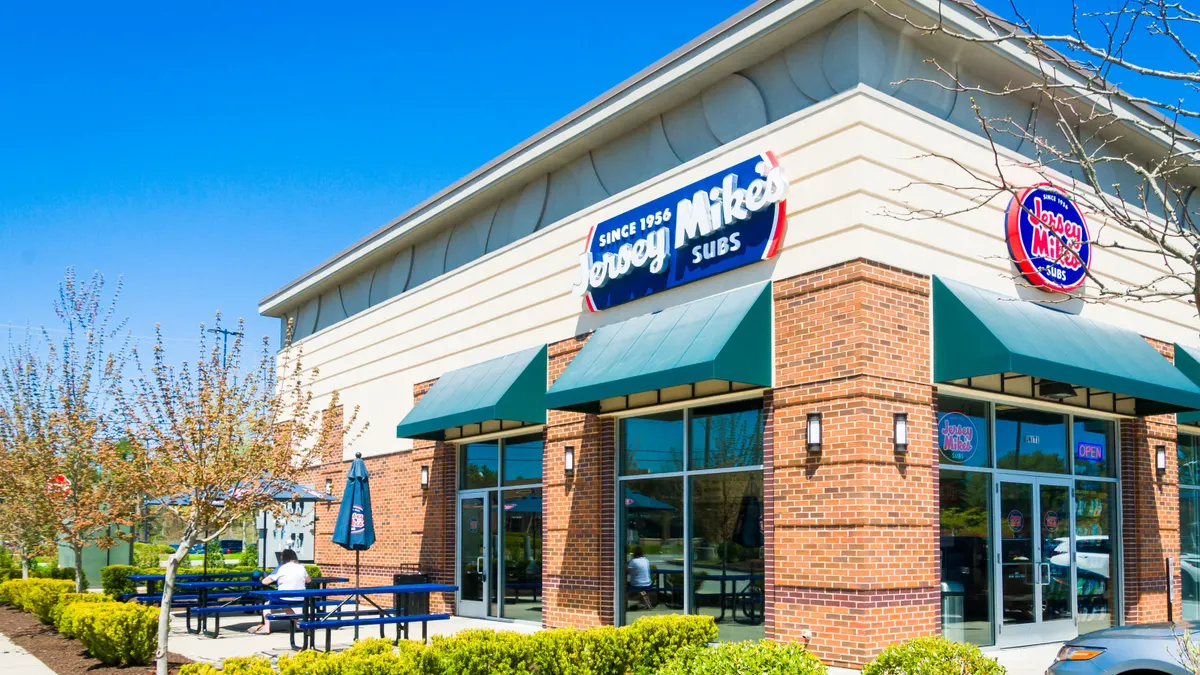
Jersey Mike’s plan to go public reflects more than just the sub sandwich chain’s rapid growth — it’s a signal that IPO activity is coming back to life.
The last time the IPO market was hot for restaurant chains was in 2021 when sales and profits were on the rise coming out of the COVID-19 pandemic. That year, Portillo’s, Sweetgreen, Dutch Bros, Krispy Kreme and First Watch went public.
Fast forward to the present, and industry experts are tracing renewed investor confidence in restaurants to Black Rock Coffee’s IPO last year, which raised nearly $300 million.
“The successful IPO of Black Rock Coffee last September demonstrated robust investor hunger for growth-oriented restaurant chains,” said Jerrold Bregman, a partner of the California-based BG Law. “It is probably no coincidence that Jersey Mike’s — backed by the deep pockets of Blackstone — has also recently thrown its hat into the IPO ring.”
Inspire Brands, which owns rival sandwich chain Arby’s and Dunkin’, also signaled interest in going public earlier this year.
“[Jersey Mike’s and Inspire Brands] are quality companies. They have great models. They have great experience,” said Mark Davis, CEO of Black Rock Coffee. “I think there’s a value proposition there that works really, really well and there’s a history of return that works.”
After joining the public markets, Black Rock Coffee maintained its same-stores sales momentum and unit growth, and Davis expects to open at least 36 restaurants this year. Jersey Mike’s seems poised for a similar path — the brand has posted steady year-over-year growth in sales, average unit volumes and unit count.
“A good restaurant IPO is one that has a good and effective roll out experience and strategy,” said Michael Halloran, lead corporate and securities partner at Halloran Farkas + Kittila. “Expansion followed by fairly immediate new store profitability leads to a higher multiple.”
Investor interest in restaurants regains steam
Restaurant IPOs come in “spurts,” Halloran said, usually on and off every two to three years. Fast casual chains appear to be favored by investors, meaning Jersey Mike’s could be highly desired.
“IPO candidates have two important choices for liquidity: a buyout by a private equity fund or another restaurant chain or an IPO,” Halloran said. “When the prices achieved through an IPO exceed what private equity and industry buyers are willing to pay, the IPO alternative is taken.”
Investor appetite for IPOs is growing not just for restaurants, but across multiple industries, especially with excitement over SpaceX’s public offering, experts said.
“It’s a great time now because the capital markets are active,” Bregman said. “There’s money that is on the sidelines and available.”
Restaurants typically have steady cash flow but also accrue a lot of debt, which can be rolled off by raising money through an IPO, Halloran said. Other companies, like SpaceX, typically rely on big contracts and business can be more unsteady compared to restaurants, he added.
Companies also are waiting longer before they go public. Decades ago, companies would wait as little as five years, but now they are waiting over nine years to go public, Halloran said. The time delay can help create stronger, more established companies that can handle a move to the public markets that typically comes with additional pressures over performance metrics.
“The market is more rigid now about expectations and delivery of expectations,” Davis said. “If you’re going to be a public company, I think you’ve got to deliver and you have to be able to do it for a long time.”
Pros of going public
Sometimes an IPO doesn’t lead to a company going public, as a private equity firm could come in after looking at financials and offer a higher price than what would be gained during an IPO, Halloran said. Fogo de Chão, for example, shared its intentions of going public in 2021, but was later acquired by Bain Capital in 2023, which kept Fogo private.
Even after an IPO, companies have the ability to file a secondary offering of equity and possibly debt or convertible debt to raise money for expansion with good germs on that money, Halloran said.
“The public market gives you ready access to file an S-3 and raise more money for expansion,” Halloran said, who added that this isn’t just liquidity for present investors but also an ability to offer stock options for employees, which could boost worker retention.
A successful IPO could help Inspire’s owner, Roark Capital Group, pay down some $3 billion in debt that Inspire used to acquire Dunkin’ and Baskin-Robbin’s in 2020 for $11.3 billion, Bregman said.
“The positioning of the IPO, which could unleash some $2 billion in fresh capital, stands as a resounding testament to the success of that transformative 2020 acquisition,” Bregman said. “Lightening that debt burden will free up cash flow on a going-forward basis, positioning the company for continued expansion, bold new ventures and sustained growth.”
Risks of going public
While going public can provide much needed capital, it also comes with risks, especially since finances become completely transparent. Activist investors have taken aim at different restaurant chains in recent quarters, including Cracker Barrel and Wendy’s.
But experts say there is plenty that a company can do to minimize attention from activists.
The best protection for management is to run the business well and be transparent about its decisions, experts said. Strong finances, particularly year-over-year returns on ROI and revenue increases, is one of the best defenses, Halloran said.
“You have to have a model that works for the public markets,” Davis said. “It’s really important to do what you say you’re going to do. I would say that is probably the number one rule. … I think where you get into trouble is where you chase trends or you try to be something you’re not to manipulate the stock price for lack of a better term.”
Management also should take into consideration different opinions and advice from minority shareholders.
“Companies often get terrific ideas from minority or activist shareholders,” Bregman said. “It becomes problematic when … management isn’t responsive and they’re not getting the job done and they’re not listening to minority shareholders.”
Public companies should have good quality controls in place related to outbreaks, which Chipotle learned the hard way in past years with outbreaks of eColi, norovirus and salmonella, Halloran said. Company policies should include good hiring practices to avoid disruption from increased immigration enforcement.
Part of what has made Black Rock sales and traffic has been its hiring practices.
“One of our greatest strengths, again, is we have a large applicant pool that wants to be with us,” Davis said. “And I think when you get that great retention and great experience, it in turn drives those great sales.”
Hiring the right people, providing good products and offering a good experience for customers at its stores, within its app, through third-party delivery, and at its drive-thru, “it works out great,” he said.
“We’ll continue to grow units at 20%,” Davis said. “We’ll grow our EBITDA at least 20%, and those things work out great as a public company,” Davis said.
Impact of Jersey Mike’s IPO
Jersey Mike’s has the management in place and strong financials that could help it become successful as a public company. It also has a strong growth story, with 3,300 units open and a domestic pipeline of more than 1,600 stores, per its S-1 filing.
The company plans to have 300 restaurants in Canada by 2034 and another 400 in the U.K. and Ireland, which Halloran said is “good stuff.”
The fast casual chain is valued at about $12 billion, which Halloran said is 387 times higher than its 2025 revenue of $310 million and 65 times its net income.
Same-store visits have grown during the first four months of the year and been relatively stable since May 2025, according to Placer.ai data. Monthly visits, in particular, have remained in the high single digits, a success in itself as other fast casual chains have struggled with traffic growth over the past few quarters.
“Jersey Mike’s growth story is about more than rapid expansion,” Ezra Carmel, content writer at Placer.ai, wrote in a June report. “The data suggests the chain is pairing disciplined real estate growth with widening mainstream appeal — a combination that could support both its potential IPO ambitions and its continued dominance in the sub sandwich space.”
Impact of Inspire Brands’ IPO
If Inspire Brands does land its anticipated $20 billion valuation, it could be one of the largest IPOs in recent restaurant history, Bregman said. This valuation would catapult Inspire to “the rarefied stratosphere occupied by gastronomic titans like Restaurant Brands International, and even the twin colossi of fast-food royalty: McDonald's and Starbucks,” he added.
“Given the colossal scale of this offering, the success of Inspire Brands’ IPO is poised to send powerful market signals — and perhaps even serve as a beacon of inspiration — for other fast-growth, private-equity-backed consumer-facing companies eyeing the public markets as a path to liquidity.”’
Inspire Brands’ $34 billion in annual revenue will likely “whet investors’ appetites,” Bregman said. The company has a highly integrated franchised system with over 2,700 operators, which creates a predictable cash flow that “makes portfolio managers salivate.”
“Though I don’t have crystal ball, and our firm does not represent any of the participants in connection with Inspire Brands’ contemplated IPO, I would say this much with confidence: Inspire Brands’ announced IPO is a resounding net positive for the industry and for investors alike, even if it is likely to only ratchet up the competitive pressure on your neighborhood mom-and-pop eatery,” Bregman said.
Correction: A previous version of this article incorrectly listed data relate to Jersey Mike’s same-store and monthly visits. The article has been updated.