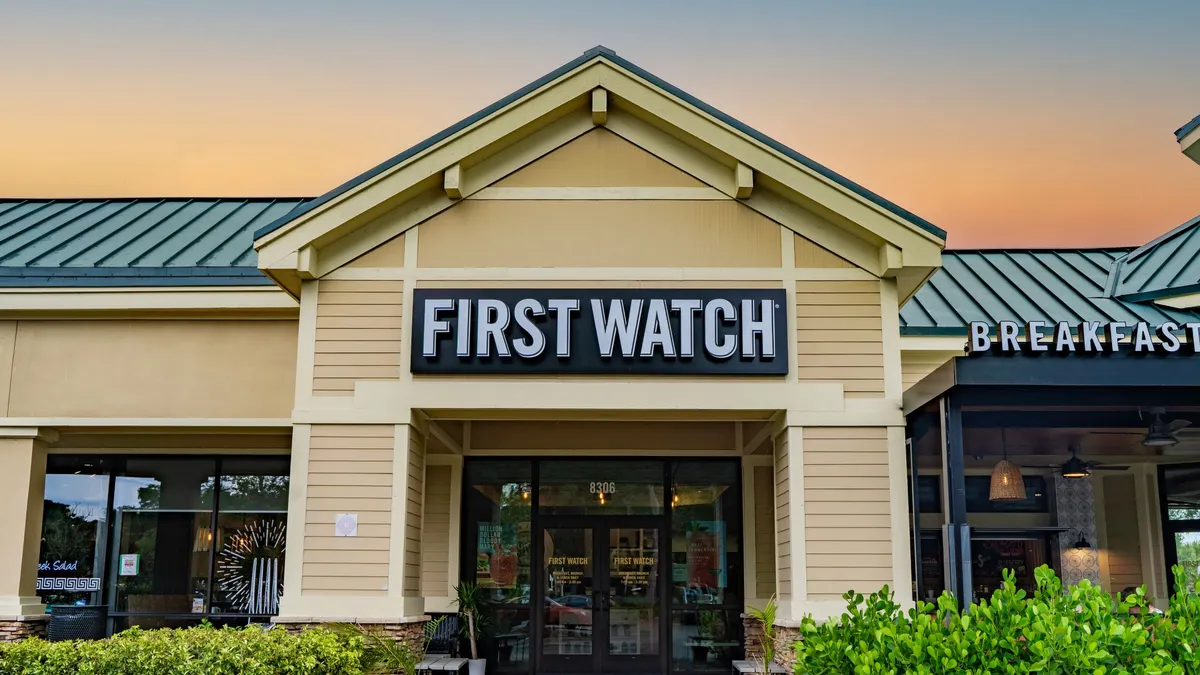
For the past few years, First Watch has been on a growth tear. Not only is the breakfast chain opening restaurants at a rapid pace, but it also has posted same-store sales gains over the past six consecutive quarters.
A key ingredient to this momentum is the chain’s willingness to spend and experiment in areas that lead to profitable growth.
Since joining First Watch in 2023, Ashlee Weisser quickly learned how this balance plays into the chain’s overall success. After her promotion to CFO in June, this has become even more of a focus, especially as the chain ramps up its marketing spending to build brand awareness.
Weisser is also juggling the brand’s development and menu innovation costs, which can grow sales and traffic.
During the second quarter, First Watch increased its same-store sales by 3.4% and revenue grew 12.2%, according to the earnings release. Traffic fell by 0.4% during the quarter, but sequentially improved. In June, it increased year over year, First Watch CEO and President Chris Tomasso said during an earnings call last week.
“We want to provide value to the customer, but we also have to provide value to the shareholders and the teams,” Weisser said in an interview. “That balance between how much you charge for something or how much you spend to get something is a fine line.”
Collaboration between teams has helped First Watch walk this tightrope.
“There isn't just one voice at the table,” Weisser said. “So finance isn't coming in and saying ‘no, you absolutely cannot spend that money.’ It truly is a partnership in understanding what's important and what's going to drive the business forward.”
Increased marketing costs
Marketing has been a huge conversation at the chain, and has been a growing expense in 2025 and 2026, compared to prior years, Weisser said. But the additional expense has already led to improvements.
“Since implementing an expanded marketing strategy early last year, brand awareness has been building, and we believe contributing to our improved same restaurant traffic trend and overall same restaurant sales growth,” Tomasso said. “Our marketing objectives are focused on driving at least one more visit from existing customers, while also positioning First Watch squarely in the consideration set for new customers.”
Seventeen percent of new customers returned for their second visit this year, which is tracking to be higher than average, Tomasso added.
First Watch is using targeted, data-informed marketing tactics “to reach consumers where they are, speak to them with greater relevance, and evaluate the return on that spend with more precision than traditional broad-based marketing alone,” he said.
The chain is measuring the success of its marketing efforts, ensuring that spend not only drives traffic and return-on-investment, but also improves brand awareness, creates buzz and leads to positive feedback, Weisser said.
The chain is also building up its branding through use of video platforms like YouTube and connected TV, which allow it to reach specific demographics within markets and tailor messaging at a local level. The chain is also enhancing its influencer and social media tactics.
“Utilizing this test, learn and act model, we have a richness of data to analyze, allowing us to evaluate the performance of each tactic. With this knowledge, we're able to shift dollars toward the channels, markets, and messages that are demonstrating the highest levels of performance,” Tomasso said.
First Watch already ranks among the top tier of customer favorites, and has a high intent for future purchases compared to national and regional breakfast competitors, Tomasso said.
“These results demonstrate that our marketing investments are not only increasing awareness of the First Watch brand, but also strengthening occasion consideration and supporting conversion of potential customers into regular customers,” Tomasso said. “We're encouraged by the performance, as indicated by unaided brand awareness increasing more than 50% and aided brand awareness increasing 15% since early last year.”
The company is testing another marketing initiative, but neither executive shared details.
Premium menu item lifts food costs
First Watch’s seasonal menus can increase costs because they add new ingredients to the menu. Such was the case with its summer menu, which includes a Chipotle Steak and Queso Hash that Tomasso said will be the second best-selling, limited-time offer once the menu concludes in mid-August.
However, the additional beef costs were higher than expected, thanks to higher-than-anticipated demand, which ballooned costs by 100 basis points year over year, Weisser said.
“We tested a year in advance and, coming into this LTO, we knew exactly how much the steak was going to cost us, because we had it contracted, so we weren’t surprised on the cost per pound,” Weisser said. “When we test an item and then we roll it out nationally, it behaves very similarly, shockingly so sometimes. This time we were very surprised. It performed better than we thought.”
She added that this could be related to growing interest in high-protein menu items. The LTO also received attention on social media, and the chain’s marketing also focused on the item, which helped, she added.
“It did temporarily drive our food costs a little bit higher than we anticipated, and once that LTO rolls off, we expect it to look a little bit more normal,” Weisser said.
Development costs
The company expects to incur capital expenditures of $145 million to $150 million, most of which is related to new restaurant projects and remodels, per the release. The chain will open 53 or 54 new company-owned units and nine or 10 franchised-owned restaurants this year.
First Watch opened 18 new systemwide restaurants across 15 states in the last quarter, and has over 100 projects in various stages of development, Tomasso said, adding that the company still has a significant runway to eventually reach 2,200 units nationwide. It currently has 665 systemwide restaurants, according to the earnings release.
“The sale volumes of our 2025 and 2026 restaurant classes continue to outperform both the comp restaurant base and, importantly, their underwriting targets,” Tomasso said.
Weisser said the chain is aiming for 50 new company-owned units annually, as part of a new development goal. That number was determined after modeling different development paces from a cash flow, EBITDA and overall business perspective.
“I am incredibly excited about the opportunities ahead. We have a differentiated brand, attractive unit economics, a substantial runway for growth and a team that consistently delivers results,” Weisser said during the earnings call.