
Restaurant marketers have spent years mastering email — subject line testing, send-time optimization and segmentation. But there's a widening gap between the effort email requires and the results it delivers. Open rates hover around 20-25%. Click-through rates land at 2-3%. And competition for attention in an inbox gets more intense every year.
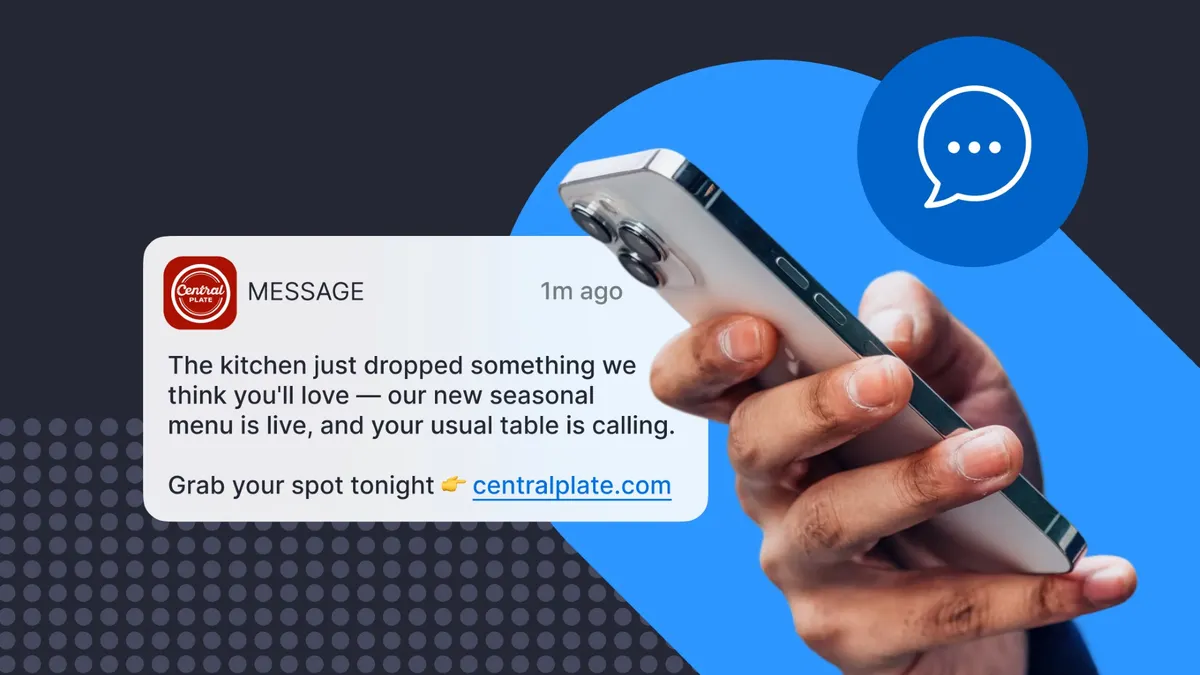
SMS doesn't have that problem. Text messages are opened at a 98% clip, with response rates running 21-35%. Olo data shows guests who opt in to SMS visit more often and spend more per visit than those who don't (46% more frequent and 4% higher AOV, driving a 69% higher guest lifetime value).
Some restaurant brands shy away from SMS because of the per-message cost — but it's one of the most valuable tools restaurant marketers have to reach guests where they're paying attention. The programs that actually move the needle are built on automation — messages triggered by guest behavior that run continuously without ongoing manual effort.
This is where the per-message cost pays for itself: not by broadcasting to your full list, but by reaching the right guest at the right moment with something relevant to what they just did. A guest completes an order and a follow-up lands within minutes. A loyalty member edges close to a reward and gets a nudge. A guest goes 60 days without returning and a re-engagement message goes out automatically.
Here are four smart ways restaurant brands are putting SMS to work — beyond the coupon blast.
Capture post-visit thoughts while your brand is top-of-mind
The post-visit window is one of the highest-value windows available to restaurant marketers. Guests are still thinking about the experience, which makes it the right moment to ask for feedback, surface a reason to return or drop a surprise reward. Post-visit surveys sent via SMS consistently outperform email, in some cases by more than 90% on completion rates (with higher guest satisfaction, too).
Example: "Have 30 seconds to tell us how you did? We'll drop a surprise for you on your next visit."
Turn regulars into loyalty members
Loyalty members are another natural fit. They've already opted in and shown they want to hear from you. SMS works well for reward alerts, expiring points reminders, and converting repeat visitors who haven't yet enrolled. Guests who've returned twice are strong loyalty candidates; a well-timed text can close that gap before the habit breaks.
Example: "You're basically a regular! Start earning on every visit."
Reach guests when the timing is right
SMS is a natural fit for catering and new menu launches, where timing and awareness are everything. A guest who ordered catering six months ago may be planning something new — but won't think to check your menu unless something prompts them. The same goes for new menu items: a guest who orders regularly but hasn't tried your latest additions isn't uninterested; they just haven't been pointed in that direction. A well-timed text can reach a guest at exactly the moment they're thinking about their next meal or planning an event, prompting them to act.
Example: "This season, make your gatherings festive and flavorful. Check out our holiday catering menu."
What email sets up, SMS finishes
Email and SMS do different jobs, and understanding that distinction is what makes both channels more effective. Email handles broad awareness — launching an LTO, telling the story, reaching the full list. It builds anticipation. SMS then does the job email can't: creating the urgency that gets guests through the door on a specific day.
Used together, they cover the full funnel. A guest sees the email and gets interested. The SMS arrives a few days later with a time-sensitive offer and a direct link to order. Each channel does what it does best, and neither is doing the other's job.
Example: "Looking for dinner plans? Try our new family meals tonight and get 10% off."
Restaurant brands that get the most from SMS aren't treating it as a broadcast tool. They're using it to close the deal — a precision channel tied to guest behavior, targeted by visit history, and paired with email to cover the full funnel. As guests spend more time on their phones and less time in their inboxes, the brands that show up in the right place with the right message will be the ones that earn the next visit. SMS is one of the most direct paths to get there.