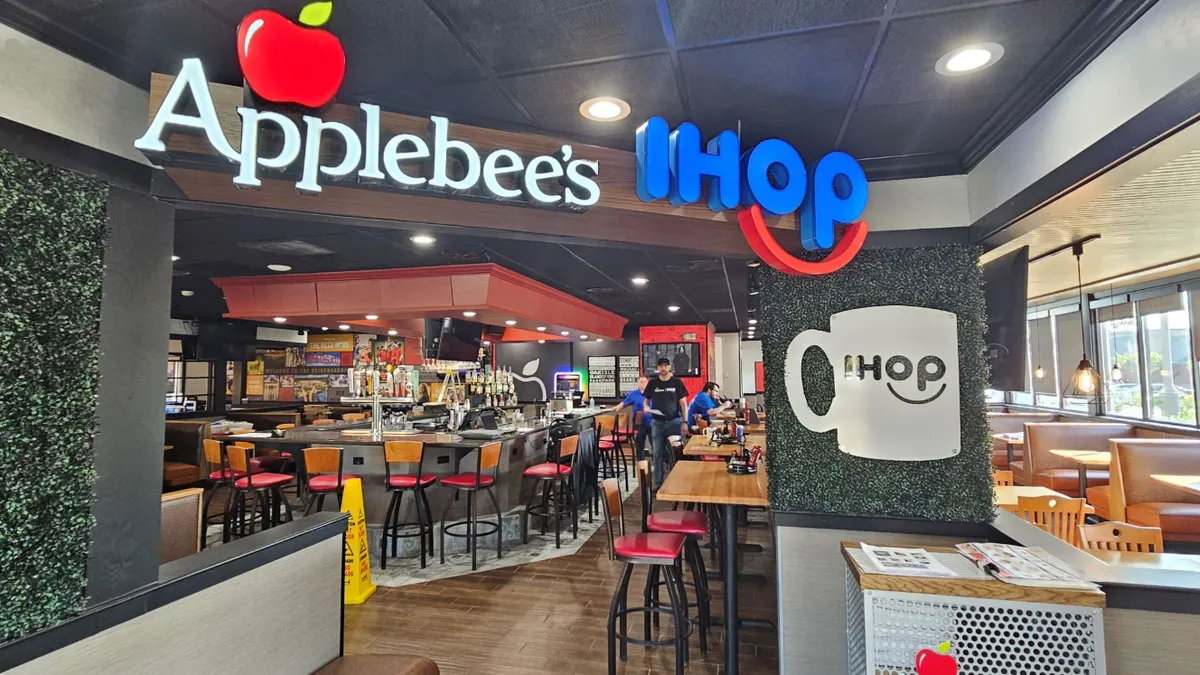
Dine Brands has a novel way to keep struggling restaurants open: add another concept to a single-branded restaurant.
The chain has been deploying dual-branded Applebee’s and IHOP restaurants since last year, and has now reached 45 units in the U.S., including seven company-owned locations, with 12 more under construction.
Some restaurants close because they don’t generate enough revenue, but adding another brand can make it a more viable location, CEO John Peyton said.
During the second quarter, Applebee’s and IHOP had 13 new restaurant openings and 30 restaurant closures. This activity also included nine net dual-brand openings, according to an earnings release.
Peyton said closures aren’t related to industrywide trends.
“We've got restaurants that are 20, 30, even 40 years old. Landlords change, markets change, leases change, and so it's all part of the normal course of business,” Peyton said. “For a system our size, one can expect up to 2% a year of restaurant closures, and that's where we are and where we've been.”
Dine Brands reported mixed sales performance during the second quarter, with Applebee’s year-over-year comparable sales down by 1.8% while IHOP’s U.S. same-store sales increased 1.5%, according to an earnings release.
Dual brands boost sales, revenue
Dine Brands plans to have 80 co-branded IHOP/Applebee’s by the end of this year and is already seeing a significant sales uptick from the conversions.
“We’re very pleased that this 2x revenue is settling in and repeatable now that we’ve got 45 restaurants,” Peyton said.
The cost to convert a single restaurant into a dual-branded unit is about $1 million, and guest feedback has been positive, he added.
About two out of three guests order from both elements of the menu. In the morning, there might be omelets and ribs at the table, while in the evening there could be skillets and pancakes, Peyton said.
“Our focus going forward is now fine-tuning the operational model, looking at making the kitchen more efficient, making the labor more efficient and doing the next generation of the menu,” Peyton said.
During the quarter, a dual-branded restaurant opened in Los Angeles, providing a proof point that this type of restaurant can work in larger urban markets. That restaurant has already seen sales double, he said.
Peyton said there isn’t yet enough data to show if opening a dual-branded restaurant works better in urban, suburban or rural markets. Dine also doesn't yet know if a smaller or larger revenue restaurant is better to convert, but the company is analyzing these questions.
“As of now, the restaurants that have opened across all different store types are performing within a fairly narrow band,” he said.
Franchisee interest has also grown as more of these restaurants go live, Peyton said. About 12 franchisees participated in the first rounds of dual branding, and more franchisees are signing up, he added.
“After 45 [units], we're starting to see real results, and it's unlocking other franchisees who just took a more cautious approach and wanted to see what the operating restaurants looked like,” Peyton said.
Despite adding another brand to a restaurant, marketing remains much the same; each individual brand follows the national marketing and product release schedule of the overall brand, Peyton said. If Applebee’s has a promotion like Two for $25 with Cheeseburger Wonton Tacos, the Applebee’s within the dual-branded restaurant will advertise it, just like a single-branded location.
For local advertising, there may be digital and social media or local campaigns to support new dual-branded locations, he added. Dine will work with local marketing and PR teams to get the word out as each restaurant opens to excite local media, business leaders and elected officials to create more buzz.
Remodels also raise revenue
Another way Dine Brands is boosting sales and revenue is through single-brand remodels. It is currently in the midst of remodeling Applebee’s restaurants through its Lookin’ Good program. The program refreshes various exterior elements, including the tower, the lighting, iconography and landscaping, Peyton said. Internally, restaurants get new wall coverings, art and lights, as well as new chairs, tables, upholstery and a new floor and a refreshed bar.
“The guests love it,” Peyton said. “We’re getting great feedback from guests and we’re seeing an increase on average of about 5% in sales after a restaurant renovates. We’re also seeing a great response from team members who work in the restaurants who feel great about working in a new, fresh environment that’s been invested [in] and nurtured.”
Peyton said Dine expects to have about a third of its Applebee’s restaurants refresh by the end of the year. Within two years, it will get to 80% of the system.
IHOP is also planning to refresh its restaurants, but teams are in early design phases and working with franchisees to create a model, Peyton said. There currently aren’t any agreed upon packages or due dates.
“Taken together, dual brands and investing in the physical restaurant experience matter and the early results validate that conviction,” Peyton said during an earnings call.