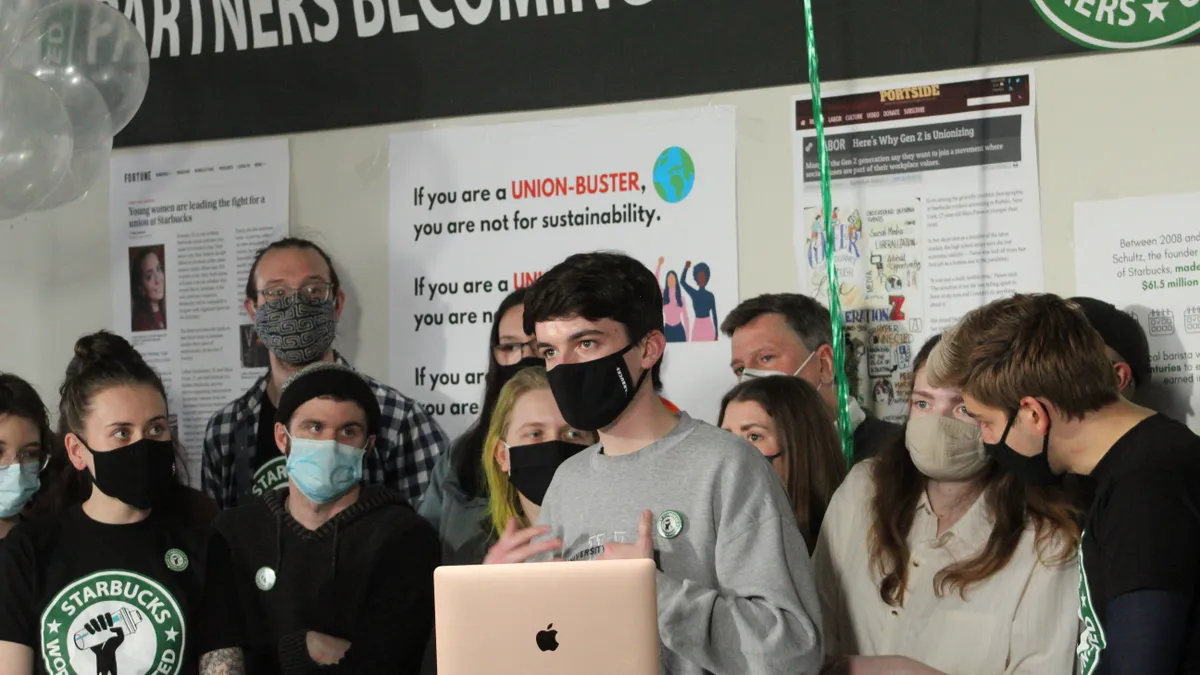
On Dec. 9, 2021, Starbucks Workers United did something that had long been almost impossible. The group, then composed of union salts, shopfloor leaders and volunteer organizers, won two National Labor Relations Board elections at a national fast food brand. They have since managed to repeat this feat about 600 times, while similar efforts at Chipotle and Dunkin’ largely failed to capture similar momentum.
Four years later, Starbucks Workers United is trying once more to do the impossible. This time, the union is looking to push Starbucks to sign a contract, through an indefinite strike at more than 140 stores.
Four years on, the union drive is stronger than ever, said Michelle Eisen, a long-tenured barista at the first unionized location who left the company in May to work for the union. But the stakes have never been higher — a defeat in an open-ended strike could prove profoundly demoralizing for the campaign.
Here are four numbers that reflect the state of play in the QSR sector’s biggest-ever union drive.
SBWU has won about 650 separate NLRB elections. Due to store closures, however, the number of stores it represents is somewhat lower. For example, when Starbucks closed over 400 stores at the end of September, the retrenchment ended up shuttering about 59 union stores — about 10% of the union’s base.
The drive started in Buffalo, New York, and its suburbs in the summer of 2021. Organizing in that market culminated in two wins that December, unleashing a tidal wave of national organizing. But the first victory was hard fought, Eisen said.
“By the time we got to that win, I was elated to have won, but I was also pretty disillusioned and disappointed by this company at that point,” Eisen said.
In the months before the election, Starbucks flooded the market with managers, pulled pro-union workers into one-on-one meetings with executives, disciplined workers for pro-union attire and brought in workers from unorganized stores in order to, allegedly, dilute bargaining units.
But within days of the first election win, Eisen said, “[there] was just this outpouring of desire from baristas across the country who also wanted to join the fight. It was in that couple of weeks, right after our win, that things started to crystallize for me that this was going to be big.”
The first national wave of organizing in 2022 pushed the union from two shops at the start of that year to about 250 by its end — with 71 stores filing for elections in March 2022 alone. While the rate of organizing slowed, SBWU has continued to file for elections in new stores, with at least 170 election petitions filed in 2025, according to NLRB records.
Now the union represents roughly 11,000 workers across over 560 stores, a small fraction of the brand’s vast North American company-operated store system, but still a huge number overall.
During the first year of Starbucks Workers United, organizing and strike tactics often differed by region — one Boston location saw a notable strike lasting over two months. But the union’s tactical repertoire largely became focused on short, symbolic strikes and solidarity organizing with investor and consumer allies.
No action embodied that tactical focus quite like the Red Cup Rebellion; in November 2022 and 2023, workers at the chain staged major demonstrations, including walkouts, pickets and strikes, impacting hundreds of stores in some cases. These actions were of limited duration and in 2024 the union did not launch a Red Cup Rebellion — the union and the company were in the middle of bargaining following a framework agreement on negotiations. Later that holiday season, SBWU called a multi-day strike in several cities over what it described as inadequate economic proposals from the company.
SBWU has struck several times over other issues, with walkouts related to the preemption or removal of Pride Month displays in 2023 and to dress-code changes earlier this year.
On Nov. 13, SBWU launched its first open-ended national strike, aimed at bringing the brand back to bargaining on terms more favorable to the union. Timed once more to Red Cup Day, that action started at about 65 stores, and has been escalating week-by-week since.
A Starbucks spokesperson said that the chain has not seen a significant disruption to its operations as a result of the strike, and said that most stores impacted by work stoppages have remained open.
“As we’ve said, 99% of our 17,000 U.S. locations remain open and welcoming customers — including many the union publicly stated would strike but never closed or have since reopened,” Jaci Anderson, a Starbucks spokesperson said. “Regardless of the union’s plans, we do not anticipate any meaningful disruption. When the union is ready to return to the bargaining table, we’re ready to talk.”
Eisen said that the majority of stores where the union has gone on strike are either closed or operating with significantly reduced hours. Strike-impacted locations that are open are staffed primarily by managers and by workers from nearby, non-union stores, Eisen said. The union will continue to escalate, and the passage of the strike vote in November means the rest of the union’s storebase could take action at any point.
“The company should be taking this very, very seriously,” Eisen said. “I don't mean to be glib about it, but we've had a lot of national actions on this campaign. This is already by far the longest. It will be the biggest.”
In April 2024, at the height of the detente between Starbucks and Workers United, the company met with 150 in-person bargaining delegates for a bargaining session in Atlanta; another 250 store-level bargain representatives attended virtually. Those delegates were selected in an election process in which roughly 70% of the workers represented by SBWU participated, the union said at the time.
Bargaining continued through the end of 2024, including at least one major session after Brian Niccol’s accession to the CEO post. Talks have since collapsed, with the company claiming the union presented economic demands it characterized as not serious. Starbucks said the union abandoned negotiations over those economic proposals.
Eisen characterized the proposals as modest and said they amounted to less money than Brian Niccol’s total compensation package — which was worth roughly $97.8 million last year but was based primarily on equity compensation. Eisen said the economic portions of the bargaining issue amounted to about $75 million.
Since the failure of talks, SBWU repeated this store-level process for electing leaders in preparation for the ongoing strike, Eisen said, starting with meetings of regional organizing committees to discuss strategy. The union also telegraphed its moves to the company in the hopes of encouraging Starbucks to resume negotiations on terms more favorable to the union.
“We were very public over the summer when we began electing strike captains in our stores. And we said, ‘we're electing strike captains, we're training strike captains. We're getting these stores ready to take action if you don't come back.’ And then we very publicly launched a strike authorization vote,” Eisen said. “This was not a secret to the company.”
That store-level mobilization made the ongoing strike possible, and further escalation likely.
Despite hundreds of electoral wins, worker pressure at the store level, interventions by activist investors like New York City comptroller Brad Lander, legislative pressure, and solidarity campaigns by activists, the union is still without a contract.
“We were very close to a finished contract last December when the company failed to show up with just a few more proposals that would have resolved the remaining issues,” Eisen said. “Most of that contract is sitting somewhere with a whole bunch of [tentative agreement] proposals, we just have these couple remaining pieces.”
Eisen said the union’s proposals have pushed the company to adopt other policies as well, like the expansion of paid parental leave.
“We've gotten a lot of things in four years,” Eisen said. “Credit card tipping, which the company could have done for a decade and didn't even become a potential option until the union demanded it.” Starbucks has denied these changes were a response to union organizing.
But without a contract, the union is still in a difficult position. High industry turnover means its base must be continuously re-organized, the National Labor Relations Board could reverse its Biden-era stance blocking most union decertification drives at workplace with outstanding unfair labor practice charges, and stalled bargaining may weaken the union’s position with workers it represents, particularly if the ongoing strike ends without an agreement.