The following is a guest post from Chris Boyles, vice president of food safety at Steritech, a company focused on food safety. Opinions are the author’s own.
Food manufacturers work hard to get allergen labels right. Even so, undeclared allergens keep turning up near the top of the U.S. recall list. They caused nearly half of all food recalls in 2023 and about one-third in 2024, according to U.S. PIRG Education Fund analyses of federal data.
When those failures happen, carelessness is rarely the cause. More often the problem is monotony. A plant worker may run the same cleaning step or changeover hundreds of times, and eventually one of those repetitive steps gets a little less attention than it needs. The mixer shared by two products isn’t fully cleaned between runs, and traces of milk or wheat end up in the next batch.
Restaurants are now being asked to solve the same problem, with far less routine and standardization than a plant, and with menus that change much more often.
The rules are already moving
Since July 1, California's SB 68 has required chains with 20 or more U.S. locations to tell guests in writing which of the nine major food allergens are in each menu item they serve in California. It's the first law of its kind.
For most operators, though, the bigger driver is the FDA Food Code. It isn't law on its own, but nearly every state writes some version of it into its regulations.
The 2022 edition added a requirement that operators notify guests in writing which major food allergens are in unpackaged food. A growing number of states have adopted it, and these new requirements carry over to the FDA’s 2026 Food Code which was released on Sept. 17.
The provision itself, 3-602.12(C), is written broadly. It requires operators to tell consumers in writing “of the presence of major food allergens as an ingredient in unpackaged food items,” but it doesn’t say the notice has to be specific to each item.
The guidance FDA gives inspectors, in Annex 7, goes further: it says the written notification must declare which major food allergens “are contained in that food item.”
Most states adopt only the provisions into law, so that’s what operators see. Most inspectors, however, are trained and standardized on both the provisions and the annexes. That leaves room for misunderstanding between operators and the inspectors they work with.
Why restaurants have it harder
Recipes get adjusted, suppliers get swapped, and the menu turns over with every promotion.
Limited-time offers show the problem clearly. If an LTO involves a major allergen, the brand may need a new supplier, reprinted allergen information and retrained staff, all for something that disappears in six weeks. The guest with a sesame allergy only wants to know whether the new item on the menu is safe to eat.
The hidden risk is how much restaurants rely on their suppliers to be accurate and consistent. A sauce supplier has a production outage, and your buyer has to find a replacement fast. The new product is labeled correctly, but its formula uses egg and the old one didn’t. When it’s received at the restaurant, the case looks the same and the sauce tastes the same. Nobody checks the ingredient panel, and the allergen guide or menu still says what it said last month. When a guest asks whether the dish has egg in it, a team member gives a sincere, confident and wrong answer.
This can’t be fixed solely inside the four walls of individual locations. The fix has to start with buyer protocols and supplier approval, and include a dependable way to pass changes along when they happen.
A sign is a start, not a system
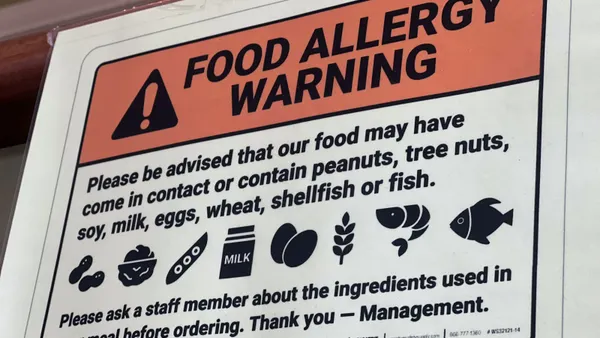
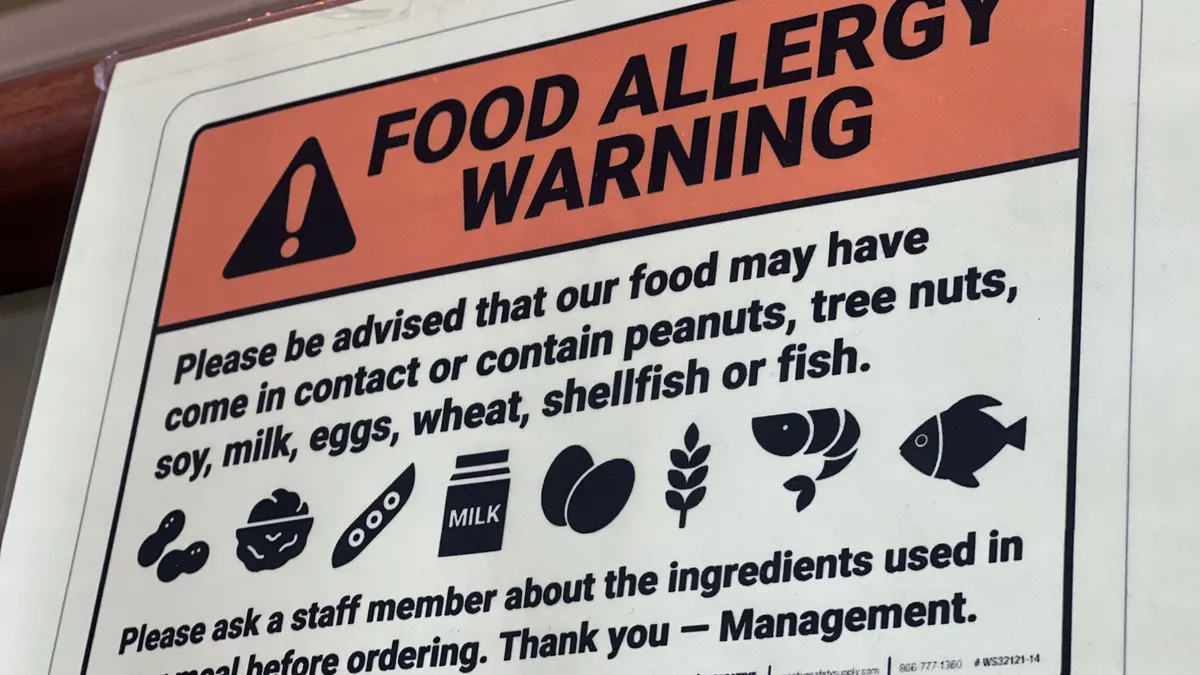
Some operators post a single advisory sign at the entrance or point of sale listing every major allergen used anywhere in the building. If a guest with a peanut allergy knows peanuts are in the kitchen, they may decide the risk of cross-contact from shared equipment is too high.
The problem is that a sign leaves the hard questions to a conversation with the person taking the order. The guest must know how to ask the right question. The team member has to know the answer, or know to find someone who does. The best operators will use both an advisory sign and a documented, well-maintained system to ensure they execute correctly every time.
What to do in the next six to 12 months
The Food Code isn’t the only standard to watch. A number of states have passed their own allergen requirements, and some go further than the newest Food Code.
If you operate in several states, don’t build a different program for each one. Build one standard that meets the strictest requirement you face, wherever it comes from.
Start with your suppliers. Review your approval process and current contracts so you know which major allergens are in every item and require suppliers to notify you before any change. Then, decide exactly what happens inside your organization when that notice arrives.
Next, build an accurate allergen list for every finished menu item from your recipes, and define how it will be kept current. Decide which allergen-related requests you can deliver reliably and which you should decline. For the ones you accept, spell out every step from taking and documenting the order to preparing it, double checking it and delivering it.
Then think about where that allergen information lives. Printed allergen guides go out of date quickly at the location level. Many multi-unit brands that control their ingredients and recipes centrally are moving to a single online source of truth.
The cost you won't see
A bad news story can certainly damage a brand, but the bigger risk is quieter. About 33 million Americans live with food allergies. When one of them can't get the information they need to eat safely, they usually don't complain. They just don't come back to that location, and maybe not to the brand.
The biggest misconception I hear is that this is optional. Regulations are coming, but guest expectations are already here.
Brands that build this system now will keep those guests. Brands that wait will be building it in a hurry, on an inspector's timeline.