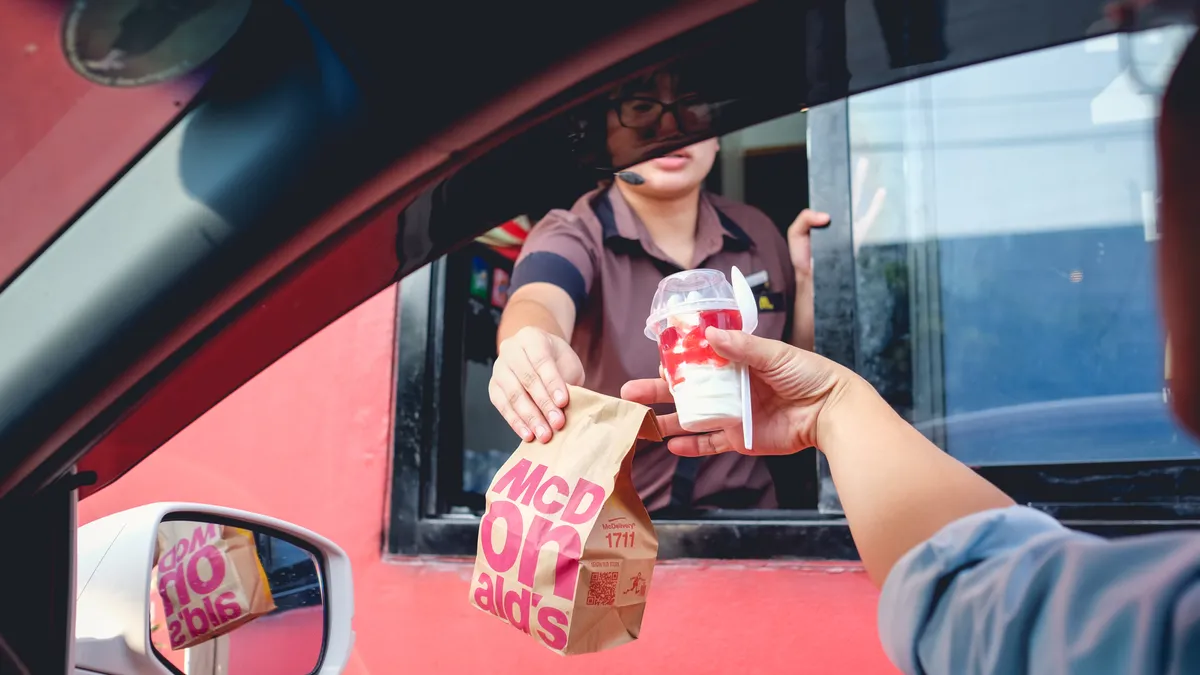

When McDonald’s launched its $5 Meal Deal on June 25, 2024, it kicked off what is arguably the most aggressive value-promotion cycle the QSR industry has run in a generation. Soon after, Burger King launched the $5 Your Way Meal, Wendy’s promoted the Biggie Bag and Taco Bell introduced the Luxe Cravings Box. Other major chains like Starbucks, Sonic and Jack in the Box also joined in.
Now, two years later, the spending data shows what these promotions achieved – and what they didn’t.
Of the 18 major QSR brands in this analysis, 15 had lower customer retention in May 2026 than in May 2024, when the value wars began. On average, brands lost 1.69 percentage points in retention. Only three brands – Church’s Chicken, Popeyes Louisiana Kitchen and Chick-fil-A – managed to improve retention.

Value-meal promotions are supposed to attract customers, encourage repeat visits and build loyalty. But the transaction data shows the reality is more complicated.
What happened at McDonald’s
If the value wars had a protagonist, it was McDonald’s. By standard metrics, the brand did well during this period. In the past year, transactions rose by 7.9%, spend increased by 12.6% and average order value grew by 4.4%. Even with the $5 deal, ticket sizes did not drop much.
But McDonald’s customer retention told a different story. In May 2024, before the $5 Meal Deal, retention was 61.2%. It dropped to 56.4% by January 2025, then recovered to 59.5% by April 2026 – still 1.7 points lower than where it started.
McDonald’s saw a big jump in traffic, but it took longer for customer retention to bounce back.
What happened at Wendy’s
Wendy’s retention dropped from 41.3% in May 2024 to 38.2% in April 2026, a 3.1-point decline – the biggest in the dataset. Over the past year, transactions fell 2.7%, spend dropped 1.2% and average order value rose 1.6%.
Of all the brands with major value programs, Wendy’s is the one where transactions, spend and retention all went down.
What happened at Raising Cane’s
Raising Cane’s saw 8.4% more transactions and 15.5% more spend over the past year. Its average order value rose 6.6%, the second-highest among all tracked brands. These are top-quartile results in the QSR group.
But during the same two years, Raising Cane’s retention dropped from 32.8% to 29.9%, a 2.9-point decline – the second-biggest change in the dataset.
Raising Cane's didn't run a major value promotion during this period, which makes the retention drop more striking. Transaction and spend growth were both in the top quartile, but retention still fell by 2.9 points – suggesting that the trade-down environment affected customer behavior across the category, not just at brands actively discounting.
Where traffic and loyalty grew together
The data shows that discounting doesn’t always mean losing loyalty. Three brands in the group grew both transactions and retention over two years, each starting from a different place.

Church's Chicken had the most notable results: transactions rose 21.3%, the highest among the analyzed brands, while average order value dropped 4.4%. Retention increased by 0.56 points, the biggest gain in the group. Lower prices led to more visits and loyal customers.
Popeyes grew transactions by 12.0% with average order value almost unchanged (+0.9%) and retention up by 0.20 points. They saw more volume without lowering prices.
Chick-fil-A started the value wars with retention close to 50%, second only to McDonald’s and ended with retention slightly higher (+0.13 points) and transactions up 10.2%. In a period when most brands lost retention, maintaining a high level was itself a strong result.
These three brands didn’t use the same pricing strategy. Church’s lowered prices a lot, while the other two kept prices steady. They also started with different retention rates, from 22.8% to 49.7%. What they have in common is that their promotions led customers to stick around, not just chase the next deal.
Three key patterns from two years of data

- Retention movement is broad across the cohort. This isn’t a story about a few brands. It’s 83%. The cycle created a sector-wide trade-down environment, and customers responded by spreading their wallets across more brands than they did two years ago.
- Transaction growth and retention growth no longer go hand in hand. Of the 12 brands that grew transactions in the past year, 9 saw retention drop over two years. None of the 6 brands that lost transactions gained retention. Looking at just one metric doesn’t show the full picture.
- Average order value (AOV) followed these patterns too. Brands with flat or lower AOV during promotions, like Church’s (-4.4%), saw better retention with their traffic growth. Brands with sharply rising AOV, like Raising Cane’s (+6.6%), often had more unstable retention.
What this means for the future
Promotion strategy and loyalty strategy are different, and the data shows they should be measured separately.
The brands that will do best in the next phase are those that can answer three key questions using data:
- Which of our customers are growing their share of wallet with us organically, without a discount?
- How much of our promotional traffic is incremental, and how much is cannibalized from existing loyal visits?
- When customers leave us for a competitor’s deal, do they come back, and how much of their wallet comes back with them?
You won’t find these answers in loyalty program sign-ups or transaction counts. They’re in verified spend data, compared across competitors, locations and over time.
The Value Wars are best understood through the data. Brands that grew both traffic and retention show one path, while the rest show another. Both stories become clear in the numbers.
How Facteus sees it
Facteus measures consumer spending the way the value wars actually played out: at the merchant level, across every major QSR and c-store brand, with a one-day lag and 2+ years of history. The numbers in this article are pulled directly from the same dataset our customers use to make their own promotional decisions every day.
Methodology: All spend, transaction, AOV and retention figures are from Facteus transaction data. Spend, transaction and AOV year-over-year metrics reflect the trailing 12 months (May 2025 through April 2026) compared with the prior year (May 2024 through April 2025). Retention figures cover monthly customer retention rates from May 2024 through April 2026. Promotion names, launch dates and any interpretation of why specific brands gained or lost loyalty are drawn from public reporting and industry context. The data can show a correlation between promotional cycles and retention trajectories. Causation requires additional context the data alone does not provide.