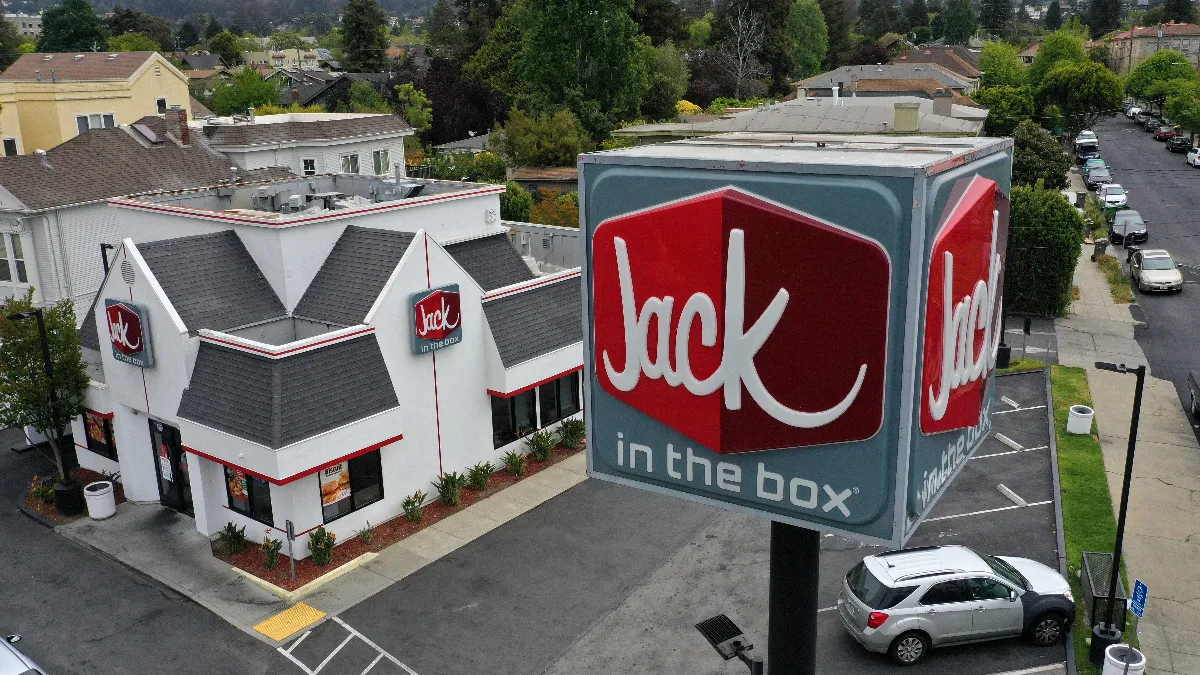
Jack in the Box is struggling to fend off prominent activist investor Sardar Biglari — and the stakes are high.
Biglari is targeting the chain following a streak of same-store sales declines and for selling Del Taco for far less than its acquisition price. He wants to oust board chair David Goebel. Recently, two of major proxy advisory firms, Glass Lewis and Egan-Jones, bolstered Biglari’s case, saying there were compelling reasons not to support Goebel’s re-election.
Jack in the Box’s performance has lagged noticeably behind its peers, the last three consecutive quarters have seen same-store sales dips exceeding 6.5%. Only Wendy’s has seen a similar drop in its same-store sales — notching more than an 11.3% decline in Q4 2025 — and has also attracted activist interest.
Jack’s stock price is also down over 80% across the last five years. On top of that, the brand has amassed more than $1.6 billion in debt, for a 6.5 to 1 ratio to adjusted EBITDA.
Jack in the Box's same-store sales trouble
According to Keith Gottfried, the founder and CEO of Gottfried Shareholder Advisory, neither Goebel’s re-election nor his defeat are likely to end Biglari’s efforts to influence the burger brand, and the fight may drag on for years. Here’s a look at how both potential board scenarios could impact Jack in the Box.
If Biglari prevails at the board vote
If Biglari Capital succeeds in persuading a majority of shareholders to vote against Goebel, the board may still reject his resignation, Gottfried said.
“[Goebel] would be required to tender his resignation,” he said. “The board could make a decision to reappoint the chair.”
Such a decision would, however, come with some significant downsides, such as sparking negative sentiment among investors.
“[Keeping Goebel wouldn’t] look great because the shareholders have spoken,” Gottfried said.
But there are reasons why Goebel specifically might be reappointed: he has served on the board since 2008, providing a significant degree of stability and continuity in brand leadership. His institutional knowledge could also prove an asset in the Jack on Track turnaround plan. Goebel’s extensive restaurant industry experience, including a stint as Applebee’s CEO and as a Boston Market operator during its heyday, could also insulate him from an ouster attempt, according to a presentation from Jack.
His removal, Gottfried said, would be disruptive. Lance Tucker, the CEO, has only held his position since the end of March 2025. Goebel’s experience may allow him to “mentor the current CEO and provide oversight to the current CEO who's trying to right the ship,” Gottfried said.
But Goebel’s long tenure and stability is also the foundation of Biglari’s case against him. According to a press release issued by the activist investor, long-tenured directors with limited turnaround experience “continue to control all key board committees. Recent board additions were reactive, not proactive.”
A disruption to the company’s institutional history is not a downside from Biglari’s perspective, given Jack’s ongoing problems.
But regardless of whether Goebel is reelected, this single proxy contest will not remake Jack’s board. Biglari began the proxy fight by proposing other board nominees, including himself, but subsequently withdrew those nominations. At Cracker Barrel, the company shrank its board by a seat after Biglari led a campaign to oust one director, but its strategy has remained largely the same.
The primary result of a Biglari victory would be a shift in public perception.
“It would be a PR win and it would put some pressure on the company,” Gottfried said.
If Biglari fails
If Biglari’s track record in previous restaurant proxy battles is a prologue, Jack in the Box is in for a war of attrition. Biglari has spent the better part of a generation fighting with Cracker Barrel over the strategic direction of that company, Jack said in its presentation. This persistence could signal a long fight for control of Jack’s board.
“You’ve got a 9.86% shareholder who has a huge amount of affinity for the restaurant sector,” Gottfried said. “You win this little battle with him, but he's still there. Cracker Barrel keeps winning again and again but he's still there. And so for them, what do you do?”
The company’s adoption of a poison pill will make it harder for Biglari to build up a larger stake in the chain, Gottfried said, so the brand has less to fear from a direct takeover attempt than from an extended battle over the board’s composition. Gottfried said Jack in the Box will likely have to deal with Biglari’s efforts to change the company for years.
A stalemated fight lasting for years will likely not benefit the chain and will instead sap resources from its management.
“Their advisors are top shelf,” Gottfried said, noting that recent filings show the brand is being advised by Sullivan & Cromwell, a major law firm, Bank of America Securities, and Joele Frank, Wilkinson Brimmer Katcher, a major communications advisory.
This distraction from leadership and operations may be more damaging than the simple expenditure of consulting fees; a climate of uncertainty and distraction could undermine turnaround efforts and retention of corporate employees, Gottfried said.
“You’re talking millions and millions of dollars in expenses, and lots of management time,” Gottfried said. “Someone has to meet with all these advisors, and so when they're meeting with all these advisors, plotting their defense and implementing it, what isn't getting done? They're not executing.”