Nearly four years after MTY Group bought Wetzel’s Pretzels, the company is seeking new opportunities for brand awareness and unit expansion.
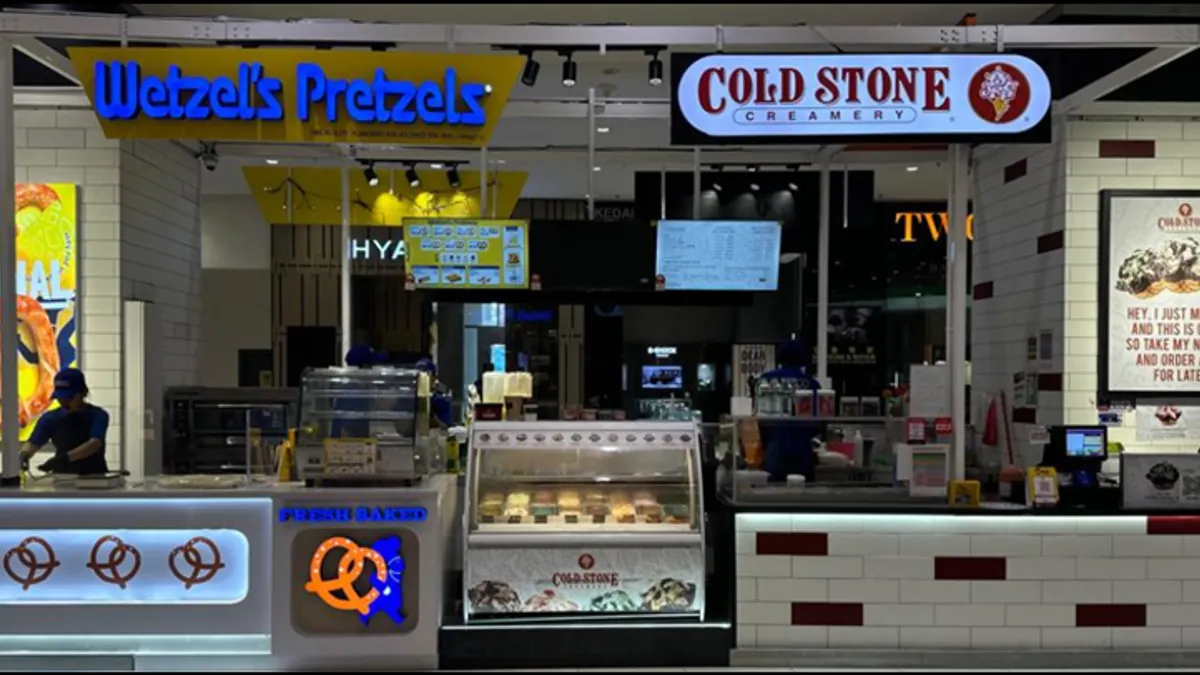
While Wetzel’s opened its 500th store in California in May, the company, through its subsidiary Kahala Brands, recently launched a co-branding strategy with Cold Stone that could create more growth opportunities.
Kahala expects to open at least 17 co-branded Wetzel’s and Cold Stone units this year across New York, Texas, Kentucky, Arkansas, Virginia, New Mexico, Nebraska and Oklahoma. It recently opened a unit in Clifton Park, New York, after opening a store in Columbus, Ohio — the first Wetzel’s in the state. So far, Kahala has eight co-branded locations open and another 40 in the pipeline.
Co-branding has long been a part of Kahala’s strategy. While not every brand works in combination with others, many of them do well in a co-branding environment, said Jay Goldstein, vice president of franchise development at Kahala.
The company has already co-branded Cold Stone with Planet Smoothie, Sweet Frog Brand with Planet Smoothie and Sweet Frog with Wetzel’s Pretzels.
The combination of Wetzel's and Cold Stone gives guests access to new flavors by having access to the menus of both brands. It also provides franchisees with more opportunities to grow units and sales while accessing markets that weren’t possible before, Goldstein said.
“The salty and sweet combination has been appearing forever so now we have the opportunity to offer that to guests in one unit,” Goldstein said.
There are no plans to offer combined menu items any time soon, Goldstein said. But for now, the two brands will offer separate menus primarily because the number of co-branded locations are limited and it doesn’t make sense to adjust menus until there is greater scale.
Co-branding also allows both brands to enter venues that would not have been possible otherwise. Wetzel’s are typically in non-traditional locations such as malls, airports and arenas, but with Cold Stone, the brand becomes available to streetside locations, where the ice cream chain primarily resides, Goldstein said.
“By offering Wetzels in a street-side location, it has expanded the brand's presence and also increased sales, not only at the individual unit level, but for the Wetzel brand in general,” Goldstein said. “That's been a great benefit for the growth of the brand.”
On the flip side, Cold Stone isn’t normally in malls, but pairing it with a Wetzel’s allows it to be, he added. Goldstein said Cold Stone doesn’t really work on its own in a mall because traffic count is typically lower in the middle of the day, which is when people typically search for a treat. Malls don’t have enough foot traffic in the afternoon to support a Cold Stone on its own, he said.
More opportunities for franchisees
The combination also has opened up new real estate options and brought additional excitement to prospective operators. Of the new Cold Stone franchisees awarded units last year, nearly 20% had a co-branded option. This year is running at about the same pace, Goldstein said.
“When we have candidates who are not aware of the option and it’s brought to their attention through the onboarding process, the level of excitement goes up tenfold because now they realize there are multiple different menu line items they can offer to their customer base and feel confident that additional sales are going to come from that,” Goldstein said.
There are some markets that Cold Stone can’t enter because the market is too small to support a successful location, but adding a Wetzel’s makes that possible.
Franchisees also have larger real estate options open to them. A Cold Stone typically needs only 1,200 to 1,400 square feet, but a co-branded unit would need at least 1,600 square feet, which opens up additional spaces and creates more "negotiating power,” Goldstein said.
The co-branded units coming to market have so far been new builds, but Kahala is considering existing locations where there is enough space for a Wetzel’s to be tacked on. Adding a Wetzel’s to a Cold Stone also would require new equipment and some remodeling, he added.
“We have quite a few existing owners who are looking for the opportunity,” Goldstein said. “We're just hopeful that all the spaces can support it.”
While there isn’t a specific target or city in mind for co-branding, Kahala has found that in markets where Cold Stone is very mature and there aren’t a lot of opportunities for multi-unit growth, co-branding become more relevant because the franchisee can scale with fewer units because there are two businesses within one location.
A shift in labor requirements
Operators should look at a co-branded unit as two separate businesses even if they are under the same roof, Goldstein said.
They require different preparation methods and have different staffing requirements. Ice cream has a longer shelf life than a fresh pretzel, which typically has to be eaten the same day. This means staff on the pretzel side need to be focused on constantly producing the offering so they are as fresh as possible.
And while a traditional Cold Stone operator can be a little bit more hands off, they have to be more involved with a co-branded location, he said.
“You have to be more engaged because there’s more to do,” Goldstein said.
Kahala will work with franchisees on how best to deploy labor and share best practices on what other stores have been doing to provide guidance.
Franchisees don’t necessarily need to have experience with business ownership or with restaurants, Goldstein said. The most important quality is having a high level of experience managing people and personalities, which goes a long way with customer service, Goldstein said.