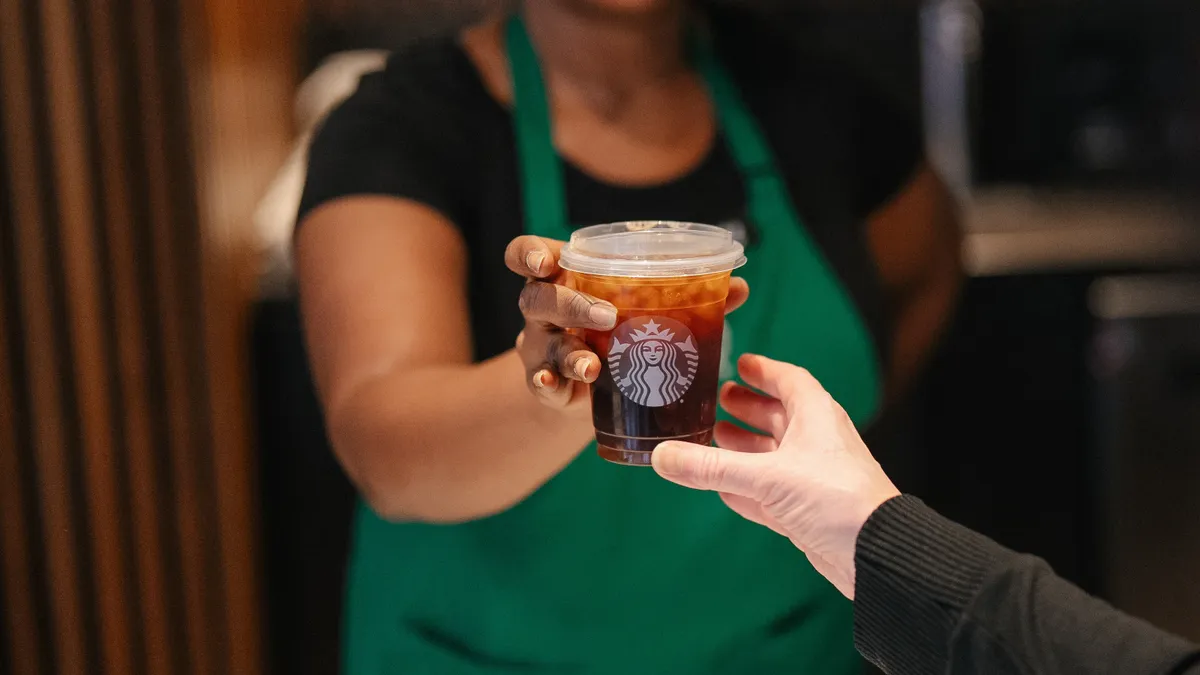
Starbucks’ 2026 Investor Day was a victory lap for CEO Brian Niccol, who opened the event by saying the company’s same-store sales growth in the last quarter “demonstrates the momentum that we have in this business and how things are really taking hold.”
But Niccol, who has reshaped the chain’s in-store experience, marketing focus and operations since taking the helm in late 2024, said there’s more in store for the brand.
Other executives presented a vision to investors of Starbucks as a growing chain, with a vibrant menu innovation pipeline and ambitious plans to integrate technology — including artificial intelligence.
Major development white space
Starbucks closed about 400 stores in an abrupt wave at the end of September 2025, following a strategic review of the brand’s store portfolio.
Now, the chain plans to open 400 net new units in North America by the end of fiscal 2028, according to a press release issued in conjunction with its Investor Day.
Chief Operating Officer Mike Grams said that after those openings, the chain sees the potential for about 5,000 new coffeehouses in the U.S. in the long-term, “which will ensure we maintain and grow our market share, particularly in the Central U.S., the South and parts of the Northeast.”
The extension of the brand into the afternoon dayparts — supported by menu innovation, marketing, and secular changes in consumer behavior — could increase that whitespace still further, Grams said.
Still, this development ambition is limited compared to the pie-in-the-sky projections the chain shared three-and-a-half years ago, when Howard Schultz said it would open 10,000 more stores by the end of 2025 and hit 45,000 total locations. The chain currently has about 41,000 stores worldwide, according to the Investor Day release.
The resumption of an ambitious development agenda is made possible by the success of the brand’s turnaround under Brian Niccol, which helped Starbucks finally post positive comps growth in its core market last fiscal quarter.
New food, new drinks
To capitalize on that sales growth and the traffic momentum accompanying it, Starbucks is looking to expand its menu, which it rationalized through a series of cuts earlier in Niccol’s tenure.
Tressie Lieberman, global chief brand officer, said the chain now has a whole slate of menu innovation prepared.
Lieberman said the chain is launching new customizable Chai drinks, and new espresso and matcha beverages this year, with special ube and coconut flavors coming in the spring.
Food, which is approaching 30% of the chain’s sales in the morning daypart, is increasingly critical, Lieberman said.
“This February, we're expanding our bakery case with a curated lineup of globally inspired flavors designed to elevate the customer experience,” Lieberman told investors. That lineup includes a strawberry matcha loaf.
Starbucks is also making a play to expand its relevance in the afternoon daypart, by reworking its Refreshers, which is currently a $2 billion platform and its fastest growing drink lineup. Soon, consumers will be able to choose decaf options or add an extra pump of the company’s energy blend, which includes caffeine and B vitamins, Lieberman said.
The breadth of menu innovation is meant to insulate Starbucks from competitive pressure.
“We're not chasing trends. We're building on a beloved platform, and never giving customers a reason to go anywhere else,” Lieberman said. “Offering new afternoon friendly beverages is the first step on our path towards introducing a new afternoon ritual to complete the occasion and deliver sustainable growth.”
A chatbot to customize orders and drive customization
Starbucks is looking to integrate artificial intelligence into the ordering process for many digital customers, according to a separate announcement detailing the company’s AI strategy.
“We’re actively developing a first-of-its-kind Starbucks ordering companion designed to help customers discover their perfect beverage through natural, intuitive prompts,” the company said.
Lieberman said the chat interface the company is looking to build could help customize drinks.
“Say you're in the mood for a banana bread latte, we'll provide you with a customized beverage recipe from Starbucks, but the value proposition goes deeper than just that drink ideation. We'll also help you find a coffee house and complete your order, making the whole process seamless,” Lieberman said.
Starbucks wants the technology to enable consumers to “order a beverage, not by scrolling a menu, but by describing their mood and goals for the day,” Lieberman said.
The chain’s menu innovation in recent years has emphasized customizable elements, like cold foam, Lieberman said.
“Cold foam is now one of our largest modifiers and represents one-third of our billion dollar customization business,” Lieberman said. “Customers can now make 90% of their drinks a protein drink with an upsell to protein milk or protein cold foam.”
But customization does drive complexity and could strain in-store operations, especially if the company unleashes an ordering product that drives consumers to order nearly infinitely customizable drinks. The strain caused by the brand’s customization has led to mobile order bottlenecks in the past, and earlier in the turnaround process Niccol expressed a desire to institute “guardrails” around customization.