Ask yourself why anyone actually goes out to eat, because it’s almost never about the food itself. You go to a restaurant to be served for an hour or two, in a place where the outside world stops existing for a little while.
I say that as someone who spent years working as a server, a bar back, a bartender, and even cooking as a private chef before I ever moved into financial technology exclusively for restaurant operators. When the industry is described as a broken business that needs to be fixed, we know exactly what that sounds like from the dining room floor.
Very little about this industry runs on the Silicon Valley playbook, and most “swap in an AI” pitches feel disconnected from a restaurant’s reality. Cold emails don’t work here, because everything gets done person to person, with a handshake. So when technology shows up promising to remove the people from a people business, operators can smell it immediately, and are right to walk away.
The customers are already telling us what they want
None of this is an argument against technology. The problem is AI pointed at the guest experience, when that experience is the one thing an operator can’t afford to dilute, and customers are already saying as much.
Fortune recently reported roughly 80% of consumers still prefer ordering from a human over an AI agent. Yet executives keep rolling out drive-thru bots and then acting surprised when nobody wants them even though the bread and butter of a restaurant is how people feel when they interact with it, in any form. Automating that feeling away doesn’t cut a cost so much as it cuts the product itself, which is the experience.
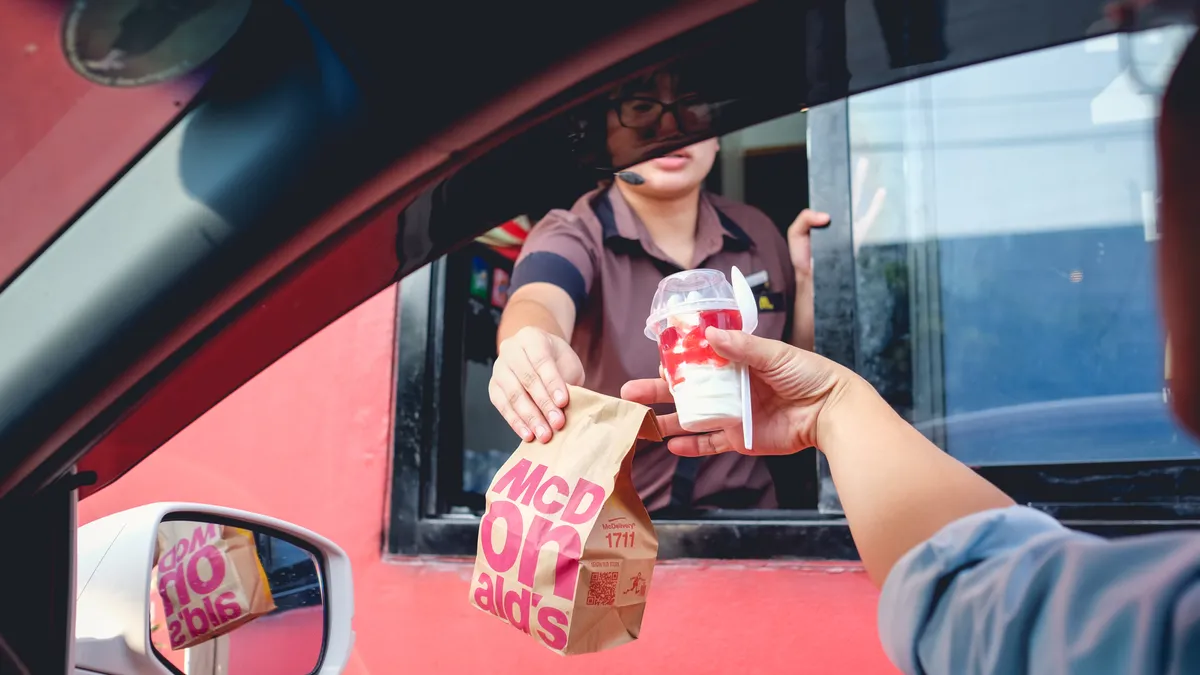
Set that against what McDonald’s did with its ordering kiosks. Instead of stripping the person out of the transaction, the chain used technology to turn ordering into something closer to a game, where guests browse, customize and take their time. The kiosk keeps the experience intact and changes how a customer moves through it, which is the same industry acting on the opposite instinct.
That is the difference between technology that is built strictly for efficiency and technology created to scale hospitality.
There’s no such thing as time savings, only time allocation
This is where the industry has the AI conversation backwards, because there is no such thing as time savings in a restaurant, only time allocation. Every operator is already at capacity, so the useful question is never simply what can be automated, but what time is being taken away from and where that time is being put instead. Saving a busy operator 30 minutes means nothing unless the tool also makes clear where the restaurant can support its operations with that saved time.
Good AI in this industry takes away $1 tasks and hands back $10 time, but it has to be just as good at finding the $10 opportunity as it is at eliminating the $1 chore. The point of buying an operator time is to put them back on the floor, in front of the guest, running the micro-moments that turn a first visit into a regular one.
That lesson is learned fastest behind a bar, where the managers who harp on the tiny things, like saying hello, asking about someone’s day and remembering the small stuff, watch their staff pull in noticeably more in tips for doing so. The experience is where the money is, which is exactly why AI should be aimed at protecting that experience instead of competing with it.
Restaurants also run on social currency
You don’t need a survey to feel this. In a city like Austin, where self-driving cars are now everywhere, a human driver who signals to merge gets waved in, because letting them over is a small good deed and a little social currency exchanged between two people. A driverless car that signals can get ignored, because there’s no one in there to acknowledge another driver, meaning a 20-minute ride can stretch to 25 even though nothing malfunctioned. The human reason to cooperate simply wasn’t there, and restaurants run on exactly that kind of social currency, multiplied across every table and every shift.
Plenty of operators refuse to let an AI bot answer the phone, on the logic that the people calling want to talk to a person. They may be leaving some efficiency on the table, but they understand something a lot of well-funded technology keeps missing: the phone call is part of the hospitality rather than an obstacle to it. If someone is calling rather than using a mobile app, they might have a detailed question only a person can answer, or are looking for human interaction.
As the world works from home more, automates more and talks face to face less, restaurants only become more important, because they are one of the few places left where a person is guaranteed to be around people and to be served by them.
That is what a diner is buying when they spend $50 on a plate; the purchase isn’t really $50 of food, but $50 of experience. Any AI that respects that fact can do good in this industry, from better prep to less waste to fewer late nights buried in paperwork and more time on the floor. Any AI that ignores this in its design is just automating the hospitality out of hospitality, and that is simply wrong.