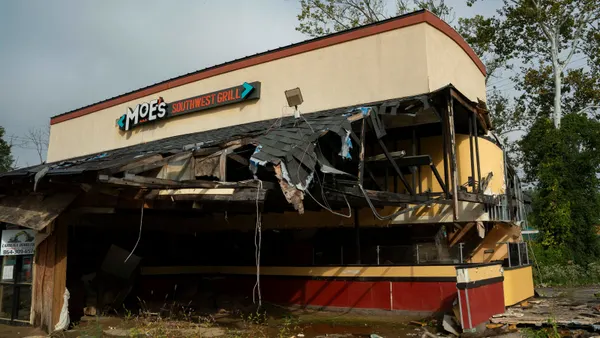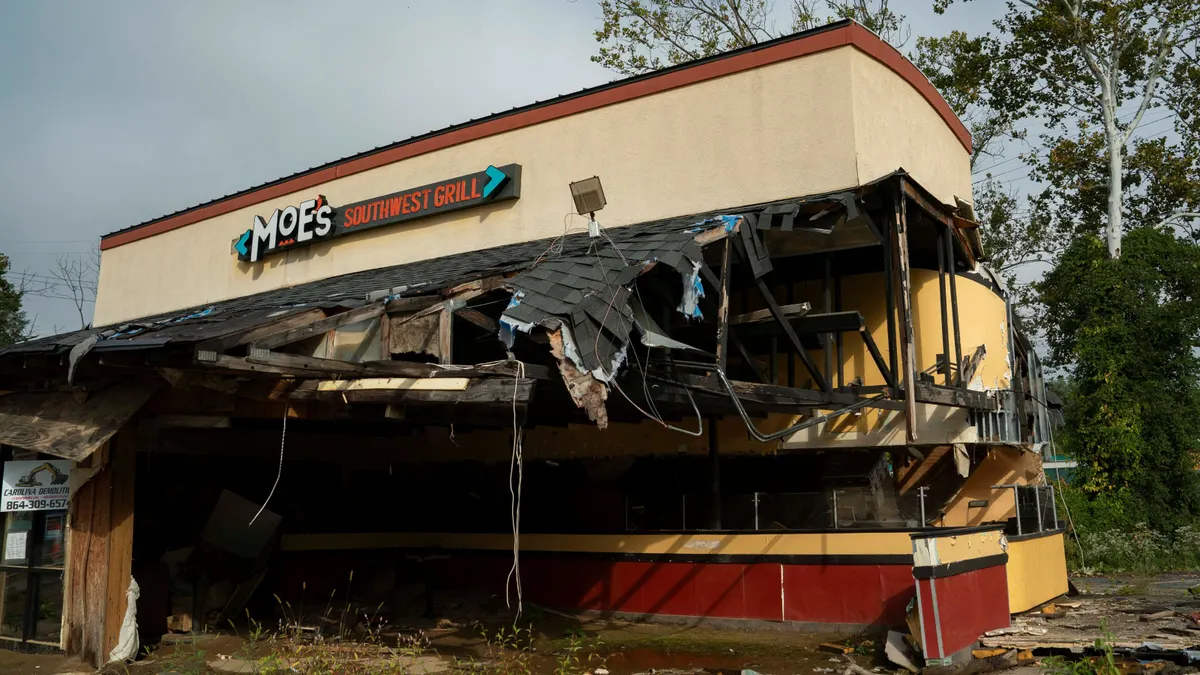
From California wildfires to Gulf Coast hurricanes to Midwest storm damage, restaurants face a wide range of natural disasters, as well as accidents like a kitchen fire, that can lead to lost business and closures.
In fact, 90% of all businesses fail within two years after a disaster, according to the Congressional Research Service. Additionally, 40% of businesses do not reopen after a disaster, and another 25% close a year later, according to the CRS.
Even operators whose buildings emerge unscathed can lose income to reduced foot traffic, road closures, utility outages and supply chain disruptions, said Ryan Smith, assistant vice president of claims at insurance brokerage Hub International.
Restaurant sales in Georgia, for example, dropped nearly 10% year over year the week Hurricane Helene struck in 2024, even though fewer than 2% of the state’s restaurants were closed, according to Black Box Intelligence data.
But experts say the biggest losses occur after a disaster because most businesses don’t have a plan for what to do afterward. Three in four businesses without a business continuity plan fail within three years after a disaster, according to the CRS.
“Regardless of where you are in the country, developing a business continuity plan is first and foremost,” Smith said. “Know who to call, what vendors to use, who your insurance company is, and how to file a claim.”
But most restaurant operators don’t know what they would do the day after a fire or flood, said Chris Cervantes, founder and president of Disaster Restoration Consulting.
“Restaurant managers are trained to run restaurants, not to manage a fire, an insurance claim, restoration contractors, environmental specialists, permits and the fire department all at once,” Cervantes said. “You’re held hostage to the phone book or a bad referral.”
And even if restaurants avoid a natural or man-made disaster, they can still be affected by disasters that impact neighboring businesses. A restaurant in a strip mall, for instance, can be flooded by sprinklers if a fire occurs in a nearby storefront.
“A disaster may not damage your building directly, but it can still shut you down through roads, supply chains, power, drainage or the systems you share with neighboring businesses,” Cervantes said.
Insurance limits
After a disaster, restaurant owners often discover that their insurance won’t cover the full cost of the damage and that rebuilding costs more than expected, partly because of changes in building codes and permitting, Cervantes said.
Restaurants often end up underinsured because coverage is expensive or because operators don’t update their policies as their businesses grow. On top of that, brokers often don’t ask how the business has changed at renewal, which can provide operators with a false sense of security.
Making matters worse, franchisees must also keep paying advertising and royalty fees to the franchisor, even while shut down, Smith said. Business interruption coverage may eventually reimburse those costs, but the money is due up front. They should ask whether the fees can be temporarily waived after a disaster so existing capital can go toward repairs.
Plan ahead
Planning is what separates the restaurants that survive a disaster from those that don’t.
The first step is simply asking “What would I do?” Most operators don’t have an answer because they have never asked the question, Cervantes said.
“Trying to build the response plan while the building is on fire is a nightmare."

Chris Cervantes
Founder and President, Disaster Restoration Consulting
To answer that question, operators should create a basic recovery plan that identifies decision-makers (and their backups), secures senior-leader commitment, and lists preferred restoration and environmental vendors.
Vendors can survey the property in advance, learn the locations of gas and water shutoffs, and agree on pricing and decision-making authority before an event ever happens.
The plan should also specify what happens in “minute one,” Cervantes said, from which numbers to call to what each person does.
Waffle House is the industry’s benchmark for emergency readiness. The chain provides its restaurants with a playbook for closing ahead of mandatory evacuations and reopening quickly. Its restaurants stop serving so rarely that the Federal Emergency Management Agency created the “Waffle House Index” to gauge a storm’s severity.
“Trying to build the response plan while the building is on fire is a nightmare,” Cervantes said.
Pre-vetted vendors matter most after a regional disaster, when labor and restoration capacity tighten, Smith said.
“Having a prior relationship with a mitigation or remediation vendor can move you to the front of the line,” he said. “The faster a claim is submitted, the faster the carrier can inspect the property, and the faster that occurs, the faster the rebuild can start.”
Operators should choose contractors who know how to work with insurers. Many repair, mitigation and remediation vendors don’t capture estimates and invoices in a way that’s easy for insurance companies to digest, creating unnecessary payment delays, Smith said. Contractors familiar with the estimating software insurers use to price repairs can streamline the process.
Once a plan is in place, operators should resist the urge to control every technical detail of the recovery, Cervantes said. Trying to manage unfamiliar territory personally, from environmental testing to permits, can slow the rebuild.
“The best operators set up the avenues of success in advance and then get out of the way so that the owner can focus on employees, vendors, deliveries and payments,” he said. “There is rarely a snap-your-fingers recovery. Plan for what can happen, not only for the best case.”