Dive Brief:
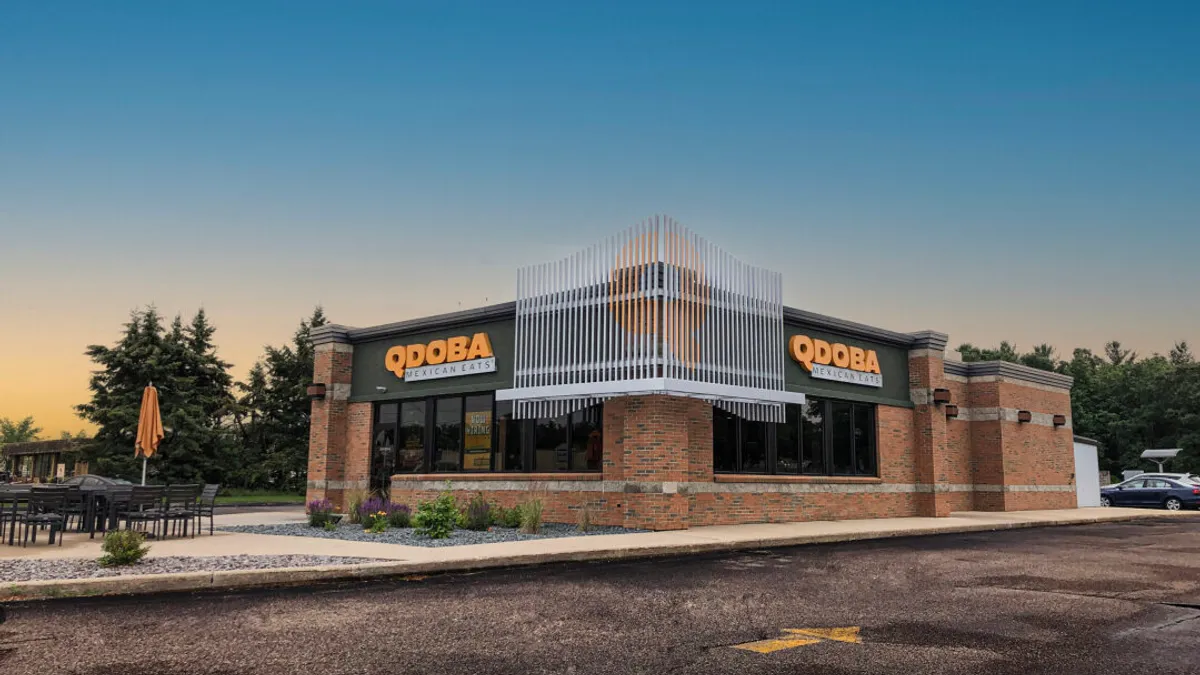
- Qdoba signed two new franchise development agreements in the Southeast and expanded a major Western agreement, the chain said Wednesday.
- The three deals commit operators to developing 113 new units for the chain, which would bring the roughly 865-store brand close to the 1,000-unit mark in the absence of other development agreements.
- Qdoba said it plans to increase the franchised portion of its store system to 85% as it pushes toward its 2,000 unit goal. It is targeting 100 unit openings per year. That would roughly double its 2025 net openings, but still leave it growing slower than Chipotle, the Mexican fast casual sector’s company-operated leader, which expects to open 350 to 370 units this year.
Dive Insight:
Much of the chain’s development will be powered by multi-unit operators from other systems joining Qdoba.
The brand signed a 30-unit deal in the Atlanta metro area with a former McDonald’s operator, according to the press release. The brand also announced a 20-unit deal in the Nashville area with a 12-store Zaxbys operator whose “focus on operational excellence positions them to sustain growth while expanding into Mexican fast casual.”
But the largest deal is a revision of Qdoba’s existing relationship with 7 Star Eats. That franchisee — a subsidiary of B Wild Investments — acquired 22 stores to bring its total number of Qdoba restaurants to 42 in the Pacific Northwest and the Mountain West. 7 Star raised its development target to 63 new locations in Colorado, Utah, Washington, Nevada and New Mexico.
Barry Dubin, B Wild’s founder and CEO, said Qdoba “has the brand, menu, and unit economics to win” the Mexican fast casual segment.
In addition to the recent deals in the West and South, Qdoba is targeting growth on the East Coast and prioritizing markets including California, Texas, Florida and Georgia. Non-traditional venues with built-in demand, including airports, universities and military bases, are another growth target for the chain.
The chain is backing this growth ambition with national marketing — its first such campaign launched in October. Earlier this year, the chain completed a $435 million whole business securitization intended to refinance some of its debt at a reduced cost and thereby improve its liquidity.