
Fast food chains have spent the last few years competing around value as economic pressures continue to stoke uncertainty and uneasiness in consumers. But as lowered prices cut into already tight profit margins and casual chains continue to make gains with value-minded diners, fast food marketers will have to move beyond price-point value to drive sales and traffic.
“Value is no longer just about price,” wrote R.J. Hottovy, head of analytical research at location analytics platform Placer.ai, in a recent blog post. “In 2026, winning restaurants will pair aggressive pricing with innovation, limited-time offers, and cultural relevance to justify discretionary spending.”
An analysis of recent earnings reports by fast food chains demonstrates how successful such multifaceted marketing strategies have been, while hinting at what is coming down the pike this year.
McDonald’s tries to go three-for-three
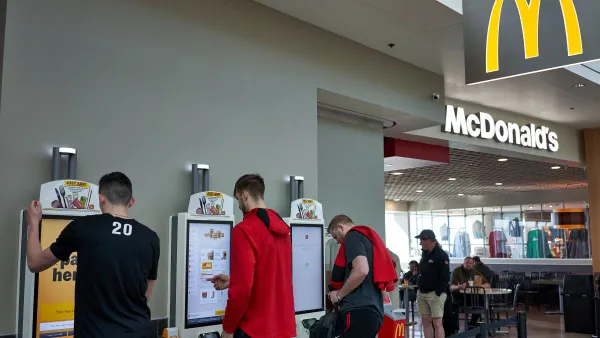
Fast-food leader McDonald’s saw comparable sales grow 5.7% in Q4 2025 and more than 3% for the full year, per its latest earnings report. The chain in September rolled out an Extra Value Meals platform, but executives stressed that continued growth will not depend on the menu category alone.
“As we look to 2026, success will again depend on going three for three: compelling value that brings customers in the door, breakthrough marketing that creates meaningful moments for our fans and menu innovation that provides great tasting food for our customers,” CEO Chris Kempczinski said on a call discussing the earnings.
McDonald’s called out cultural plays that have been a renewed part of its marketing playbook in recent years. The chain’s collaboration with “A Minecraft Movie” spanned more than 100 markets and was its largest global campaign ever, while a holiday push themed around the Grinch saw McDonald’s sell nearly as many themed meals as its Minecraft effort and a 2024 collector cups promotion combined.
“Both record-setting programs show how uniquely positioned McDonald's is to tap into culture at massive scale, reinforcing the power of a One McDonald's way of marketing and our ability to share creative excellence across the system,” Kempczinski said.
In addition to its movie-themed meal campaigns, McDonald’s drove engagement in digital and loyalty channels with its latest Monopoly game. The effort resulted in one of the chain’s largest digital customer acquisitions ever, and notched nearly 500 million games played. McDonald’s now has about 46 million 90-day active users in its U.S. loyalty app.
“Our U.S. business had its strongest comp guest count gap to the nearing competitive set in Q4 in recent history, so I think those are all signs of encouragement to us,” CFO Ian Borden said on the earnings call. “The key, though, is you've got to get the three for three. It's not just about value and affordability or about menu or about marketing individually. It's how you bring those together and leverage them to kind of get that holistic output.”
Burger King asks for feedback
Burger King in the U.S. continues to invest in marketing, operations and remodeling as part of its long-running Reclaim the Flame turnaround plan. The Restaurant Brands International chain saw U.S. comparable sales grow 2.6% in Q4 and 1.6% for the full year and claimed to outperform the burger QSR industry in nine of the last 12 quarters.
“Burger King executed compelling marketing, offered consistent value, improved operations, and continued to make progress on modern image, helping the brand once again outperform the burger QSR industry and reinforcing my confidence in the brand's trajectory as macro pressures ease,” said RBI CEO Joshua Kobza on a call discussing the earnings.
In the way that McDonald’s relied on Minecraft and the Grinch to drive sales, Burger King utilized a Q4 collaboration timed to the release of “The SpongeBob Movie: Search for SquarePants.” The activation drove strong guest engagement and boosted kids meals to their highest incidence level in the last ten years, and was the first major move executed under Joel Yashinsky, who was appointed CMO of Burger King’s U.S. and Canada business in April.
“I think that Joel and the marketing team did such a nice job on all of the elements of that: the IP, the products that they developed, the packaging, and then we executed it well at the restaurant,” Kobza said of the effort. “But it delivered great results because of all the underlying work that we have done in the business, and it really told us that I think we are ready to take this business to the next level and really elevate the brand based on the work that we have done and the fundamentals.”
Burger King was able to retain traffic after the SpongeBob promotion, growth the chain attributed to a value platform around $5 Duos and $7 Trios that offered consumers choice and consistency since its launch early in 2025.
“In a year when there was significant noise across the industry around value, this dependable platform allowed us to focus our marketing behind Whopper-led innovation and family partnerships that attracted new guests to the brand. Looking ahead, we will continue executing this balanced strategy,” Kobza said.
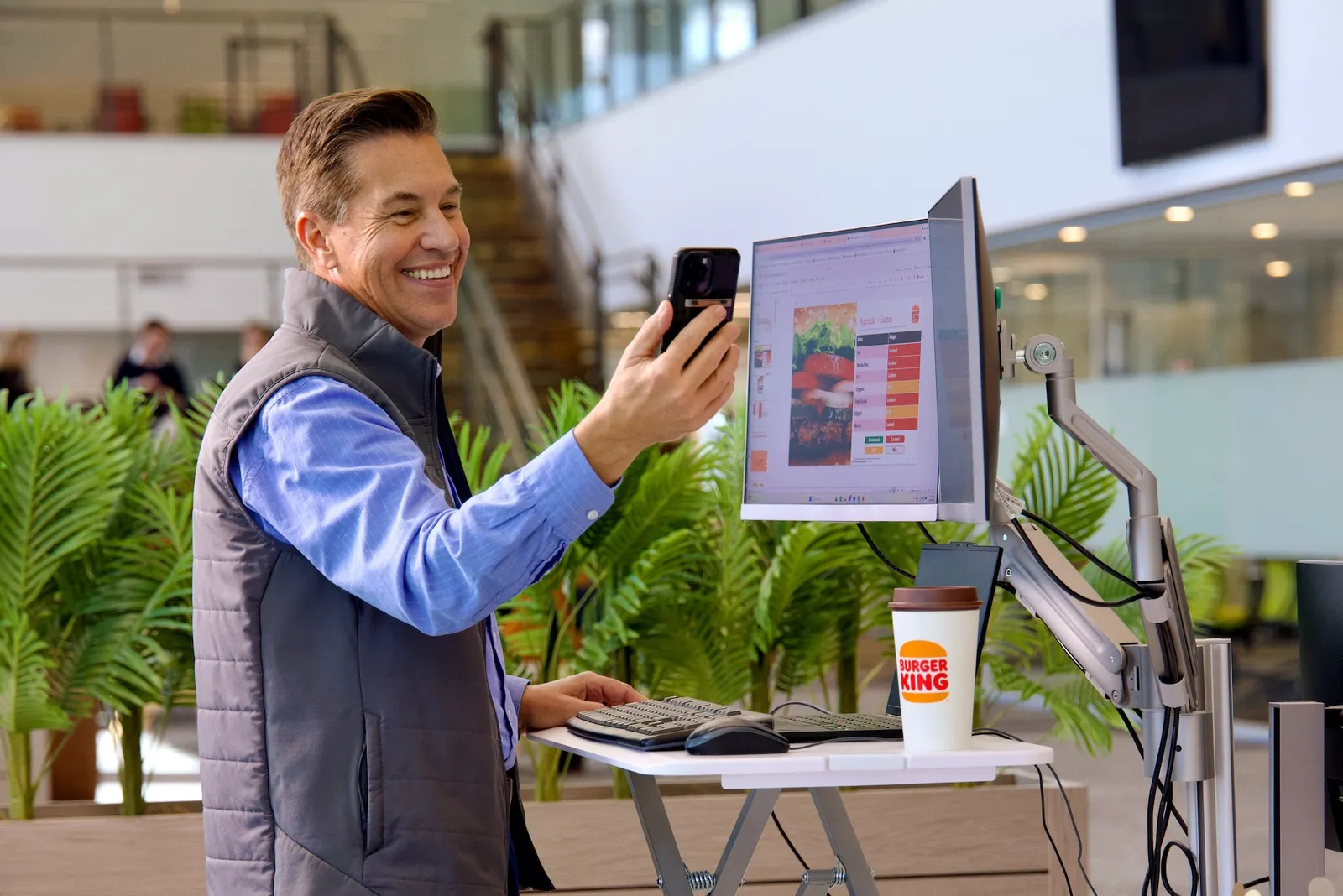
Burger King has iterated innovation around its flagship product in offers like the Million Dollar Whopper contest and “Whopper By You” platform by relying on consumer input and its “Have It Your Way” ethos. That mindset continues in its latest campaign, launched Feb. 17, that allows guests to call or text Burger King President Tom Curtis with their thoughts and feedback. The executive will personally respond to as many daily calls as possible, with the chain promising to review and respond to every message.
“There's nothing like hearing from Guests firsthand, so I'm excited to have an even greater opportunity to have live open and honest conversations, ask questions, and see how we can create an even better Burger King together,” Tom Curtis, president of Burger King U.S. and Canada, said in a press release.
Wendy’s plays catch up
While McDonald’s and Burger King were on the upswing to close 2025, Wendy’s saw its fourth straight quarter of negative sales growth, with global systemwide sales down 8.3% in Q4 and down 3.5% for the full year. The rough earnings report was expected, with marketing spend down significantly in the quarter after the chain had front-loaded its ad spend at the top of year.
Coincidentally, the quarter looked even worse compared to the same-year period in 2024 that saw Wendy’s run its own successful collaboration with the SpongeBob franchise — a year before Burger King’s effort — that helped the chain outpace the QSR burger category in traffic and dollar growth.
As part of a Project Fresh strategic plan that launched in November, Wendy’s will look to revitalize its brand as the highest quality choice in QSR by engaging consumers in more relevant, distinctive ways, CFO and interim CEO Ken Cook said on a call discussing the earnings.
Wendy’s completed a comprehensive consumer segmentation study and translated those consumer insights into a framework that will inform priorities, the customer experience and how it communicates around its brand and value. The new framework has informed its new marketing and menu approach for 2026, Cook explained.
“We’re taking a balanced approach across core, innovation, and value offerings, supported by improved messaging that connects with customers in socially and culturally relevant ways. In addition, we’ve established a more disciplined programming structure to ensure a steady stream of new news that keeps the brand top of mind and supports higher customer frequency while providing restaurant teams adequate time to train and execute with excellence,” the executive said.
Like its competitors, Wendy’s has strengthened its value offerings, with Biggie Deals that use a tiered pricing structure. In addition, the chain plans to optimize its marketing mix by allocating more spend in digital, social and streaming channels.
“We are increasing culturally relevant marketing in these channels, leveraging our consumer segmentation insights and new data and analytics capabilities for more targeted messaging,” Cook said. “We’ve significantly increased our always-on social engagement, and that awareness will translate into traffic over time.”
Challengers go for nostalgia via TV
QSR market leaders are not the only campaigns to utilize cultural collaborations to drive engagement and sales. But challenger brands that do not have the cachet to pull off family friendly, major motion picture promotions have increasingly relied on transgressive advertising and nostalgia for their own campaigns.
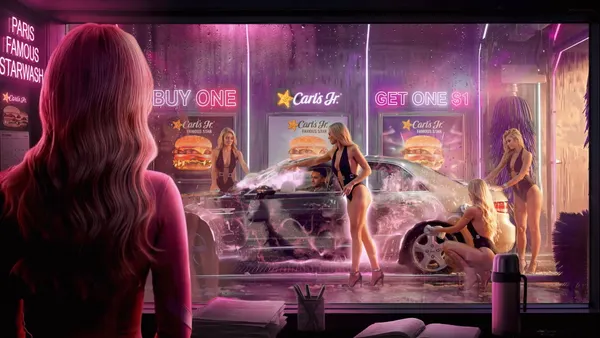
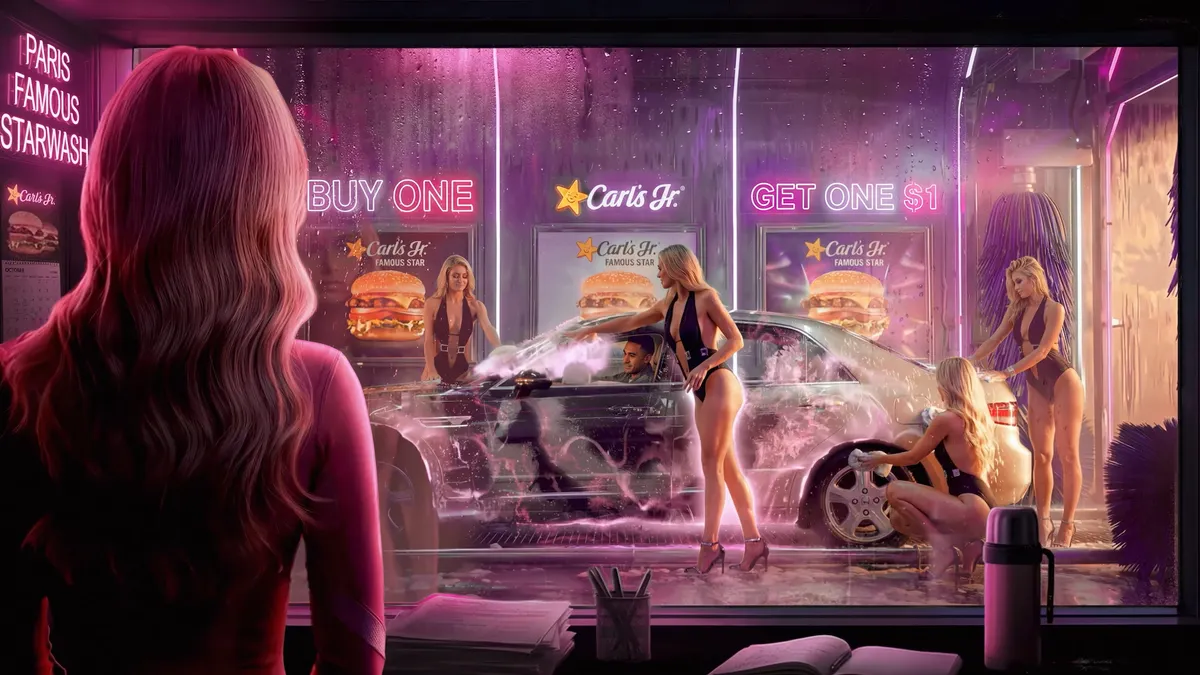
CKE Restaurants brand Carl’s Jr. on Feb. 10 brought back pop-culture icon Paris Hilton for a campaign that continues to build on the brand’s return to bikinis-and-burgers marketing that it had eschewed nearly a decade ago. After starring in the brand’s ads in the mid-2000s, Hilton last year made a cameo in a campaign for the brand centered around Alix Earle, an entrepreneur and social media star that is a Hiltonesque figure for Gen Z.
In the brand’s latest ad, two guys take their car to Paris’ Famous Starwash, a car wash operated by a handful of bikini-clad, electric-eyed Hilton clones. After the artificial intelligence-generated car wash sequence, the ad ends on the actual Hilton, who offers consumers a buy one, get one for $1 Famous Star burger deal.
“AI let us do something magical: we went back in time to one of advertising's most iconic moments, then pulled the real Paris Hilton through it into today,” said Kara Gasbarro, vice president of creative and brand strategy at CKE Restaurants, in a statement around the campaign. “It's surreal and fun and expands creative possibilities. But here's what matters: when you peel back the fun AI, you're left with real Paris, and a real burger that tastes as incredible today as it did in 2004.”
The spot was created by agency Native Foreign in partnership with CKE’s in-house creative team. A 30-second spot is running across CTV and social, with content featuring Hilton running on TV in traditional channels. Two 15-second spots have more than 10 million views combined on the brand’s YouTube channel at press time.
Jack in the Box is also reheating an old campaign to promote a new offer. As part of its 75th anniversary, the California-based chain is bringing back its Hot Mess Burger with a series of one-day-only pop-ups throughout the month. To promote the menu item and its “tour,” the chain rolled out a 60-second ad that looks back at its mascot’s time as an ‘80s rock star.
The ‘80s persona originally appeared in a 2013 Super Bowl ad that ended with a joke about a woman who exposed herself at a rock concert becoming the mother of the mascot’s child. The new ad features Jack Box looking back at memories of this period, featuring his time with a blonde groupie and their debaucherous time in hotels, limos and police stations. The spot is running across linear TV, connected TV, YouTube and social platforms including TikTok and Snap.
Carl’s Jr. and Jack in the Box utilizing a mix of national and streaming TV follows a QSR industrywide trend of embracing targeted advertising on streaming to generate sales while remaining on national linear TV, especially around sports, for awareness.
“QSR brands are one of the best examples for how advertisers can effectively utilize streaming to reach their intended audience, without abandoning the continued strength of linear reach,” said Tyler Bobin, director of brand solutions at iSpot, in emailed comments. “Quick-serve brands have been able to leverage streaming to deliver locally specific messaging, test marketing concepts and creative versioning, while also getting a clear line of sight to measure whether these things are actually working and how to make valuable optimizations to their media plan.”