For some brands, ghost kitchens are still alive and well. These delivery-centric locations help fulfill delivery demand, particularly in markets where a physical location may not be practical.
Earlier this year, Pressed Juicery partnered with CloudKitchens to open sites in 27 locations, and Chick-fil-A opened in a CloudKitchens location in Miami in the neighborhood of Wynwood.
While Chick-fil-A uses ghost kitchens in areas with high delivery demand, Pressed Juicery is using the channel to expand its consumer packaged business.
“It reinforces our vision to bring our clean products to more people, and it just aligns the whole CPG growth strategy,” Pressed Juicery CEO Justin Nedelman said.
These two brands are showing that ghost kitchens can still be profitable way to fulfill orders in certain market conditions.
Meeting high delivery demand
Chick-fil-A uses delivery-centric locations like CloudKitchens in areas where there is high delivery demand and consumers desire more fulfillment options, Ashley Peard, senior principal program lead for Chick-fil-a’s nontraditional restaurants, wrote in an email.
“In a community like Wynwood, the delivery-centric location helps us provide the Chick-fil-A experience in a way that aligns with how many people choose to order and enjoy their meals today,” Peard said.
The Wynwood location allows Chick-fil-A to serve guests who aren’t within a delivery radius of a traditional restaurant but are located in an area with high delivery demand.
“We see this as less about following a trend and more about listening to our customers and meeting the needs of the communities we serve,” Peard said.
Much like any Chick-fil-A locations, the Wynwood outpost will focus on “operational excellence and guest experience,” Peard said.
“We see this as less about following a trend and more about listening to our customers and meeting the needs of the communities we serve.”

Ashley Peard
Senior principal program lead, Chick-fil-A
Chick-fil-A evaluates consumer demand, delivery patterns and community needs when it considers new concepts. The chain relies heavily on independent owner-operators who understand what matters to their local communities. The Wynwood location is managed by a Miami native who is “invested in both the restaurant’s success and the community’s well-being,” Peard said.
Using ghost kitchens is part of Chick-fil-A’s natural evolution to reach guests wherever possible. Over the years, the restaurant chain has expanded its capabilities for drive-thru, carryout, mobile ordering catering and delivery, Peard said.
“Delivery is one way we’re able to provide added convenience and bring Chick-fil-A closer to where guests live and work,” Peard said. “As guest needs continue to evolve, we’ll continue to listen, learn and assess how we can best serve each community while maintaining the same standards, care and hospitality people expect from Chick-fil-A.”
Using ghost kitchens to expand product delivery
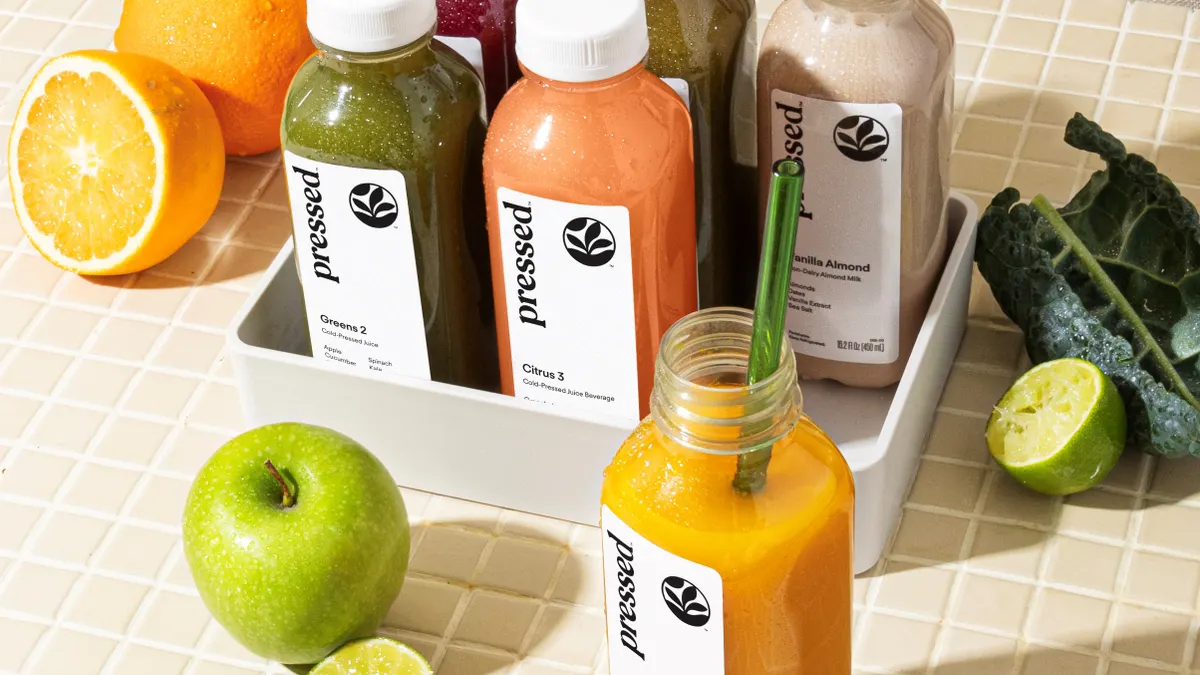
Pressed Juicery is using CloudKitchens to expand its consumer packaged goods business, which has become a key growth strategy over the past two years. The chain now sells its juices in roughly 10,000 grocery, retail, hospitality and foodservice locations nationwide.
“It's a full transformation of the business from a four-wall retail operator to a true CPG brand,” Nedelman said. “We're slowly decreasing our footprint while we lean into the CPG business, and then lean into Cloud, so I don't see us opening stores anytime soon.”
This business allows Pressed to be in more locations than its roughly 100 stores, expanding its reach without incurring significant operational costs, Nedelman said.
“That [CPG] business has grown seven-fold in the last two years, which is obviously a huge number with very minimal CapEx than it takes to build new stores,” Nedelman said.
While most of its CloudKitchens locations are near existing stores, the chain has tested a location in a new trade area for Pressed. Nedelman said that location could generate $250,000 in incremental sales, but without having to spend $1 million to build a store.
“There’s a lot of untapped, unmet demand that we’re going to be able to meet immediately with [CloudKitchens].”
Justin Nedelman
CEO, Pressed Juicery
Most of Pressed’s stores have a high digital sales mix — almost 60% — so offering bottled juice through CloudKitchens makes sense for delivery, he said.
“If we have a situation where we're closing a store for various reasons, we're able to immediately, for the most part — not every market's available — light up CloudKitchens and seamlessly continue to execute,” Nedelman said, adding that, in some instances, digital guests are unlikely to notice the difference in their delivery orders.
While Pressed has a growing business through third-party marketplaces like Uber Eats and Grubhub, its website still generates millions of hits each month, he said.
“There’s a lot of untapped, unmet demand that we’re going to be able to meet immediately with [CloudKitchens],” he said.
The company currently sells juices, shots and cleanses through CloudKitchens, but it could consider offering açaí bowls as well, depending on demand, Nedelman said.
CloudKitchens essentially act as a distribution hub for Pressed while the chain continues to generate demand through its website. CloudKitchens teams then assemble the products and hand them off to a third-party aggregator.
To ensure the guest experience remains the same, Pressed’s operations team that runs its stores also is managing its CloudKitchens operations. The team monitors CloudKitchens metrics to make sure they hold up to the store experience, items remain in stock and orders are fulfilled with accuracy.
CloudKitchens could also open up more touchpoint for individuals who have only been able to order Pressed through its direct-to-consumer shipping channel, Nedelman said. Typically these guests spend an average of $125 per order, whereas CloudKitchens delivery can accommodate smaller orders without high shipping costs, which can range from $10 to $20, depending on location.
“We hope to decrease that [channel] if these Clouds can provide a much more efficient delivery mechanism than shipping ice across and juices across the country,” Nedelman said.