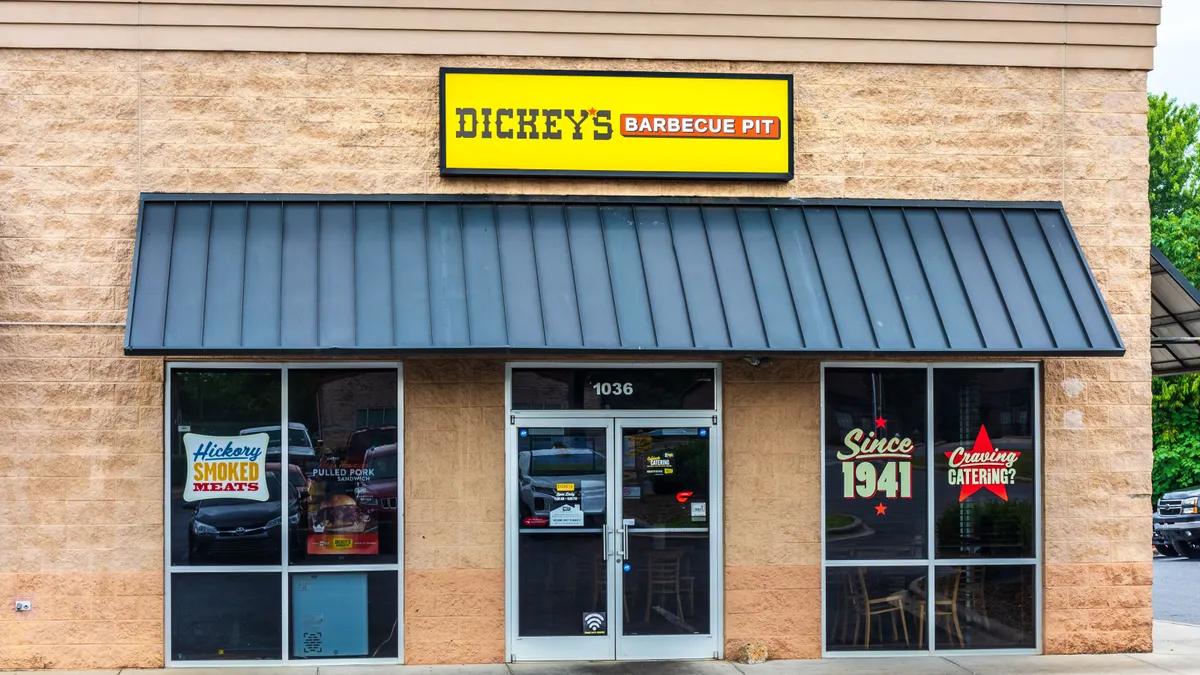
For some consumers, a coupon promising a free pulled pork sandwich is a compelling reason to visit a restaurant. And if the food is good, diners might come back again and again, growing sales and brand power. That’s the theory, at least, at the core of Dickey’s Barbecue Pit’s marketing strategy.
But Dickey’s franchisees are crying foul over such promotions.
Operators claim that the chain’s combination of freebies, surprise and delight loyalty perks and deep discounts on digital, catering and first-time orders are catching owners off guard and forcing them to eat the cost of full orders — wiping out their margins.
Over time, Dickey’s franchisees said, this dynamic has pushed some owners to the financial brink and diluted the brand’s identity because many customers are unwilling to pay for undiscounted menu items.
“We don’t have customers in our ecosystem that are paying full value,” said Franchisee 1, a Dickey’s operator in the Southwest. Two franchisees who spoke to Restaurant Dive for this article requested anonymity, citing possible legal retaliation from Dickey’s over sharing potentially sensitive information. Three other Dickey’s operators confirmed this information, but declined to be quoted.
Franchisee 2, a Dickey’s operator in the Mountain West, shared a screenshot with Restaurant Dive of a receipt for a $170 order for which a customer paid nothing.
“That’s a brutal one to take,” Franchisee 2 said, adding that many consumers use loyalty points for large orders to maximize their savings.
A strategy focused mostly on discounting could hurt in the long run, said Luke deWilde, head of marketing and partnerships at Claim, a customer acquisition social app that has access to large amounts of payment data. Such tactics might lack the precision required to attract high-value customers who are willing to pay full price.
Reporting this story
This article is based on interviews with multiple Dickey's franchisees and Denning Petersen, Dickey's senior vice president of revenue. The names of two Dickey's franchisees have been withheld to prevent possible corporate retaliation. A third franchisee, David Boisture, who is an area director with the brand, spoke with Restaurant Dive in an interview arranged by Dickey’s PR team. Restaurant Dive corroborated the information supplied by the anonymous franchisees with interviews with three other operators who spoke on background and are not quoted in this story. Restaurant Dive also interviewed a customer acquisition expert.
Restaurant Dive also reviewed Dickey’s franchise disclosure document, sections of its owners manual, copies of its marketing calendar supplied by the anonymous franchisees, receipts from heavily discounted orders, discounts offered by the chain’s online channels and promotional materials for its loyalty program.
Dickey’s own records show significant challenges for operators. 2024 was a disastrous year for the chain’s franchise system, according to its FDD. A net 83 franchised restaurants closed, pulling its unit count down to 385. On top of that, the brand has a considerable rate of transfers among its franchisees: 106 stores changed hands in 2024, and 71 changed hands in both 2023 and 2022.
This year may be worse: A hand count of the restaurants in the United States listed on Dickey’s website on June 30, 2025, found 318 open units, a loss of 67 restaurants compared to 2024. A December count of the restaurants listed on Dickey’s website found a further drop to 314 open units. Dickey’s latest press releases say the chain has 387 total units across several countries.
Operators fear more franchisees could go under, and the brand’s position could erode further, if the level and pace of current discounting continues. Dickey’s encouraged its operators to give out 50 “Be My Guest Cards” for free sandwiches every day for the first three months of the year, according to a copy of the marketing calendar viewed by Restaurant Dive. David Boisture, a Dickey’s franchisee and area director for the brand, said operators might pass out the cards at churches, office parks or local jobsites to help drive customer acquisition. Additional operators said Dickey’s treats the practice of distributing the cards as a baseline expectation.
“We’ve literally become a discounted brand,” said Franchisee 2, “[Diners are] not going to pay full price. I used to say [Dickey’s] was Bed Bath and Beyond, back when Bed Bath and Beyond was still in business.”
Denning Petersen, senior vice president of revenue at Dickey’s, said the brand recommends, rather than requires, operators to hand out the Be My Guest Cards.
Boisture said the Be My Guest Cards helped grow the brand’s customer base and that he didn’t feel pressured to hand out 50 a day.
Boisture said it was reasonable for Dickey’s to expect franchisees to be active in their communities and hand out Be My Guest cards to increase brand awareness and build up a consumer base.
“You’re not just going to sit in the easy chair,” Boisture said.
But franchisees argue that it’s too easy for diners to take advantage of Dickey’s current discount infrastructure — including its loyalty program, which offers frequent discounts, as well as sandwich cards and digital and catering discounts. Franchisee 1 said he has a customer who comes in every week and redeems a free sandwich.
“That doesn’t seem like that’s the way that program should be intended,” he said.
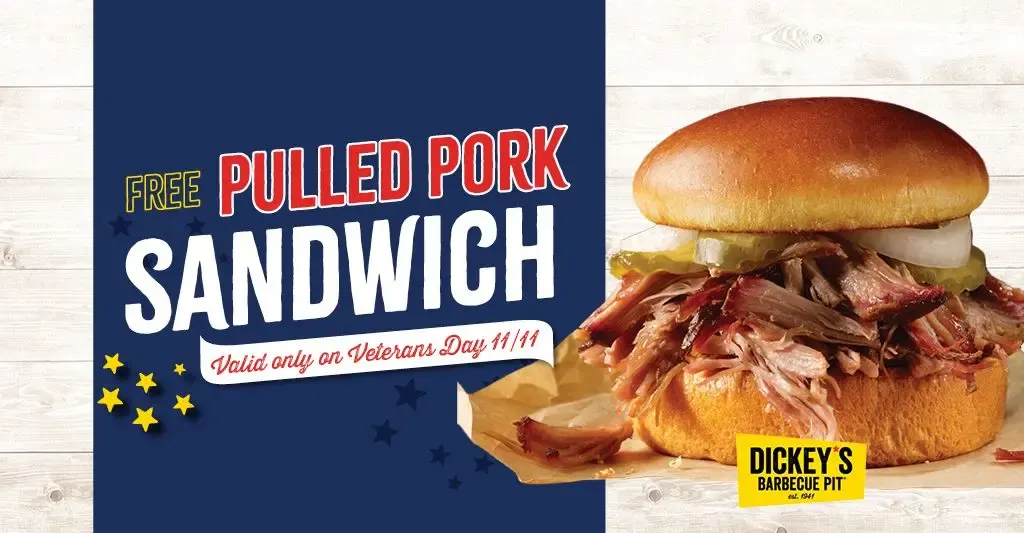
Discounting reimbursements dried up, but requirements hold firm
Dickey’s has, at times, sought to help franchisees defray the cost of free items by offering reimbursements. But the scale of those reimbursements and the process to obtain them make it difficult to recoup the expense of menu items, franchisees said.
Despite this challenge, restaurant owners are expected to participate in a wide range of discounting practices beyond the free sandwich cards. This can squeeze margins, as consumers can access deals often, ranging from simple discounts off online order to free menu items. Dickey’s franchising agreements require operators to participate in these systems.
Dickey’s franchise disclosure document shows operators are obligated “to offer and participate in such discounts, giveaways, customer loyalty programs, and other promotions at your sole cost and expense.”
Franchisee 2 said Dickey’s used to offer a $1 reimbursement for every free sandwich operators redeemed using money from the monthly marketing fees franchisees paid under their franchise agreements. But, he said, that practice has lapsed.
“The discounts have just definitely hurt; they're not strategic."

Franchisee 2
A Dickey’s operator in the Mountain West
“Eventually, the reimbursements just stopped,” Franchisee 2 said. As a result, both Franchisee 1 and Franchisee 2 said, operators are incurring significant risk.
“They’re expecting you to give out 50 free sandwiches a day,” Franchisee 1 said. “On top of that, they want you to participate in their discount program. Obviously, we don't really have a choice to participate or not.”
A franchisee who distributed the suggested number of Be My Guest cards every day risked being on the hook for 4,500 free sandwiches in Q1 2025 alone.
Dickey’s menu prices vary by location, but Franchisee 2 said his units sell sandwiches for about $7.99, meaning his restaurant could have eaten nearly $36,000 in free sandwiches in one quarter if all the freebie cards were redeemed. Both Franchisee 1 and Franchisee 2 said Dickey’s store volumes tend to be about $500,000 a year or $125,000 a quarter, meaning complete redemption of the sandwich could be equivalent to about 29% of sales.
Petersen told Restaurant Dive that Dickey’s still reimburses franchisees for the cost of goods sold for redeemed items. If an item’s ingredients and packaging cost $2.50, for example, Dickey’s will reimburse the owner $2.50.
Franchisee 1 said Dickey’s has not communicated with him about reimbursement in about a year. The company required franchisees to take a series of complicated actions in order to be reimbursed. Franchisee 1 said this made it difficult, time consuming and unreliable to seek reimbursement.
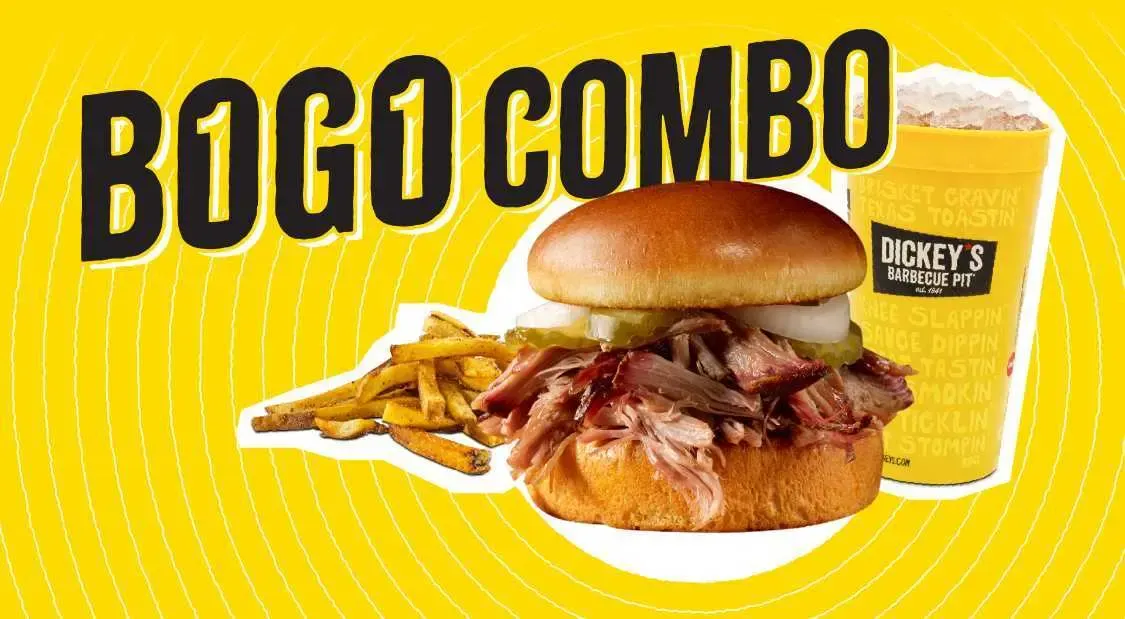
Sandwich freebie cards aside, Dickey’s offers many discounts to its customers. On June 27, for example, the chain offered a buy one-get-one-free deal on combos, equivalent to a 50% discount.
Restaurant Dive measured daily discounts at one Virginia Dickey’s in June and again in December, and calculated the discounts on three deals present in June and two in December.
Dickey's online discounts
“The discounts have just definitely hurt; they're not strategic,” Franchisee 2 said.
The frequency of discounts, including through its loyalty program, Franchisee 2 said, has hurt Dickey’s overall brand proposition. Instead of bringing in new customers, the chain’s discounts are being redeemed mainly by repeat users who know when to expect them: “You got a big group of couponers that are just only going to come in when the foods start cheaper, pretty much free.”
Petersen said the brand’s discounting strategies are tailored both to attract new guests and to increase frequency.
Digital and catering discounts hurt, too
Discounting practices at the barbecue brand range beyond just offering free cards or time-limited discount specials. Digital channels and third party delivery aggregators — increasingly important order conduits for the brand — present consumers with more opportunities to redeem discounts, occasionally without franchisees knowing the orders are even discounted. Discounts on catering orders, which come with high ticket totals, mean franchisees sometimes end up eating steep discounts with little preparation.
Franchisee 2 estimated that 70% of orders at his restaurant come through digital channels. Some digital orders, Franchisee 2 said, aren’t always clearly marked as discounted, exacerbating problems with sales projections.
Franchisee 2 said that about half of digital orders at his locations are discounted. Those discounts don’t appear on the tickets as they’re printed in the store, which can lead to confusion.
“You think you're getting paid one thing and then [customers] are getting a deal,” Franchisee 2 said. Dickey’s franchise disclosure document does not specify whether the brand informs its franchisees about deals ahead of time.
According to Petersen, only about 3% of digital orders have some sort of discount applied to them. Dickey’s informs its franchisees of all marketing campaigns through weekly marketing calls, he said.
Boisture said a minority of owner-operators regularly attend the marketing call.
Franchisee 1 said discounting on digital orders was so extreme that he doesn’t advertise the Dickey’s loyalty program or digital channels in-store. About half of the orders coming to Franchisee 1’s store through Dickey’s owned channels are discounted, while those from third-party sources — like DoorDash and Uber Eats — often also have discounts.
“If [Dickey’s] wants to run an ad campaign or a discount campaign, they go directly to DoorDash and they'll run it, and that'll get put on your account,” Franchisee 1 said. “If you’re not watching closely, then that campaign can run for months… and you're not able to put an end to it.”
Boisture, however, said he didn’t think the brand offered digital discounts without consulting store operators.“To my knowledge, there's no digital offers going out without the approval of owners.”
Franchisee 1 said the digital discounts typically range between 20% and 50%, with a strong emphasis on buy-one-get-one deals in recent months. In his experience Dickey’s very rarely discloses when it’s running a discount campaign, he said.
Dickey’s website offers discounts to diners right off the bat.
When Restaurant Dive was reporting this story during the spring and summer, Dickey’s site featured a pop-up tab that read “Win up to 20% off your online order.” Clicking on this opened a spinning wheel that purported to offer discounts in increments between 5% and 20%.
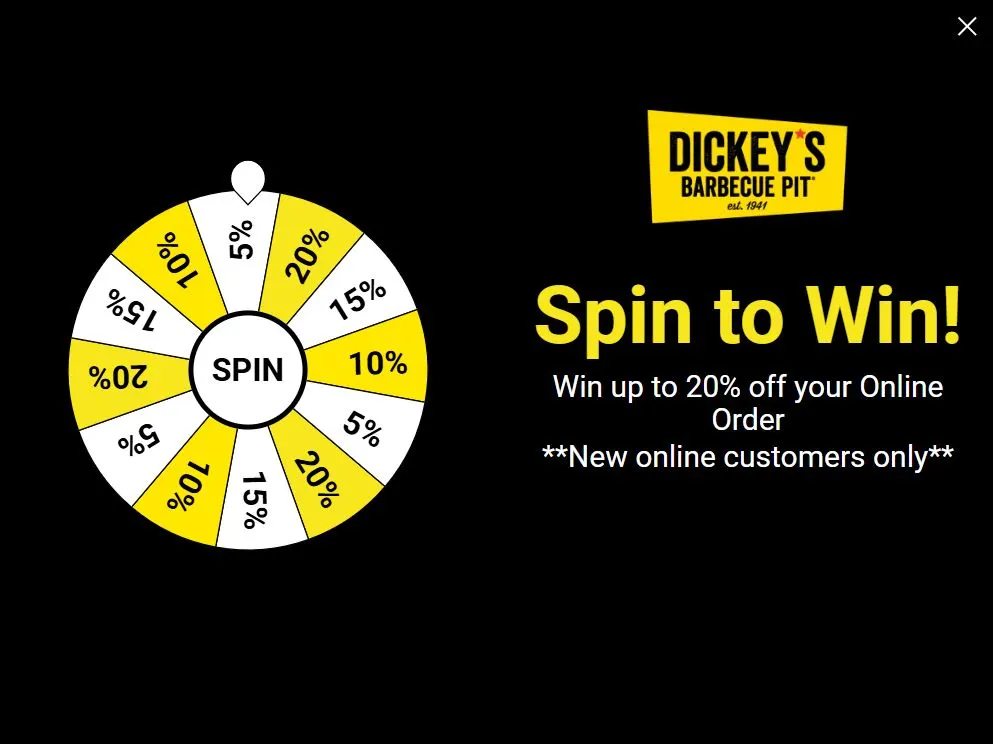
Restaurant Dive spun this wheel in 20 different browser sessions and got the 20% discount each time, instead of one of the other possible discount levels. The discount wheel was supposed to be available for first-time online ordering customers and requires an email address to sign up for it. Restaurant Dive never finished placing an order.
Petersen said Dickey’s varies the discount returned by the wheel based on seasonality, and that spring and summer months — the periods Restaurant Dive initially spun the wheel — were slack seasons where the brand employed greater discounting.
After Restaurant Dive interviewed Petersen in early October, the pop-up for the discount wheel no longer appeared when Restaurant Dive attempted to place online orders using different computers and web browsers.
“Any which way you look, you’re going to find a discount,” Franchisee 1 said, adding that the online discounts had a substantial impact on his margins.
Dickey’s also offers discounts — often 20% — on some catering orders. Franchisee 1 said these orders can range into the low thousands of dollars, and related discounts severely erode his margins.
“We’ve [had] orders that are $400 discounted,” Franchisee 1 said.
Petersen said Dickey’s only offers catering discounts up to a threshold set by individual franchisees.
The section of the brand’s owner’s manual that covers profit expectations forecasts catering orders as having no additional hourly labor costs or occupancy costs. Dickey’s estimates, in the same section of the owner’s manual, that catering orders should comprise about 15% of sales.
Despite the expectation that catering orders account for nearly one-sixth of sales, Boisture said that catering orders ought to be purely incremental to labor costs.
Petersen said catering labor was built into the model, and that specific costs associated with large, one-time orders would be covered by catering and delivery fees.
Dickey’s loyalty offers frequent discounts
Loyalty programs are another facet of the brand’s discounting strategy. While many restaurants use these programs to offer narrow ranges of discounts, or to incentivize particular consumer behaviors, franchisees say the frequency of loyalty promotions and the brand’s estimates of cost-of-goods sold, eat into margins still further.
An overreliance on loyalty transactions also trains consumers to treat brands as discounters. Starbucks, to give a particularly famous example, recently decided to back away from using its reward system primarily for discounting as it was hurting the brand’s premium positioning.
When Dickey’s overhauled its loyalty program in 2024, the brand stuck with a points-per-dollar model but tacked on a host of other features, according to a press release. Those included: “treating our most loyal barbecue guests by introducing special Mystery Rewards, which are awarded every four transactions.” Bonus points opportunities and “personalized rewards, catered specifically towards their favorite barbecue offerings,” are also distributed.
“They send points to accounts just to try to drive frequency. And some of that is valid. But how often are you doing that?” Franchisee 1 said.
Both franchisees said the frequency of discounting and loyalty promotion bring in consumers, but those consumers are not an asset for operators.
Franchisee 1 said such customers sometimes exploit the “surprise and delight” aspects of the brand’s loyalty program. This exacerbates other problems facing operators and eats into margins — the brand offers “special mystery rewards every four transactions,” according to a press release announcing its 2024 loyalty overhaul.
“We’ve literally become a discounted brand. [Diners are] not going to pay full price. I used to say [Dickey’s] was Bed Bath and Beyond, back when Bed Bath and Beyond was still in business.”
Franchisee 2
A Dickey’s operator in the Mountain West
Petersen said that the brand does not actually offer particularly frequent loyalty discounts — only 0.31% of orders are part of some sort of loyalty deal, per Dickey’s reporting.
Petersen said it was misleading for franchisees to emphasize the full menu price of an item that a customer redeems. Instead, he said, operators should focus on the cost of goods sold.
“When I go down the street and buy that pulled pork sandwich that restaurant is selling it at $9.99, but the owner of that restaurant, the cost of goods is what they’re servicing. So it’s $1.50,” he said. “That's what the cost of that item is, not the $10 that the guest pays.”
But a $1.50 COGS on a $9.99 menu item is well below the 30% COGS Dickey’s estimates in its operator manual that its franchisees run in general.
Is Dickey’s a discounted brand?
Overdiscounting leaves detectable signs in a brand’s payment data, deWilde said.
A restaurant chain with lower average tickets than close competitors and a lower repeat rate likely has customers who are buying opportunistically, rather than a strong base of loyal, returning customers, he said.
Claim’s data shows those red flags for Dickey’s relative to other fast casual barbecue joints.
“We’re able to have a sense of whether things are discounted because we have a good sense of industry averages for different kinds of restaurants,” deWilde said. Dickey’s average ticket is meaningfully lower than close competitors, according to Claim’s data on spending at barbecue chains, though this does not cover all of Dickey’s store system because Claim’s user base is geographically concentrated in college towns and a small number of major cities.
“We’re seeing a lower average order value [at Dickey’s] than we’re seeing with other brands in the same space. It tells us that their acquisition strategy is oriented pretty heavily around value,” he said.
Dickey’s, Petersen said, has an average ticket of about $38 dollars, and Boisture disputed the notion that Dickey’s is a discount brand.
“It's clear that we have a tremendous amount of our people that pay rack rate,” Boisture said. “I don't think it's a heavily discounted business by any stretch of the imagination.”
For franchisees, strategy reliant on discounting can make it difficult to hit profitability benchmarks, or to make a profit at all. Documents shared by franchisees with Restaurant Dive show that Dickey’s wants its operators to have a 15% four-wall margin — Petersen confirmed that the company’s model anticipates franchisees will see a roughly 15% margin.
Franchisee 1 said this was based on unrealistic estimates for real estate costs, cost of goods sold and labor costs.
“The stars need to really align,” Franchisee 1 said. “If you’re giving 20% away like that, that's a loss for me.”
Boisture said that franchisees could attain the 15% margin by controlling food and labor costs.
“There's been far too much time and space and energy spent on pointing fingers at [Dickey’s Barbecue Restaurants International]. And I think the owners and operators of these businesses need to take responsibility, quite frankly, for what they signed up for and what they invested in,” Boisture said.
Dickey’s franchise disclosure document doesn’t include estimates of financial performance, but both Franchisee 1 and Franchisee 2 said the brand’s unit volume averages about $500,000 — quite low for restaurants. Famous Dave’s, for instance, a similar fast casual barbecue brand, has an average unit volume of about $2.6 million, according to its franchise disclosure document.
Petersen declined to share Dickey’s AUV.
The discounting brand strategy and reliance on digital orders could make it hard for Dickey’s operators to turn a profit, Franchisee 2 said, echoing deWilde’s concerns that the chain’s tactics may attract low-value customers. Petersen asserted the brand has grown in 2025 after contracting in 2024; however, the number of units listed as open on Dickey’s website decreased from 318 in June to 314 in December. Petersen acknowledged that there has been a period of instability in the brand’s footprint.
“We have not been shy from saying that in the last few years we've had to refocus our energy on our owner operators,” Petersen said. But other brands have faced significant closures and instability — Petersen pointed to Starbucks and Salad and Go’s recent closures as indicative of broader issues in the restaurant sector.
Boisture took a more historically focused view on the brand’s store closures and transfers in recent years.
“There are cycles in business where you will see periods of rapid growth and then you will see some constriction. I think that's just called America,” Boisture said.
Dickey’s said in an email to Restaurant Dive that the brand has resumed growth and that it collaboratively develops its marketing strategies with franchisees.
“We are in a strong period of growth, with 46 new locations opened in the first three quarters of 2025 alone, demonstrating the strength of our brand and the success of our Owner/Operators,” a Dickey’s spokesperson wrote.
Several franchisees have sued Dickey’s over its franchising practices, claiming Dickey’s gave them inflated sales projections and lower-than-accurate cost estimates. Last fall, a Michigan franchisee filed for bankruptcy, citing “extreme and unreasonable demands,” on operators.
Dickey’s has responded to this instability by pausing the expansion of its virtual brands and refocusing on its core menu.
“It's just that continuing snowball effect,” Franchisee 1 said. “All these high-quality operators have exited the system, because their investment is going to shit and they don't want to be a part of it anymore.”