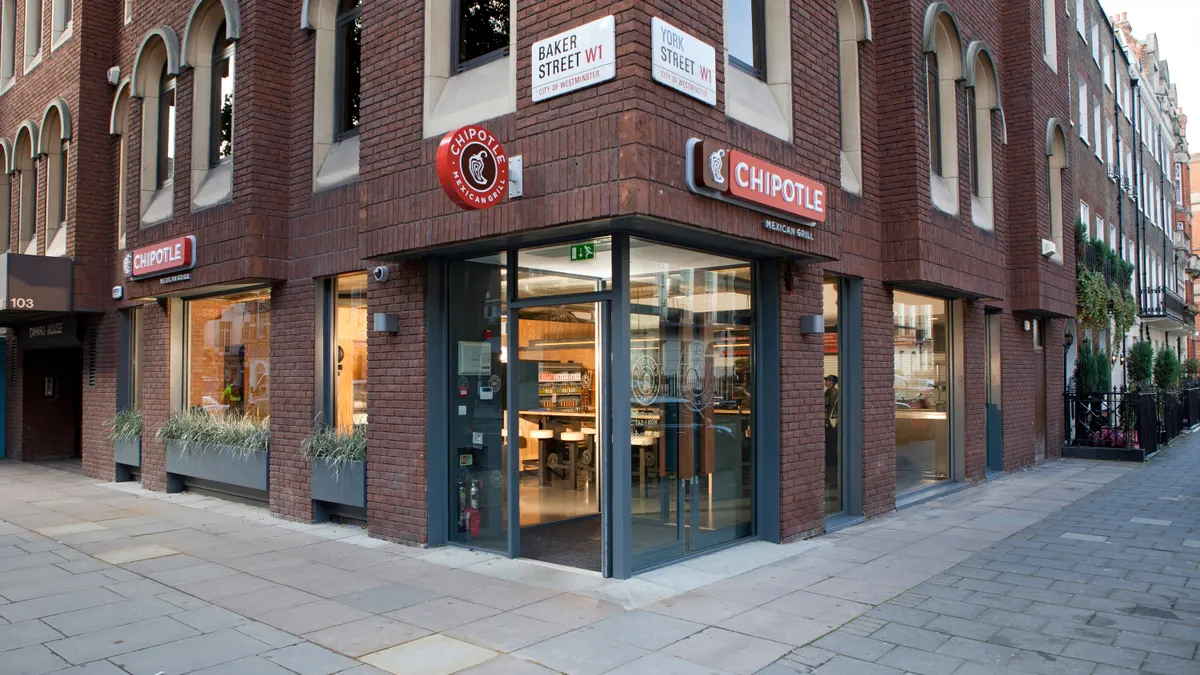

Fast-casual restaurant chain Chipotle Mexican Grill could potentially have as many restaurants outside the U.S. as it does in the U.S. one day, given several decades of additional growth, CFO Adam Rymer said.
In considering the company’s international portfolio, “there's just so much space for us to grow, whether it's in our company operated makeup when it comes to Western Europe, as well as many partner-operated restaurants outside Western Europe,” Rymer told CFO Dive in an interview.
Room to grow
The Newport Beach, Calif.-based company is “really starting to ramp up our international growth,” Rymer said, pointing to several partnerships with brand franchise operators and food groups the chain inked in recent years to open new locations in areas including Dubai, Kuwait, Mexico, Singapore and South Korea.
In September 2025, for example, Chipotle announced it would expand into Asia for the first time by partnering with global food company SPC Group with the aim of opening new locations in Singapore and South Korea this year, according to a press release at the time.
The fast casual brand’s international portfolio includes 82 locations in Canada, 22 in the United Kingdom, seven in France, two in Germany and 15 partner-operated units in the Middle East, according to the company.
The company has seen an “incredible interest” when it comes to international expansion, Rymer said, which the CFO credits in part to Chipotle’s status as an “iconic brand” and its approach to cuisine — which includes heavy vegetable content, is high in fiber and protein and “really resonates everywhere in the world,” he said.
Rymer took the top financial seat at the Newport Beach, Calif.-based company in 2024, his latest role in a 17-year tenure at the fast-casual restaurant. His past roles at the company have included VP of finance and senior director of FP&A, field finance and treasury.
Entering new markets is a key tenant of the company’s “Recipe for Success” growth strategy — a transformation plan put in place under CEO Scott Boatwright after Chipotle reported flagging same-store sales, CFO Dive sister publication Restaurant Dive previously reported.
Other key aspects of the transformation strategy include modernizing the company’s business model with the introduction of new technologies like artificial intelligence, menu innovation, and revamping the company’s rewards program.
To drive innovation, Chipotle also hired Hyatt Hotels alum Arlie Sisson in the newly created role of Chief Digital Officer in April, and named Fernando Machado — whose past expertise includes roles at Burger King and Tim Horton-owner Restaurant Brands — as chief brand officer, according to an April press release.
The fast-casual chain is seeking to continue its growth push throughout 2026, targeting a range between 350 to 370 new restaurant openings for the full-year, including 10 to 15 international partner-operated restaurants, according to its first quarter 2026 earnings report. For the company’s first quarter ended Mar 31, Chipotle saw a 0.5% jump in comparable restaurant sales and opened 49 restaurants, according to its earnings release.
“We believe that we will continue to grow at this eight to 10% pace into the foreseeable future,” Rymer told CFO Dive.
Inflation in the margins
As Chipotle moves forward with its transformation strategy, for Rymer, a key focus since taking the CFO seat has been on ensuring the finance function has “the right people in place” in order to give “the best insights to our executive team,” he said.
The company’s controller — 11-year Chipotle veteran Matthew Bush — has been serving the role for about a year, for example, Rymer said. The CFO also spends much of his time with the company’s VP of finance, Michael Johnston, he said.
“It's just a really interesting dynamic out there, both from a visionary standpoint, from a consumer standpoint, so just making sure that all our teams focus on the right areas” is critical,” Rymer said.
That’s included tapping new technologies, such as automation — and AI, where the business is in the early stages— inside of the finance function so the team can handle the operations of an expanding number of restaurants and “so that we can grow with the company, but at a pace that creates leverage, if you will,” Rymer said.
Meanwhile, “on the more strategic side, finance development, corporate finance is really helping our teams understand the post intakes to all of that growth,” he said.
Having a strong team in place that can bring that clarity is crucial in an environment where inflation and rising food costs are impacting consumer behavior, he said. The finance team plays a key role in helping the business understand shifting consumer dynamics: identifying company strengths or “where there might be pockets of weakness, so that we can inform our teams accordingly, and really adjust the strategies,” he said.
“Consumers are always discerning about how they want to spend their money, but when they're under pressure, they become even more discerning,” Rymer said.
Rising prices across areas such as beef and freight also pushed up food, packaging and beverage costs for Chipotle’s Q1, which reached 29.6% of total revenue for the quarter compared to 29.2% for the prior year period.
While “typically, we would offset inflation through price increases, because of the consumer environment, we’ve been really kind of leaning away from taking big price increases,” Rymer said. In a February earnings call, Rymer previously flagged the company’s “disciplined and measured approach” to raising prices in 2026, noting he expected the full impact to be about 1% to 2% throughout the full-year.
“We could do that because of the strength of our balance sheet, the fact that we own and operate all of our restaurants, we can allow inflation to heat in margins,” Rymer told CFO Dive. “That's an investment that we're making right now, and our value proposition that is resonating, I think, really, really strong with our guests.”