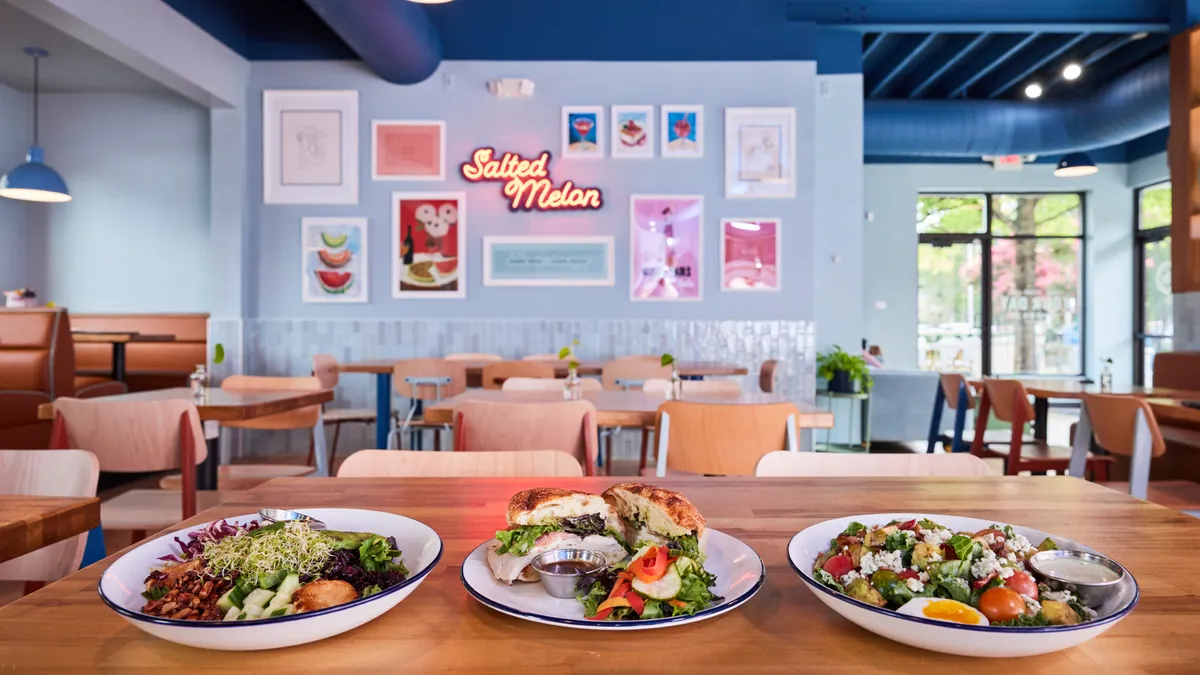

At 11:30 a.m. on a weekday at Salted Melon, the lunch rush is already moving.
Large third-party delivery orders are stacking up on the line. The dining room is filling. Guests are stepping up to the counter. In the kitchen, seven people are working through tickets—some for people sitting ten feet away, some for drivers who haven’t arrived yet. Up front, six more are managing the counter, the coffee station, and the expo shelf.
This is the part Thomas Coker and his team have prepared for since 10:30 a.m. that morning.
Thomas owns Salted Melon, an all-day cafe with four locations across North Carolina and Georgia. The model is counter service: Guests order, get a number, and find a seat. The model is designed for efficiency on paper, but with 200 orders between 11 a.m. and 1:30 p.m., it becomes something else entirely.
“It does get stressful when you have these large third-party orders coming in and at the same time your dining room’s filling up,” Thomas says. “You need to make sure that in-store customers are being taken care of.”
Below is a look at a recent lunch service at Salted Melon. Thomas walked Toast through what it took to make it happen.
The work that happens before the rush
The operational system designed to support this work was built before anyone clocked in for lunch. Positions are assigned every morning: register, smoothies, coffee, expo, food runner. The kitchen runs the same way. By the time the first ticket prints, no one is asking where they should be.
“We allocate positions to everyone on staff each day,” Thomas says. “They put together a playbook for where specific front of house employees are going to be working.”
Holding the line
Right before noon, the volume peaks. This is where the prep work really shows. Stations are running, positions are set, and the kitchen and front of house are moving in sync. But, at this pace, things can occasionally go slightly sideways.
With self-pickup and no handoff, orders are occasionally picked up by the wrong customer. The team remakes without hesitation, no questions about payment or receipts, and the expo calls it back to the kitchen without breaking stride.
That’s the job. At Salted Melon, whoever runs expo is the voice that holds the rush together, calling out long-lead tickets, flagging anything that needs attention, and keeping the kitchen informed in real time while the counter stays moving. “Whoever is running expo has to be vocal and somewhat assertive with what is needed,” Thomas says. “Because ultimately they’re getting what the guest needs. That’s really all that matters.”
After the rush
By 1:30 p.m., the large orders have tapered off. The dining room is still active, the counter is still moving, and somewhere around 200 to 250 orders have moved through. The expo gets quieter, and the kitchen starts to breathe.
Thomas would tell you the rush itself is almost beside the point.
Each Salted Melon location is built to be the neighborhood spot, for the people who live and work nearby, for the regulars, for the first-timer who walks in and lights up at everything happening at the counter. Doing it well, every day, is just how you earn it.
“The important thing is to stay calm and collected so the rest of the staff isn’t going awry,” he says. “You’re just moving in a very fast-paced way.”
The throughline across every part of Salted Melon's lunch service is preparation. Knowing who's where, what's needed, and how to absorb the unexpected. At this volume, that groundwork is often what helps make a smooth service possible. Because in a few hours, it starts again.
To learn more about Toast and the “Built For Busy” brand and campaign, visit www.toasttab.com.