In 2025, something odd happened in the United States. Thousands of fast food restaurants began to serve chicken tenders.
Some of them — McDonald’s roughly 13,500 stores, for example — once served similar products, while others — Taco Bell’s roughly 8,000 stores — tested them as an entry into a new product category.
At the same time, brands that have historically centered their menus around chicken tenders saw significant growth: Raising Cane’s, Wingstop, Dave’s Hot Chicken and Zaxbys combined added hundreds of units. Even KFC, long the sick man of fried chicken, finally managed to turn its same-store sales around.
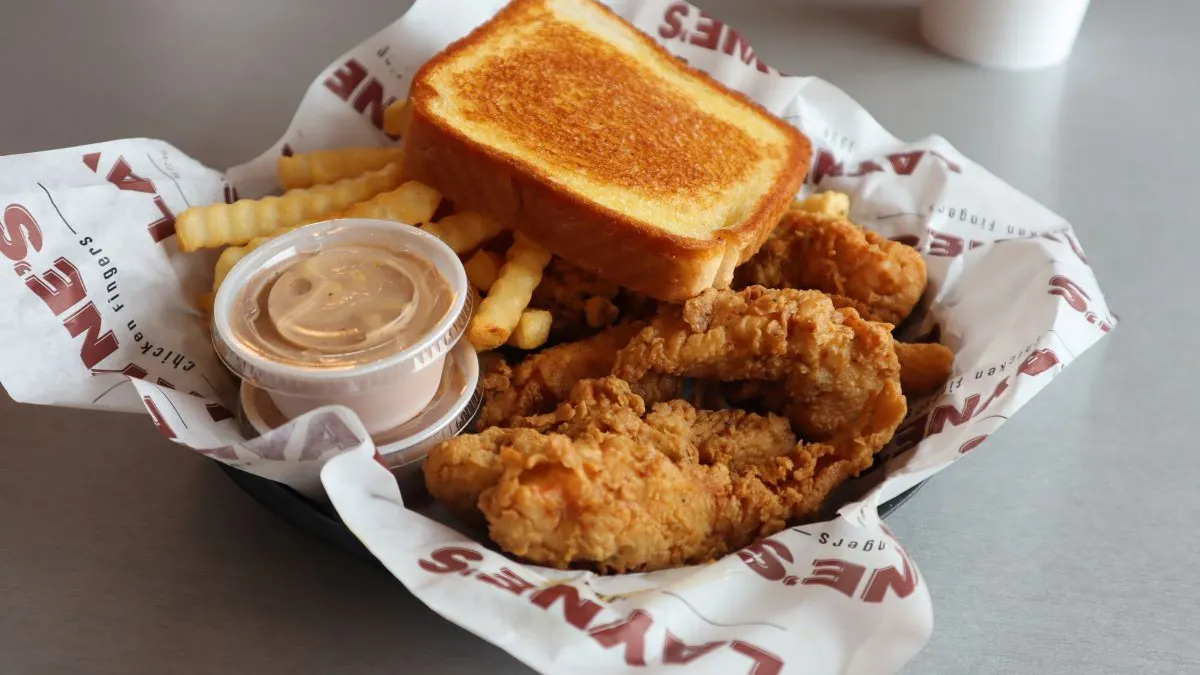
Now, Layne’s Chicken Fingers, a premium chicken tender brand with just 41 units, might seem like a latecomer to a burgeoning national market. But when CEO Garrett Reed purchased the chain in 2017, he saw the potential of a once-cult restaurant that started in a college town in Texas.
And Layne’s is growing quickly. In 2023, it had 10 units and targeted a footprint of 50 restaurants by 2027. The brand more than doubled its unit count to its current 41 locations in 2025 and operates in nine states, Reed said. Late last year, the chain signed franchising agreements for 68 restaurants, including a 44-store deal in its home state of Texas. These franchising moves are helping the chain speed up its development.
“We'll do another 100% [unit growth] this year,” Reed said. The majority of the system is franchised, and existing franchisees will be responsible for most of its growth in 2026. Reed said the brand has an expansive, multi-decade growth runway.
“We believe that the United States could handle somewhere in the neighborhood of 4,000 Layne’s,” Reed said. That may take 20 years to develop, he added.
A category of two
Key to that growth vision, Reedy said, is Layne’s brand position. Only Layne’s and Raising Cane’s focus on selling a premium chicken tender, Reed said, though tender-focused brands like Zaxbys are clear competitors. Other premium brands are in a slightly different competitive niche; Nashville Hot Chicken, for instance, is a category focused on a specific flavor profile catering to different cravings and occasions than unadorned chicken tenders.
“In the premium chicken tender market, there's a ton of runway. The desire for that product is incredible,” Reed said. “I'm surprised there's not more competition coming into the market.”
Reed said that the expansion of chicken options at QSRs hasn’t altered the demand for premium chicken tenders. The structural factors that have led to chicken’s expansion, including its price compared to beef, are not changing, Reed said. Plus, QSRs are preparing their tenders differently.
Reed defined the premium chicken tender market as being defined by meat cuts and processes. Many other brands, Reed said, cut breasts to look like tenders or to be the size of them. But not Layne’s.
“The breast is a more woody piece of meat, the tender is truly like the filet of the chicken,” Reed said.
“Most QSRs are selling you a pre-battered chicken breast, or a low-end tender, where we take the time to marinate, hand-batter, and cook-to-order our tenders, and then our sauces are made in-house,” Reed said.
A flexible construction strategy
Reed brought extensive experience to Layne’s from Main & Main Capital Group, where he worked in real estate development, often with restaurant chains, as a managing partner, according to his LinkedIn profile.
“We built for many, many national brands [and] restaurants. We built for Dutch Bros coffee. We built for Starbucks coffee,” Reed said. Development, he said, was his strength, and he brought many of his former construction and design employees with him to Layne’s when he bought the chain in 2017.
“It was cheating a little bit,” Reed said. “We already had these guys that I'd worked with for years and years, and I just took the best ones and brought them over to Layne’s.”
Reed said the chain develops through a mix of new builds and conversions of second-generation real estate. The brand has a roughly 2,600-square-foot prototype for new construction, but it also has considerable experience converting restaurants that don’t fit those parameters.
“If there is a quality second-generation building, we love that, because speed to market is a lot quicker,” Reed said.
Instead of targeting geographies, Layne’s targets demographics of consumers: Upper-income suburbia. Reed said the chain isn’t necessarily concerned with expanding in markets adjacent to its existing locations. Instead, Layne’s looks to build long-term relationships with franchisees.
“We know we have the supply chain built, we know that we have a great marketing team. And so what we're looking for is ‘can somebody execute and operate our brand to high standards?’” Reed said.
Most franchisees of Layne’s are operators of other brands, and part of Layne’s vetting process includes analyzing the quality and health of the operator’s other brands.
“We don't even consider the mom and pop franchisees that might have one unit or two units,” Reed said.
Franchisee economics make growth easier
Despite its premium market position, Layne’s works to constrain costs for operators and improve return on investment, Reed said. One way it manages this is by bulk purchasing food and equipment as a brand and charging operators at cost.
“We just contracted for 7.5 million pounds of tenders,” Reed said. “So we negotiated a deal with the chicken vendor and all of our franchisees pay exactly what we negotiated, the only difference is freight to their market.”
The brand uses similar purchasing tactics when it comes to equipment, like fryers. Layne’s is still small, so its ability to leverage scale in purchasing is still limited, compared to major chains, but no less important.
“We make our money on the 5% royalty, and that's the only way we make money, which is incredibly unique as a franchisor because just about every franchisor makes money on supply chain,” Reed said.
Layne’s menu is very simple, too, which helps minimize the cost of labor and goods sold. The brand serves chicken tenders, french fries, sandwiches made with tenders, a grilled cheese sandwich, a wrap, soft drinks, lemonade, iced tea, five different milkshakes and six different sauces.
Layne’s median food costs were over 29% of sales, with labor adding 24% and paper goods 3% in 2024, according to its 2025 franchise disclosure document. Zaxbys food costs tend to range from 31.8% to 33%, with labor between 23% and 28%, according to its franchise disclosure document, depending on restaurant performance.
Franchise Fast Facts
- Franchise fee: $45,000
- Royalty rate: 5% of Gross revenue.
- Marketing rate: 2% of Gross revenue
- Total investment: $451,500-$1,050,000
Source: Layne’s Chicken Fingers’ 2025 franchise disclosure document