Dive Brief:
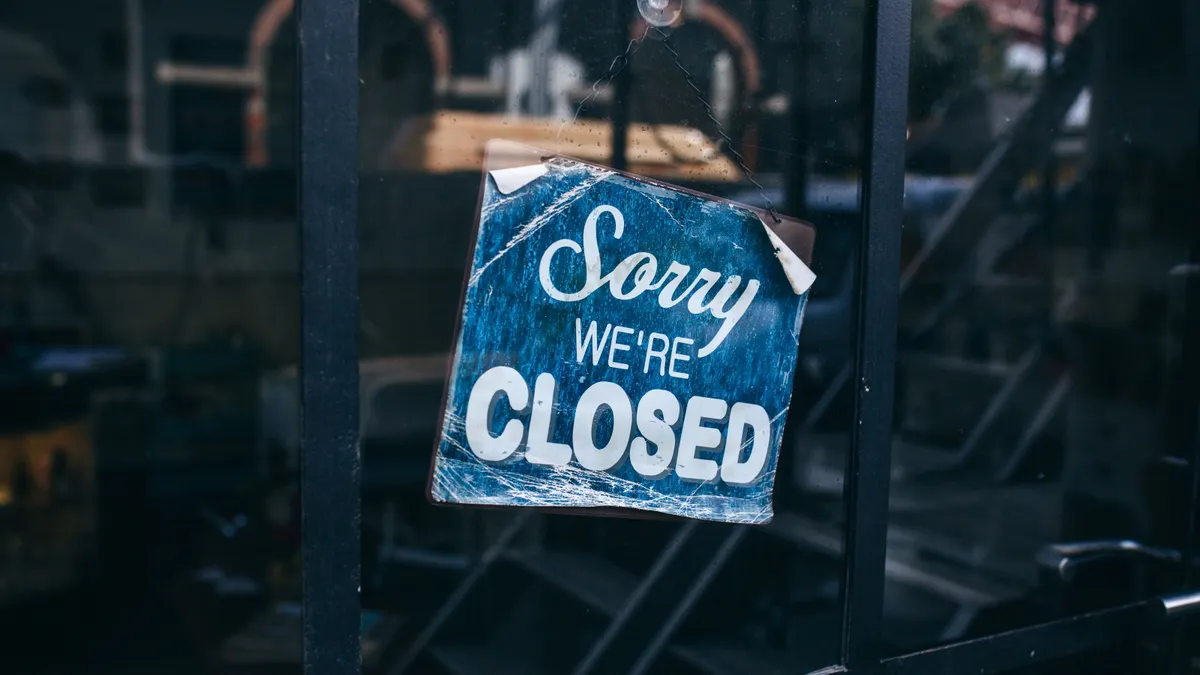
- Black Box Intelligence data revealed that 9% of full-service restaurants are at risk for closure this year, with the shuttering of casual dining chains continuing to outpace openings, the company said in a recent report. The segment has seen more than a 3% drop in net unit growth since 2022, the report said.
- Black Box said restaurants were considered at risk if units lost 30% or more of peak sales in 2025.
- Limited-service restaurants are showing more resilience, with 4% at risk of closure this year. Both QSRs and fast casual segments have seen net unit growth of 5.8% and 15.5%, respectively, since 2022.
Dive Insight:
Overall, 85% to 90% of the restaurant industry remains resilient, with only 10% to 15% operators at risk, Black Box Intelligence said. Closures also bring opportunities for brands looking to expand. Many chains, including First Watch and Dine Brands, are eyeing second-generation space to save on opening and operational costs.
While limited-service restaurants are at less risk of closures, a handful of chains, including Wendy’s, Papa Johns, Jack in the Box and Pizza Hut, have already announced they plan to close hundreds of underperforming restaurants. Closures aren’t always a sign of broader problems. Noodles & Company has previously said closures of its restaurants have led to higher sales at nearby locations as consumers visit them instead.
Black Box Intelligence confirmed that observation, saying that “demand doesn't simply vanish,” but it moves to the closest brand that can offer value and consistency in execution. Strategic closures can also lead to healthier systems for the chains undergoing closures.
“The silver lining here is that a leaner portfolio often becomes a stronger one,” Victor Fernandez, Black Box Intelligence vice president of insights and knowledge, said in a statement. “When a brand stops subsidizing its bottom 10% of units, it can reallocate capital, management attention, and marketing spend to the units with the highest growth potential. This ‘traffic transfer’ effect is a powerful tool for survival in 2026.”
Casual chains, including Red Robin and Denny’s, have closed locations in the last year. Red Robin said in February 2025 that it could close up to 70 restaurants during the next five years. However, that number could change over time. The chain made improvements at 20 restaurants that were on the closure list and said it will no longer pursue closures, Red Robin CEO and President David Pace said during a February earnings call. Red Lobster also indicated it could close some locations to cut costs.
“In an environment where cumulative inflation has driven costs up by nearly a third since 2019, it is virtually impossible for a unit to remain viable after losing 30% or more of its peak sales,” Victor Fernandez, Black Box Intelligence vice president of insights and knowledge, said in a statement. “For the 3% of Full-Service restaurants that have seen sales drop by more than 50%, the question for 2026 isn't if they will close, but when.