
The dinner rush looks different for every restaurant. One kitchen is pacing courses for an eight-top at 7:30 p.m. Another is dropping fries in batches and watching ticket times climb. The way each one uses AI looks different, too.
New data from Toast shows that the kind of restaurant you run shapes how, when, and how often you use AI. The 2026 Restaurant AI Report, which looks at aggregated, anonymized usage data from Toast IQ, the AI assistant built into the Toast platform, across Q2 2026, found that fine dining managers sent more prompts per location than any other concept.¹
Key findings from the Restaurant AI Report include:
- Fine dining managers sent 67% more prompts per location than fast casual managers. Full-service restaurants sent 41% more, casual full-service 38% more, and pizzerias 33% more.
- Sales and revenue questions were the largest category, at 30% of all threads.
- About 12% of menu and inventory questions included a request for a change right in the chat, most often an update to item stock.
- 54% of user-initiated AI interactions originated from mobile devices rather than desktops.
- 53% of all prompts landed during peak lunch or peak dinner service, against 15% at nightly close.
How do different types of restaurants use AI?
According to the report’s findings, every concept uses AI to protect margins. What changes is where they look. Fast casual managers asked about payments and store-to-store performance more than any other concept. Payment and tender breakdowns made up 10% of their sales questions, and comparisons between locations made up another 4%. That fits a model built on speed and consistency across locations.
Fine dining managers focused on the dining room. They directed 8% of their sales threads toward server performance, nearly four times the fast casual rate. And when they audited for losses, 29% of those questions were about manager comps, double the platform average. Caught during service, a problem comp can still be fixed before the night closes.
What are the most common ways restaurants use AI?
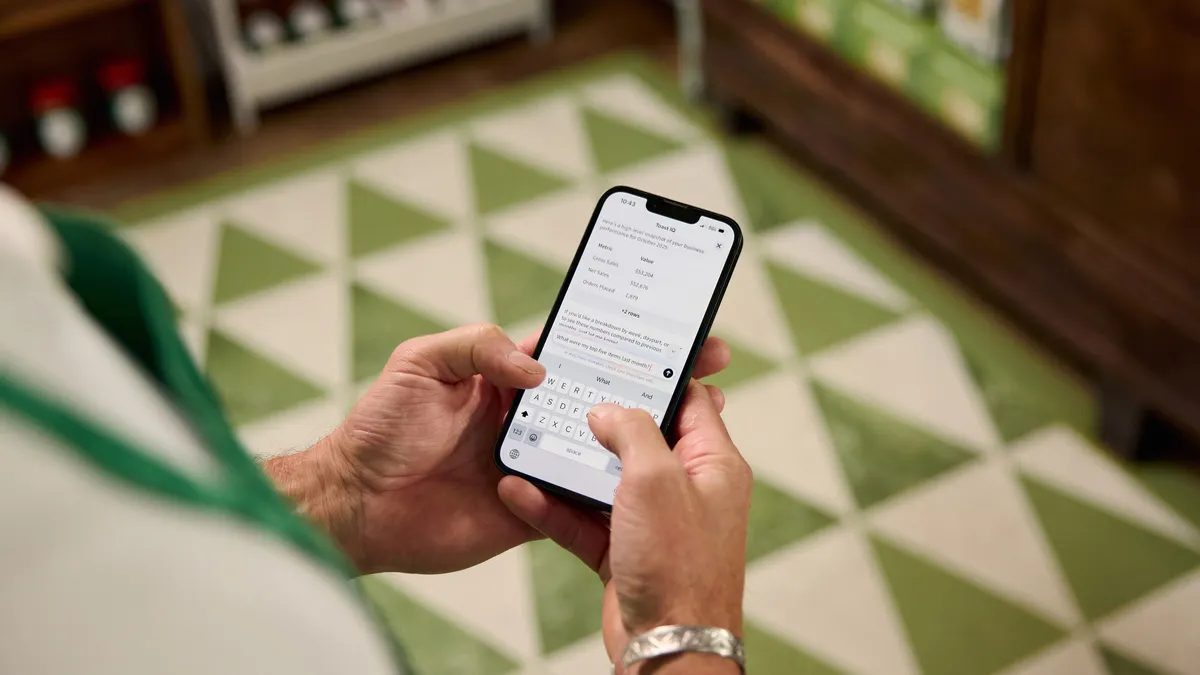
Managers ask about sales more than anything else. Sales and revenue queries accounted for 30% of all Toast IQ threads. The data shows that managers don’t just ask. They ask for changes. Menu and inventory questions came next, with about 12% of queries including a request for a change in the chat.
Operators are also on the move. AI usage leans slightly mobile, with 54% of interactions starting on a mobile device. The task shapes the device, too.
Sales-related prompts made up 40% of mobile activity compared to 19% on desktop. Operators also submitted 32% more labor and staffing prompts on mobile devices. A phone in hand may mean a manager is on the floor, where there's still time to act on the answer. When labor runs high at 7 p.m., they can shift coverage before the overtime hits.
When do restaurant managers use AI the most?
Managers reach for AI when service is heaviest. The lunch and dinner rushes accounted for 53% of all prompts. Morning prep took 19%, the nightly close 15%, and the mid-day lull just 13%. That changes what the numbers are for. A report pulled the next morning explains a night that's already over. An answer at 7 p.m. can still change it.
How can operators measure the cost of waiting to use AI?
Time your delay. Every restaurant runs on two clocks. One shows when something happened. The other shows when you found out. Pick your busiest night last week and compare a few pairs. When did an item run out, and when did it come off the menu? When did a clock-in error happen, and when did payroll catch it? The lag between each pair is your cost of waiting. Run the same check 30 days after your team starts checking numbers from the floor.
What does this mean for restaurants?
According to the Restaurant AI Report, the questions change with the concept, the shift, and what's happening on the floor. The pattern underneath holds steady: Managers are checking their numbers while there's still time to act on them. A comp gets audited mid-shift. A manager asks the chat to mark an item out of stock. Overtime gets caught at 7 p.m. instead of on the next payroll run. AI is showing up in the middle of service, not just after it, and every trip to the back office a manager skips is more time with guests.
Methodology
¹ This report draws on aggregated, anonymized Toast IQ prompt data from April 1 through June 30, 2026 (Q2 2026), covering U.S. restaurant locations only. Retail locations are excluded. The period includes all days of the week and all hours of the day. Figures are rounded to whole percentages, so they may not sum to exactly 100.
Prompts, queries, questions, and searches all refer to interactions a restaurant worker started, whether by typing a question or tapping a pre-set prompt on screen. This applies to every usage figure in the report, including the device split.
This report is an analysis of prompts: the questions and requests restaurant workers entered into Toast IQ. It does not measure whether any resulting actions were completed. Where the report describes actions, such as updating item stock, it refers to changes requested through chat, which are not confirmed as saved in the product.
Topic categories, sub-topics, and the loss prevention and menu groupings were assigned by keyword and phrase matching against prompt text, not by a built-in product taxonomy. Categories are therefore approximate, and a prompt touching more than one subject may be counted under a single category.