Dive Brief:
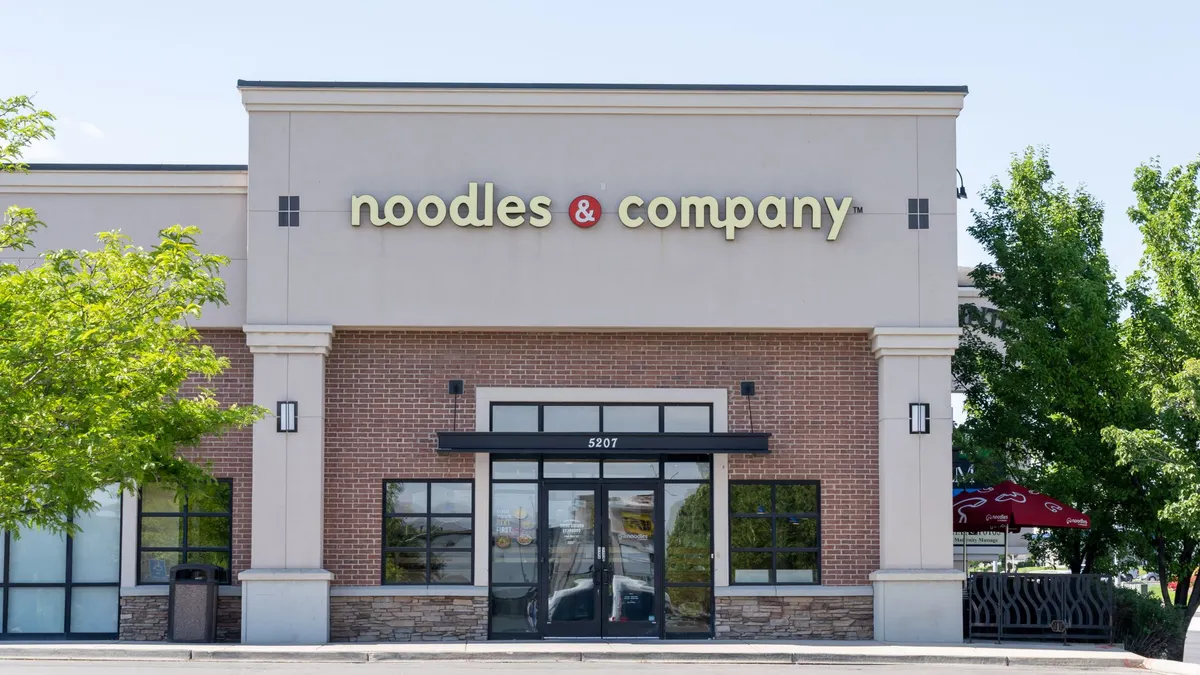
- Noodles & Company is facing activist investor pressure from Galloway Capital Partners, which has acquired a 6% stake in the company, according to filings with the U.S. Securities and Exchange Commission.
- Galloway recommends that Noodles & Company, which had 349 company-owned units as of Sept. 30, sell 200 of those locations to generate about $60 million in proceeds, “enabling the Company to retire a substantial portion of its high-cost debt,” Chief Investment Officer Bruce Galloway said in a letter to the chain's CEO.
- Despite outperforming some fast casual competitors in terms of same-store sales growth this year, Noodles & Company has been facing growing net losses, declines in revenue and negative operating margins. In September, the chain said it was exploring various strategic alternatives, including a full or partial sale.
Dive Insight:
Noodles & Company has also been closing underperforming units, and said in August that it will accelerate closures of ailing company-owned restaurants. The chain closed 20 restaurants last year and is on track to close 31 to 34 restaurants in 2025, CEO and President Joe Christina said during a November earnings call.
The chain has faced activist pressure from other firms in the past, and conceded a board seat to one such activist in 2024, Restaurant Business reported.
“We continue to be pleased with the results from closing underperforming restaurants,” Christina said. “The closures removed restaurants with negative cash flow from our system and — post-closure — we're seeing nearby Noodles restaurants experience an increase in sales and profits.”
He said that Noodles expects to “retain approximately 30% of sales [from closed stores] through transfer to neighboring units, consistent with the performance of recent closed locations.”
Noodles also began partnering with multi-unit franchisees a few years ago to become more of an asset-light company, but it has only 86 franchised units as of Sept. 30.
Noodles’ closures aren’t enough to appease Galloway Capital, which sees Noodles & Company’s shares as “materially undervalued,” according to the letter to management. Selling company units would pay down debt that has interest rates in the 9% to 10% range, reducing the chain’s leverage.
Galloway added that this move is similar to its turnaround efforts at Supercuts parent company Regis Corporation, a beauty chain the firm previously invested in that has closed hundreds of locations over the past few years.
“Equity value improved dramatically after executing a similar deleveraging strategy attributed to our activist involvement,” Galloway said.
“We see Noodles at a decisive turning point. Management has been proactive and transparent in reviewing all options, and the financial logic behind a balance-sheet reset and targeted store sales is clear,” Galloway said. “With the right steps, Noodles can remove bankruptcy risk, clean up its capital structure, and allow the equity to move significantly higher.”
Noodles & Company did not respond to a request for comment by press time.
Noodles & Company isn’t alone in facing pushback from activist investors this year. Cracker Barrel fought off its latest proxy fight with Sardar Biglari, which wanted shareholders to remove CEO Julie Masino from the board of directors. Denny’s, Dine Brands, El Pollo Loco and Jack in the Box have all faced activist investor challenges in 2025, as many chains face declining traffic and same store sales due to consumer price sensitivity and difficult macroeconomic conditions.