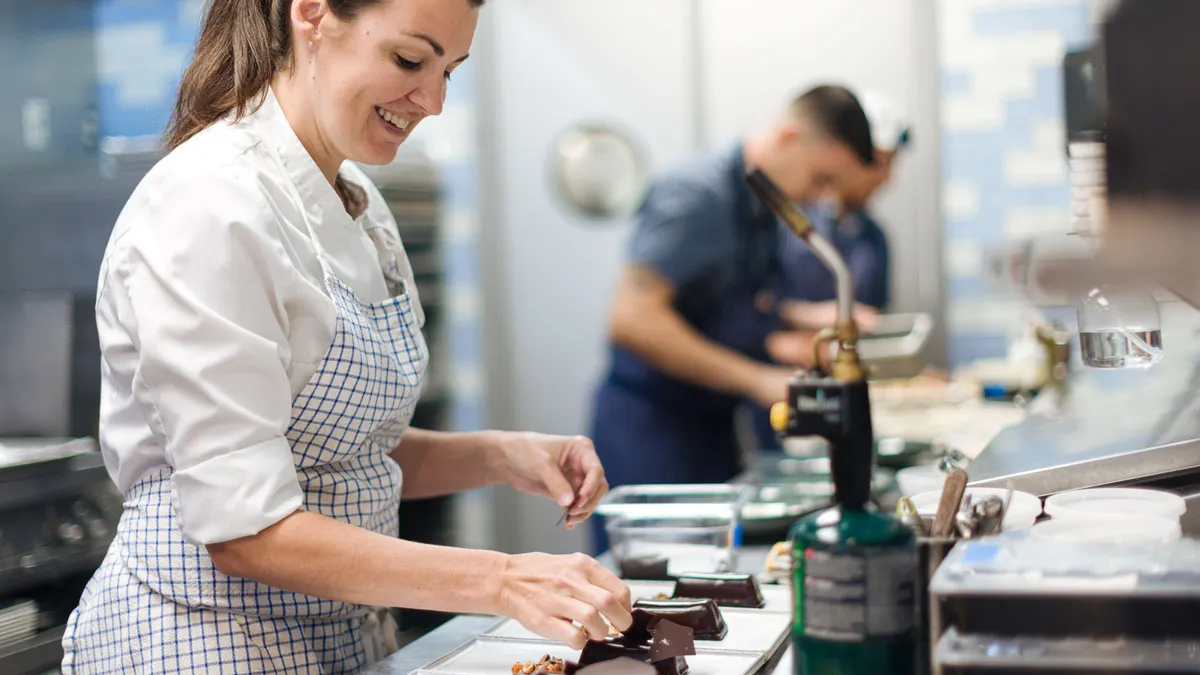
The following is a guest post from Elise Russ, co-owner and pastry chef at Clementine, a restaurant she runs with her husband John Russ. Opinions are the author’s own.
Somewhere along the way, restaurants stopped cooking.
Not entirely, of course. But little by little and for many different reasons, our industry has outsourced many of the fundamental skills that once defined professional kitchens: butchering meat and fish, making stock, making ice cream, building sauces, preserving produce. In 2026, cooking from scratch is no longer the standard — it’s becoming the exception.
Education and growth are two of the main pillars that Clementine is built upon. We strive to be a restaurant that doesn’t do things the easy way — rather, we do them the long, expensive and very complicated way. We believe that if restaurants stop teaching these foundational skills, the industry eventually loses them altogether. Which is probably why we don’t have another restaurant.
We came up in hotel kitchens at a time when luxury operations made nearly everything from scratch. They were among the few places with budgets large enough to support entire pastry teams and cooks dedicated solely to sauces. Almost nothing was purchased pre-made.
Fast forward to 2026, and that model is nearly impossible to sustain. Rising food and labor costs, paired with an uncertain economy, make every single penny count. Technique has become more valuable than ever, not just as a point of pride, but as a way to maximize ingredients, reduce waste and control costs. We often joke that the first role to disappear is the pastry chef, which makes having both a pastry chef and an assistant pastry chef feel like a crazy choice.
We are also committed to teaching our cooks the craft of cooking. As young cooks, molecular gastronomy kitchens were the most admired in the industry. But many of those cooks struggled to work an omelet station for Mother’s Day brunch or didn’t know how to make a simple stock because they were more focused on trends than on practicing the basics.
Culinary school can introduce you to the fundamentals at a basic level but it is essential to practice thousands of times to begin to understand the true nature of food and flavor. This memory has truly spurred us to make educating our staff a priority.
Teaching these skills comes at a cost. Buying whole fish so cooks can learn to butcher them — and then using the bones for stock — may lower food costs, but it significantly increases labor. We are constantly balancing what we can charge our guests with what it takes to do things the right way.
We also find that our staff has more respect for the animals and vegetables on our menu. When cooks handle ingredients in their whole form, they develop a deeper respect for them. It’s harder to waste a fish when it’s staring back at you on the cutting board. We want our staff to genuinely respect when it comes to wasting food and treat all ingredients with care and respect.
This style of cooking also strengthens our connection to the farmers and fishers we rely on, pushing us to choose ingredients that challenge and teach our team.
Another benefit of this cooking style is transparency; we know exactly what goes into the food we serve, to our guests and to ourselves. There are no hidden additives we can’t pronounce.
That clarity matters. It allows us to stand fully behind what we put on the plate, and to serve it with a sense of pride and accountability.
Our motivation isn’t completely altruistic. We love to eat and want to be able to eat good food when we retire, and if the young cooks of today don’t learn these skills, then the restaurants of the future have a very dim outlook.
From-scratch cooking teaches more than recipes. It builds problem-solving, prioritization and confidence, skills that are often lost in systems built around prepackaged ingredients and passive execution. Creating an environment where cooks are constantly learning, improving and being challenged matters deeply to us.
Doing things the hard way isn’t efficient. It isn’t cheap. But in 2026, it might be the most important choice a restaurant can make.