Dive Brief:
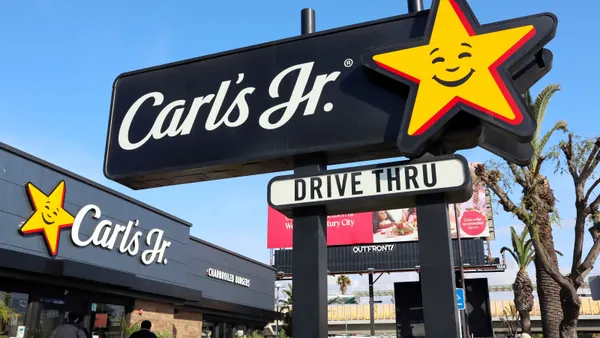
- A Carl’s Jr. operator, Friendly Franchisees Corporation, filed for Chapter 11 bankruptcy protections through the U.S. Bankruptcy Court in the Central District of California last week. The company filed for bankruptcy under various subsidiaries, including Senior Classic Leasing, DFG Restaurants and Second Star Holdings.
- The company operates 65 Carl’s Jr. restaurants across the Golden State and invests in and operates multifamily real estate, according to its website. The court filings did not indicate if the trouble with the operator’s real estate or restaurant operations led to the bankruptcy.
- The FFC is owned by CEO and founder Harshad Dharod, who acquired the Carl’s Jr. restaurants in 2000. The company claims on its website that after a few years, it drove profits and sales “far above the brand average.”
Dive Insight:
A Carl’s Jr. spokesperson said that the brand was aware of the franchisee’s filing in California, but doesn’t expect a broader impact on operations.
“This situation is specific to this individual franchisee’s financial and business circumstances,” the spokesperson said. “This has no impact on the operations of any other Carl’s Jr. locations, and we remain committed to delivering quality experiences for our guests, while driving profitable, sustainable growth for our franchisees and brand.”
FFC, per its website, is the largest Carl’s Jr. operator in California. Carl’s Jr. has 588 units in California as of 2025 — the most of any of its West Coast territories, according to its franchise disclosure document, but that number has declined by 4% from 2023, when it had 613 units in the state. The bankruptcy will only impact 11% of operations in the state, though it’s not clear if these locations will close as a result.
In 2025, Carl’s Jr. has an estimated average unit volume of $1.4 million according to Circana’s Definitive U.S. Restaurant Ranking 2026. That’s much less than half of the AUV estimated at McDonald’s, but just under Burger King’s $1.6 million AUV. Circana estimated that Carl’s Jr. consumer spend fell by 4% to just over $1.4 billion and that its location count dropped by 3% in 2025.
While it’s unclear what led to the operator’s bankruptcy, a handful of chains and franchisees have faced significant challenges in the industry of late, as consumers have pulled back on discretionary spending. QSRs like Wendy’s, Jack in the Box, Papa Johns and Pizza Hut have posted same-store sales drops over the past few quarters and said they would have to collectively close hundreds of locations across the country.
Other chains and franchisees have faced dire financials and declared bankruptcy this year. Fat Brands filed for bankruptcy protections earlier this year and is in the process of selling its assets. An Applebee’s franchisee filed for bankruptcy in late May after a decade-long battle against softening sales. A large Popeyes franchisee also filed for bankruptcy protections in January.